Chapter 8
Grade six was an eventful year in many ways. The new, modern school was becoming commonplace and now housed all of the elementary grades from one to six. Within the new hierarchy, those of us who were attending Grade six were the “seniors” in that section of the school. In a way, it almost seemed like we were already in Junior High. The formerly little hamlet of Drayton Valley was growing rapidly into a faster paced town with its accompanying new buildings, modern conveniences and services. In Grade six, we were treated to a film reel at least once per week, and frequently had visits from representatives outside the school, presenting various aspects of life outside our immediate community and further abroad. Current Affairs was a popular subject and our realm of worldly exposure was expanding on a weekly basis.
Halfway into the fall season, our teacher Mrs. Wiuff asked us to write a fictitious essay about something related to recent conditions or events from our Current Affairs studies. The relatively new president of the United States, John F. Kennedy, was a well-known and popular figure throughout the world at the time and most of us had been following his activities south of the border and beyond. I decided to write about him and I let my vivid imagination lead me into a description of the president’s assassination on the lawn of the White House. It was not one of my better pieces but, if I remember correctly, it still earned me an A- grade. The piece also earned a certain amount of interest from some of my fellow students and from Mrs. Wiuff. Although she never questioned me openly about my topic, her body language suggested that the piece had given her an uncomfortable reaction.
Two weeks later, the whole world was thrown into a sudden state of shock when JFK was shot and killed by a random sniper during a presidential motorcade through the streets of Dallas, Texas. Media coverage was inundated by the news and the western world held its breath as the story developed and the search for the president’s assassin became the prime topic for weeks on end.
The following days at school were uncomfortable ones. I’m not sure what my fellow students were actually thinking, but most of them were keeping their distance and giving me some interesting glances. However, as time passed and we learned more about the actual events in Dallas and about the possible identity of the assassin, the focus shifted away from my potential alter ego! Happily, within a couple of weeks, my relationship with my schoolmates was, more or less, restored to normal.
By 1960, the oil industry had taken a firm grip on our little community. Wells were being drilled everywhere and local landowners were signing deals with oil companies leasing 3-acre parcels of their farms, first for drilling and, later on, for oil well sites. Even the meagre $35.00 per well annual rental fee was enough for many of the farmers, and many were able to bargain for somewhat more. In addition, a significantly larger signing bonus was usually offered for the actual drilling and added compensation was paid for roadways and the occasional “battery sites”. The contracts were often negotiated for a 25-year term, an attractive prospect for many. Some men were taking off-farm employment as battery operators, and others went to work on the drilling rigs themselves, eventually changing the culture of the community permanently.
Many residents did not pay much attention to the negative effects of the new developments and , if they did, they chose not to question the source of their newfound prosperity. As more wells were drilled and more services were required, new opportunities arose, creating increasing numbers of jobs and off-farm income. The population of the area continued to rise, offering increased employment in the service sector.
But, a handful of people closer to the land had been noticing the detrimental changes to the land and how the new activity was affecting the resources that many of us had come to rely upon. Even at this point, some people’s water wells were being affected and some of the creeks and other watercourses often hosted an oily film on their surfaces. The little creek that ran past my grandpa’s spring where he got his drinking water was one of them. Poisonous chemicals were sometimes released into waterways and directly onto the land, causing sickness and even death in local livestock. Flare stacks spewing toxic waste had become commonplace. But the oil companies would never admit responsibility for damages and the Social Credit government of the day would not hold them to account. Premier Ernest Manning was not going to let a few thankless farmers come in the way of Alberta’s new fortunes. Besides, it was all in God’s hands, and the premier avidly reinforced that belief on his weekly radio broadcasts.
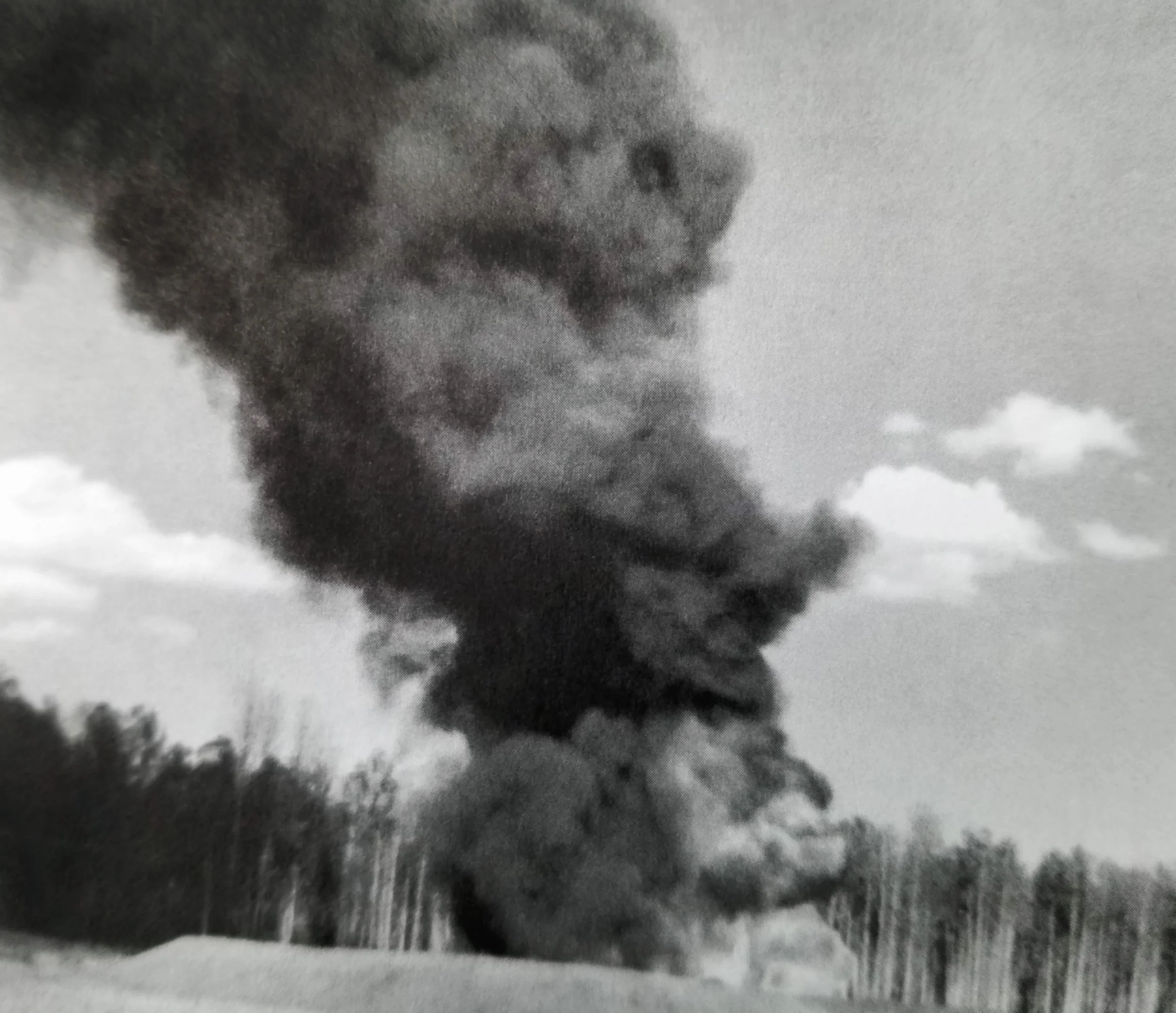
Oilfield Flare Pit
Our little community was changing, trying in its own small way to keep up with the changing larger world. As spring approached, our Grade six class was given a presentation dealing with a new life-saving technique known as “mouth-to-mouth resuscitation.” It was apparently a method that was already saving lives and could be used by anyone who was familiar with the technique. Despite a certain amount of silliness, especially between the girls and the boys, many of us recognized the value of the exercise, at least enough to grasp the general principles of the procedure. Little did I know that the method would soon be put to the test.
Not many weeks later, shortly after my twelfth birthday, my dad, my grandpa and I made one of our infrequent trips to Edmonton. It was a long trip from Drayton Valley to Edmonton in those days and there were typically a number of tasks that had to be accomplished over the course of the day. Almost all of my family’s business was concentrated to the downtown area, so that simplified matters considerably. Once a central parking spot had been decided upon, it was usually just a matter of walking from place to place until all the errands had been done.
It was a cold and windy day, one of those days when Mother Nature still hadn’t decided whether or not she would actually release her grip of winter. In spite of the elements, we simply wrapped ourselves deeper into our clothing, pulled down our hats and still managed to get the lion’s share of our tasks out of the way before lunchtime. There was a favourite restaurant along 101st Street where we often stopped when we were in the area. My grandpa was very fond of pea soup, a dish that he didn’t often make at home and which was apparently a bit of a specialty at this particular restaurant. My dad and I passed on the soup, but we all ate heartily, enjoying the warmth of the indoors and the break from walking. It had been an early start that morning.
Upon returning to the street, we found that the wind had increased in velocity. We buckled our jackets and hats down tighter and prepared to finish off the errands on our list. My grandpa was seldom without his signature wide-brimmed Stetson, which he had been struggling to keep on most of the day. The first wind blast of added intensity nearly caught him off guard, but he pulled the hat tighter onto his long grey hair, grasping at the brim occasionally for additional support.
The next stop was only a few blocks further down the street and we walked quite briskly, hoping for the next opportunity to get out of the wind. However, as we proceeded, my dad and I noticed that grandpa had fallen behind. We looked around to see him apparently still struggling with his hat. He would surely catch up as soon as he got the situation sorted out. But, after another short stretch, we looked around again, and it was obvious that there was something more serious going on. He hadn’t moved from his former position and seemed to be labouring to stand on his feet. Before we could reach him, he had slid down the side of a brick building and onto the pavement. My dad spoke to him, but there was no reply or any indication of response.
“We have to get him inside and out of the wind”, my dad exclaimed. There was an entry to a large bank nearby, so we grasped my grandpa under his arms and dragged him into the entry and then into an alcove opposite the door and away from the main flow of customer traffic. My father checked his father’s pulse a couple of times, but was unable to find a sign of life. By now, my grandpa had turned a strange blue-grey colour and his limbs were completely limp and lifeless.
Suddenly, my memory flashed back to the images of our Grade six class and the instructions on mouth-to-mouth resuscitation and I quickly explained it to my dad. “Should I try it?”, I asked. “Go ahead”, he replied, “We have nothing to lose”. I went immediately to work, trying to remember all the details I learned only a few weeks earlier. Lay the victim flat on his back, tilt the head back and the chin upward to allow for optimal airflow, and blow from mouth to mouth steadily and firmly. Turn the victim on his side occasionally to allow any accumulation of mucus to exit the mouth before it enters the throat. Use your index and middle fingers to assist in the removal, if necessary.
It was all coming back to me clearly and it was only a matter of a few seconds before my dad and I had my grandfather in the desired position for the procedure. I knelt down beside him and pressed my lips against his mouth, remembering to place my lips in such a way as to limit the loss of air as much as possible. Then I began to blow air into his mouth, firmly and steadily and with sufficient pause between breaths as to simulate the natural breathing process and timing my own breathing to match the routine.
I was barely getting into the flow of the procedure when a police officer, apparently on his street beat, held the door open and stuck his head inside inquisitively. “Close the goddam door”, I yelled, thinking only of the accompanying rush of cold air from outside. It seemed as though I had been taken over by some strange persona outside myself and I didn’t care the slightest about what kind of dignitary I was addressing. Meanwhile, a small crowd had begun to gather near the alcove where my grandfather lay, but the consensus must have been that I was the most capable person on the scene and everyone carefully kept their distance.
I continued to administer the routine for what seemed like an eternity, but nothing seemed to be happening. My grandpa’s body remained the same lifeless form it had possessed when we first dragged him inside the bank. It was beginning to look like we would be unsuccessful in bringing him back to life. “What should I do?”, I asked my dad. “Keep on blowing”, he replied, “But blow harder - you have nothing to lose!”.
I resumed my position, using my father’s words as an impetus for renewed vigour. I increased the pressure and the velocity of my blowing and shortened the length of the pause between breaths. My small body was expending as much energy as it was capable of. Then, suddenly a miracle started to take place. My grandpa’s body twitched ever so slightly and I thought I heard a short, muffled groan. That was all the motivation I needed to resume the manoeuvre with renewed strength that I didn’t know I possessed. I was now blowing harder than ever before, but still remembering the necessary pauses between breaths.
His body twitched again and then came the unexpected - pea soup! Pea soup began to come from the depths of his body and rise to his throat, into his mouth and eventually into mine. I spit out the soup and asked my father to help me turn grandpa on his side so I could extract any more of it with my fingers. Then I went back to my work, blowing at least as vigorously as before. Again, more significant amounts of soup came to the surface and, once again, we turned him on his side and I extracted the remainder.
But this time, it seemed as though he was trying to breathe on his own. We pulled him over on his side once again and more of the soup ran from his mouth. He started to take some irregular breaths and the normal colour was returning to his face and neck. With our help, he was able to sit upright on the floor and, a bit later, we were able to move him to a chair that someone had kindly brought from the waiting area.
Meanwhile somebody (maybe even a chastised policeman) had put in an emergency call but, by the time the paramedics arrived, grandpa was already on his feet, although as yet a bit tipsy. While still in a somewhat weakened state, he allowed the medics to take his vital signs and administer a couple of shots of oxygen, something which he would most certainly have ordinarily declined. Before the ambulance crew left the building, he was already chatting and joking with them and others who had remained on the scene.
I’m not sure that my grandfather actually realized what had happened that day and how close he had been to dying. Some of the details probably became known to him after the fact, through ensuing discussions and what was written afterward in the newspapers. For the time being, within a half hour, he seemed to be in his usual vibrant condition and we were able to walk back to the car, where the two of us remained while my dad finished up with a condensed version of our list of activities before heading home. Actually, without really mentioning anything, my grandpa’s only noticeable change in demeanour was that he became increasingly insistent that I was in his presence. Needless to say, that had never been a problem for me, and I spent many enjoyable days with him before he passed away two and a half years later in September of 1964. On several occasions during those years, he brought up the prospect of the two of us travelling together to his Swedish homeland that he had never again seen for almost sixty years. But my parents and I knew that such an experience would be a risky one for a young lad and his ailing grandfather. As much as I would love to have gone, we carefully sidestepped the issue without causing undue disappointment.
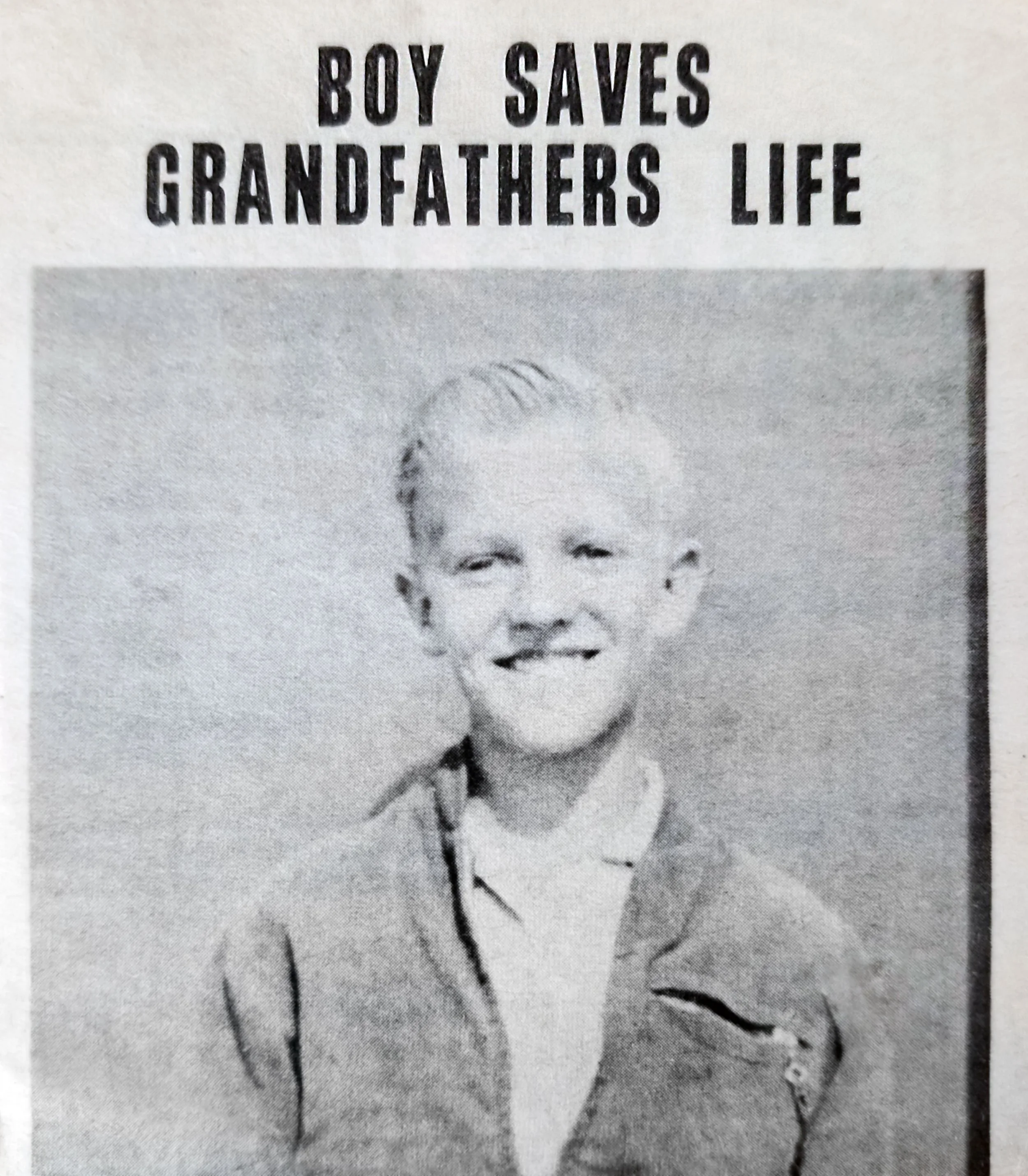
A local journalist and the Drayton Valley Lions Club soon caught wind of the story and I appeared in the headlines of a number of area publications for several weeks after the incident. I was also nominated for the “Alberta Junior Citizen of the Year” award, along with a number of other young Albertans. When all was said and done, I lost the citation to a young man a bit older than me, from the southern part of the province, who had saved his younger sister from drowning. For me, it was not really a big loss - I had already been awarded the ultimate prize on a windy afternoon in Edmonton earlier in the year.