Chapter 7
Returning to a regular school classroom had its moments. It was fun to once again be among groups of people my own age but, on the other hand, it was regrettable. I missed the natural, down-to-earth practical wisdom of the loggers and other grownups in camp, but mostly I missed the solitude and independence that I had become accustomed to through my duties and personal activities in the bush. More than ever before, I was beginning to realize that I was not built for a life of conformity. I knew I had to become my own man. I craved opportunities for personal growth which I couldn’t find via the status quo. I hadn’t forgotten my basic guitar lessons back in camp, and I managed to talk my uncle out of an old badly beaten acoustic instrument that he had tried to learn on in his younger days. I was able to fix it up, equip it with new strings and resume practicing the chords I had learned during the winter. I also started tinkering with a small 12-bass piano accordion that my dad and grandpa had found for me in an Edmonton pawn shop a few years earlier.
Academically, the return to school presented little challenge. During the winter months, I had covered the curriculum at will and in my own way, often progressing beyond the prescribed expectations of the subject material. I learned to consume knowledge according to its palatability at any given time. Back in the classroom, I found myself significantly ahead of the class in general and sitting through most of the forty-minute periods was nothing if not boring.
A bigger challenge was to be experienced on the playground. I enjoyed various sports activities, but I had always been small for my age and that was a definite detriment. I wasn’t clumsy or otherwise disadvantaged; I simply lacked the physical proportions necessary to adequately perform many of the expected functions. Although a reasonably fast runner, my legs were only a fraction of the length of many of the boys and, try as I might, I simply got left behind. Invariably, I was among the last ones chosen for the various sports teams, both during the noon hour and within the formal physical education program. But I became accustomed to my disadvantage and did my best to participate whenever it was either necessary or desirable.
However, one spring day proved to be a bit of an exception to the unwritten rule. We were playing our own brand of football, a kind of combination of American football and rugby. There were no explicit rules and the teams were made up of equal numbers from those present and available at any given time. There was an opening kickoff and, from that point, it became somewhat of a free-for-all. However, the ball carrier had to be physically tackled and both passing the ball forward and running the ball into the opponent’s end zone were permitted. After each touchdown, an opening kickoff was again required.
Big Freddie had been held back a couple of grades and was easily a head taller than even the biggest kids, and probably outweighed them by at least twenty percent. He was a fast runner and somewhat reminiscent of a fast rolling steam locomotive as he ran across the field. Simply put, when Freddie had possession of the ball, it was almost certainly a touchdown for his team. No one would dare to tackle him. Unlike me, he was one of the first players selected prior to the start of each game.
But, on this particular day, I saw an unexpected opportunity. I had often thought that there must be a way to stop Freddie on one of his seemingly inevitable runs to the opponent’s end zone. As was often the case, he was passed the ball deep in his own end. Typically, Freddie would then simply run the ball along the field, adding yet another touchdown to his growing arsenal. In usual fashion, potential defenders dropped out of range and, by midfield, he was on his own. Typically, I remained behind the pack, running as fast as I could from the opposite side of the field. But this time I could sense the potential for a unique turn of events. As he roared down the field toward the goal line, I increased my pace to its utmost, until I was running perpendicular to the length of the field and directly toward Freddie. At the last minute, I lowered my head to the height of Freddie’s belly and applied one last spurt of power to my short legs and torso. My aim was perfect and Big Freddie tumbled to the turf, dropping the ball as he fell.
I was exhausted, but Freddie was in worse condition. In my assault, I had inadvertently knocked the wind out of my opponent and he laid helplessly immobile. As the members of the teams stood looking down upon him, he slowly regained consciousness and began to realize where he was. I’m not totally convinced that he knew what had transpired because I’m not sure that he ever saw me coming. Nevertheless, he was not a happy boy as he clambered to his feet. The remainder of the game was somewhat subdued. A lesson was learned that day on the schoolyard, if not for everybody, most certainly for two of us!
My grandpa had been and still was a horseman. It was one more reason for me to admire him and, before he sold his last team, he sometimes let me help him to drive them home and into the barn. My dad, on the other hand, was a machinery man and mentioned on more than one occasion his satisfaction that the horse era was coming to an end. He was a good machine operator and really had nothing against the horses themselves, but looked forward to a career of working with a more modern and efficient medium. It seemed as though horses would have a minimal effect on my future life.
But then, as fate sometimes dictates, a glitch was thrown into the scheme. My friend Dale and his sisters in the Johnson family had acquired a couple of horses and I was welcome to join in the fun of getting to know Buttermilk and Peanuts. Their father was a horseman himself and he had even gone so far as to take some formal courses on training and working with them, a bit unique in a time when many others were following a more industrialized path. I was thrilled to be part of it all and spent many hours on the neighbouring farm, learning some of the basics of horsemanship.
In short order, I was thoroughly hooked. The Johnsons had provided me with the key to a door which my grandpa had already left ajar a few years earlier. I talked about horses daily and urged my father to consider helping me to find one of my own. Despite his innate lack of desire to become reacquainted with the horse realm, he quietly acknowledged my zeal. But he wasn’t prepared to take the easy route - that simply was not his style. He wanted me to fully appreciate the experience and to provide me with a learning experience that would follow me into the future. He and my mother’s brother had some mutual friends who had had some success with capturing wild horses from the foothills. My dad also had an old Willys army jeep that was perfect for off-road travel and, in addition, he had a number of good friends from the Stoney First Nation living at least part time out in the west country. So my dad and uncle Harmon headed out to try their luck at catching one or more “wildies”.
Much to my disappointment, after several days, they were unsuccessful. Apparently, the herds that normally travelled in the area of their search had moved on to greener pastures, and the novice wranglers came home empty handed, without as much as a sight or even a sign of any equine prospects. Through all the exciting talk about wild horses, I had come to really cherish the idea. But now it seemed as though my dream of having a horse at all of my own had vanished into oblivion.
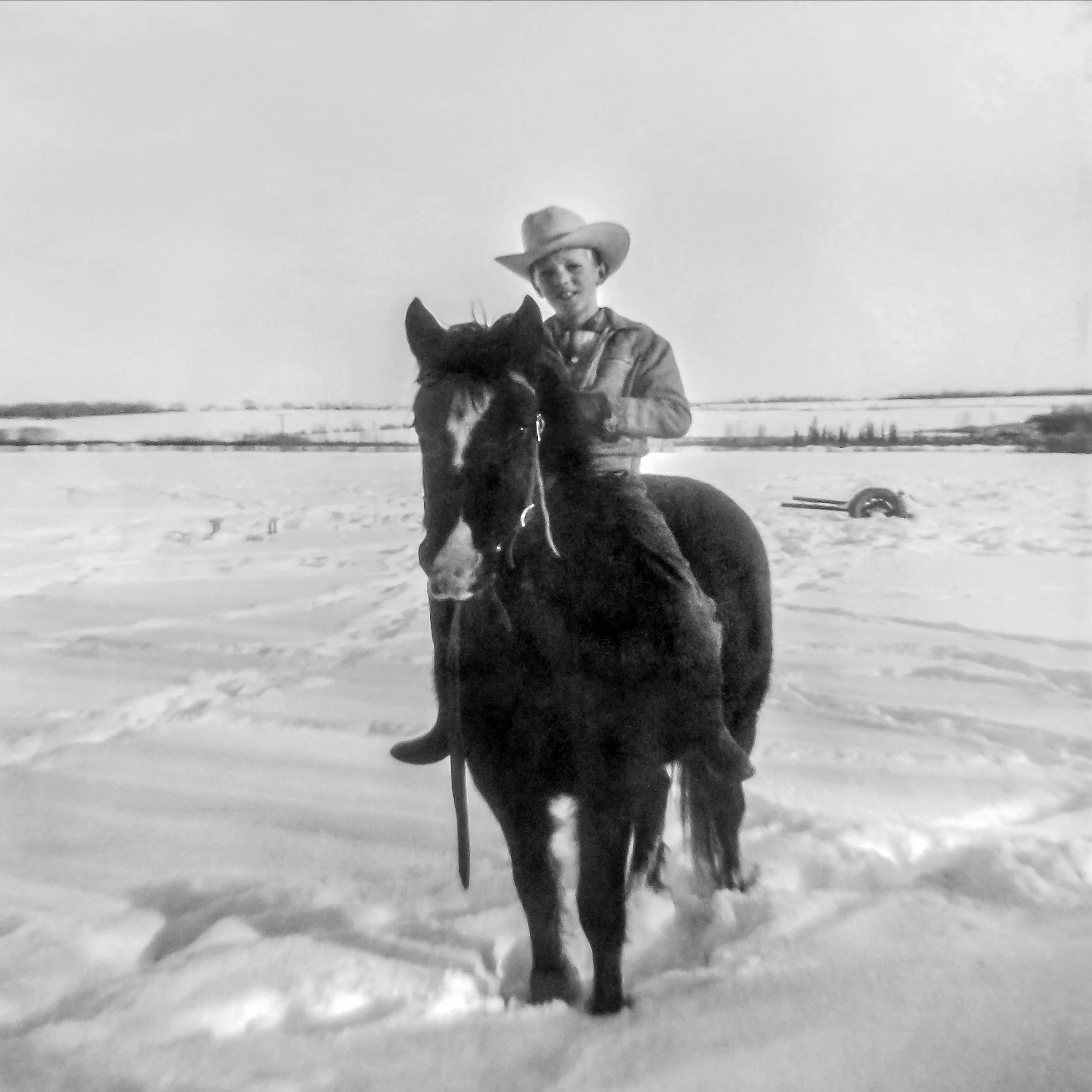
But, true to form, my dad came through with a Plan B and, within a few weeks he had located a wrangler in nearby Rocky Mountain House who was in the business of capturing and selling wild horses. I didn’t really believe my eyes as he drove into the yard with a 5-6 year old bay mare and a 2-year old black filly loaded into a makeshift stock rack on the back of his old pickup and unloaded them into a small cattle pen in the barnyard.
Princess
After a few days experimentation and consultation with a couple of horsemen in the area, it was determined that the bay mare had been mishandled by some unknown rough-handed wrangler and the nerves in her head and neck had been so severely damaged that she did not respond to a halter or rope of any kind. She would pull endlessly with her full strength against the pressure of the gear, without the slightest sign of pain or discomfort. It became apparent that she would never be broken to lead, never mind the prospect of ever riding or driving her. But she was a fine looking horse and a good companion for the younger black filly who was to be my horse.
The little filly was a lot easier to deal with. She had obviously never been either handled or mishandled by humans and had thus never acquired any habits, neither good nor bad. Once the men were able to corner her and get a halter and a lead shank in place, the rest was relatively easy. She was simply tied to a sturdy post and allowed to struggle against her own body weight until she succumbed to powers beyond her control. In a short time, she learned to respect the limits of the rope and to give way upon feeling the pressure. Except for some minor finesses, she was broke to lead. It was great to know that, with careful attention to the use of the lead shank, I was now able to lead my soon-to-be partner pretty much anywhere I wanted to go.
The next step was a bit trickier. Somebody was going to have to climb on her back and try to get her used to a bridle and to the concept of being ridden. I was totally inexperienced and much too small to take on the task and it was important that her first time under saddle was a decisive one. A family friend was quick to step up to the challenge. Roger was in his late twenties, strong, heavy-set and tall. He had been raised on the farm on the Prairies and had been riding horses since childhood. The poor little filly didn’t have a chance. Once on her back, his feet dangled almost to the ground! The little twelve inch saddle that my dad had found for me was altogether too small for Roger, but he really didn’t need it anyway. His weight and strength were more than adequate to control the little horse and, before long, Princess was complying with his tugs to the left and right on the reins. During a second and third session over the next couple of days, he showed me how to cross the reins under her chin so that she could learn to respond to the pressure of neck-reining, the usual method of steering in Western fashion.
After the initial three sessions, Roger had to leave the area and return to the Prairie. Before he drove away, he warned me to be forceful with my little horse, keep the reins tight at all times and, most importantly, not to let her “have her head”. I wasn’t entirely sure what that meant, but I thanked him for his help and advice and told him I would do my best. But I thought to myself as he drove away, that I hoped I wouldn’t have to be as heavy-handed with Princess as he had been. She was going to be my new partner and friend, and I wanted to treat her with kindness. Little did I know then that my empathy might eventually prove to be my downfall. Nevertheless, I was on my own. Roger was gone and I was obviously expected to take up where he had left off.
I was about to embark on one of the biggest challenges I had ever faced, but was totally convinced that I was doing the right thing and that I was about to become a horseman! However, there was one slight glitch in the plan at this point. Due to the absence of suitable tack, Roger had ridden my little horse bareback, without a saddle. This meant, of course, that she had never experienced the tightening of a cinch around her girth nor the presence of stirrups dangling at her sides. Both my dad and I knew I wouldn’t have the strength to tighten the cinch adequately to hold the saddle in place, nor would I have the ability to lift a saddle onto the horse’s back anyway. I really wanted to get started riding and didn’t need any further complications. But we also knew that I did not have the weight, strength or balance to ride bareback, especially at this early stage. So my dad fashioned a simple single girth strap out of a large buckle and a discarded piece of sawmill drive-belt. It wouldn’t be necessary to tighten the strap more than I was capable of, but it would still be stable enough for me to use as a handhold when I was riding, not unlike a bareback bucking rig at a rodeo. The only remaining problem was the one of actually mounting the horse without the use of stirrups, but that was soon rectified through the use of any nearby fence rail, hay bale, 5-gallon bucket or whatever else happened to be handy to stand on. Finally, I was mobile!
Adjusting the homemade cinch turned out to be less of a problem than expected. Princess had learned her lesson well regarding the power of the halter and lead shank. As long as I had her adequately tethered to a post with an attached rail fence, she would stand relatively still while I fussed with attaching the cinch. In addition, the rail fence allowed her only a limited radius of sideways movement. I soon found that, if I slid the end of the cinch over her withers until I could reach under her belly to grasp the loose end, I would cause her the least amount of anxiety. Then it was simply a matter of pulling the end around her belly, being careful not to touch her body as I pulled it toward the buckle on the opposite end. If I was careful enough to thread the loose end through the buckle without alarming her, all that remained was the tightening of the buckle. She was a bit skittish the first couple of times that I tightened the cinch and shifted the buckle to the top of her withers but, after a bit of repetition, she started to become comfortable with the whole affair. Luckily, I had been able to contain my own temptation to jump onto her back the first few times, avoiding any further trauma.
Putting on the bridle and adjusting the bit in her mouth proved to be even more of a challenge. Here again, as was so often the case, my short stature was an impediment. The headstall had to be held up adjacent to the horse’s ears with one hand, while the other hand fitted the bit into the mouth, being careful not to bang the horse’s teeth or otherwise injure her mouth. My parents helped me the first few times, until I was able to perform the procedure myself by climbing up the rails of the fence to the appropriate height so as to attain the position required to get the headstall over her ears and the chinstrap fastened. With a number of practice runs, I felt confident enough with the situation and I was relieved to think that Princess was also adjusting nicely, in spite of my awkwardness.
Now it was time for the ultimate test, actually getting on her back and taking the initial steps toward our forthcoming partnership as horse and rider! There was only one remaining security measure that had to be dealt with before we could be sent off on our own. My parents had decided that it would be best if one of them was to lead my horse while I made the first attempts at riding. I crawled into position from the security of the rail fence, adjusted myself behind my dad’s cinch strap and took the reins in my left hand. I was careful to make sure that the reins were crossed under Princess’s chin, as we would both still be learning the finesse of neck-reining. One or both of my parents would then hold onto the horse while mimicking my commands as closely as possible, so as to reinforce the signals and minimizing the confusion for the horse. It went well and, before long, my parents were able to quietly loosen the grip on the bridle and, without really knowing it, Princess and I were on our own!
At first, I was satisfied to practice my riding skills within the confines of one of the corrals intended for the cattle, and used only during the winter months. It was large enough to offer at least some limited mobility while acting as a security blanket in case of any eventual mishap. This way, I could practice mounting and dismounting, continue working on the neck reining and start getting used to riding at various gaits and speeds with a minimal amount of risk. In the event of falling off and losing grip on the bridle and/or the horse itself, it usually wasn’t too difficult to recapture her and resume where we had left off, especially with the help of a small can of oats which I had learned to keep close at hand for such occasions. Over the months and even the following couple of years, we made a significant dint in the oat bin, and trips to the medicine chest were held to a minimum only because of my characteristic stubbornness!
Spending a winter in the area upstream from the future Brazeau power dam had allowed my Dad and his men to become quite familiar with the area and its resources. Aside from the river itself and the timber remaining after the logging operations, the region possessed an abundance of wildlife, especially elk. The following year, they decided to spend at least part of hunting season trying their luck among the herds in the new area. By now, they had good knowledge of the terrain and access points. New logging trails had been constructed, providing added access to otherwise less accessible parts of the area. New undergrowth had sprouted up on the recently logged berths to provide added nourishment for wildlife. A more promising hunting ground would be hard to come by.
A hunting party was organized to set up camp somewhere close to the previous winter’s logging site. Obviously, this early in the season, access would not be much better than on our initial overnight timber cruising trip the fall before, but the availability of game would likely be equally good along the river between last fall’s parking spot and the site of the winter logging camp. If the hunting party was of significant size, the hunters could break into two camps, allowing for better coverage of the area. The group was made up of my Dad, a couple of his cousins, a few of the men from the previous winter’s logging camp and a couple of old family friends. In a day or two, after they had scouted the area and more or less deciphered the movement of the elk, my grandfather joined the group.
My grandpa was in unusually good shape for a man in his seventies and had spent most of his life in the woods. There was little concern that he might be less capable than the younger men. It was true that he had recently been somewhat troubled by spontaneous momentary blackouts and shortage of breath, but never to the point of serious concern. Doctors were not so readily available in those days and old- time lumberjacks like my grandfather had generally learned to live without them.
As I understand it, my grandfather’s first day in camp was spent hunting in a two-man team, still scouting the various areas and checking out the availability of game. On the second day, he and his partner decided, upon coming across fresh signs of elk, to split up into two different directions. As the sun began to make its way over the horizon, the hunters began to return to camp, but grandpa was not among them. His nephew, who had started out as his partner earlier in the day, had returned, not having seen his uncle, but having heard a couple of rifle shots from the area southwest of where he himself had been hunting. The initial presumption was that the older man had killed an animal and was probably skinning and butchering it before returning to camp. My grandfather was a seasoned hunter and woodsman and the men were familiar with his independent, self-reliant way of doing things.
As evening wore on, the men became more concerned and one of them fired the customary three simultaneous shots in the air as a distress signal, but the expected answering shots did not follow. A bit later, a large bonfire was built, in the event that grandpa might wander to within sight of the camp sometime later in the night. The bright spruce fire would be seen from quite a distance, even in the dark, moonless forest.
However, by daybreak the old patron had still not returned to camp and my dad and the others realized that something out of the ordinary must have taken place. It was decided among the men that the morning would be spent conducting a search and, if that did not produce the desired result, outside help would have to be solicited. Although the nights were getting colder, there had not yet been any significant snowfall, making tracking considerably more difficult.
Upon return to camp in the early afternoon, no sign of grandpa had been seen by any of the searchers and the general consensus was that he must have wandered further to the southwest than was speculated from his rifle shots the day before. It was decided that my dad would make the roughly two and a half hour drive north across the new dam site, to Drayton Valley to gather additional manpower and associated supplies. Meanwhile, the others would continue their search, spreading out more widely from the morning efforts. By now, most of the men were beginning to expect a less than ideal outcome. For the first few hours’ hunt, my grandfather had left his “grub box” in camp and had taken only his small canvas bag with the bare necessities with him on the initial trek. Everyone agreed that this would not be much sustenance for a longer duration.
It was late afternoon before my dad arrived home and broke the news to my mom and me. I simply refused to believe that a man of my grandfather’s calibre could be in danger. He had been through more than his share of difficulty and challenge over the years, and a couple of nights in the bush certainly wasn’t going to bring him down. I argued that he was probably just having trouble preparing his kill or maybe even working on transporting it back to camp.
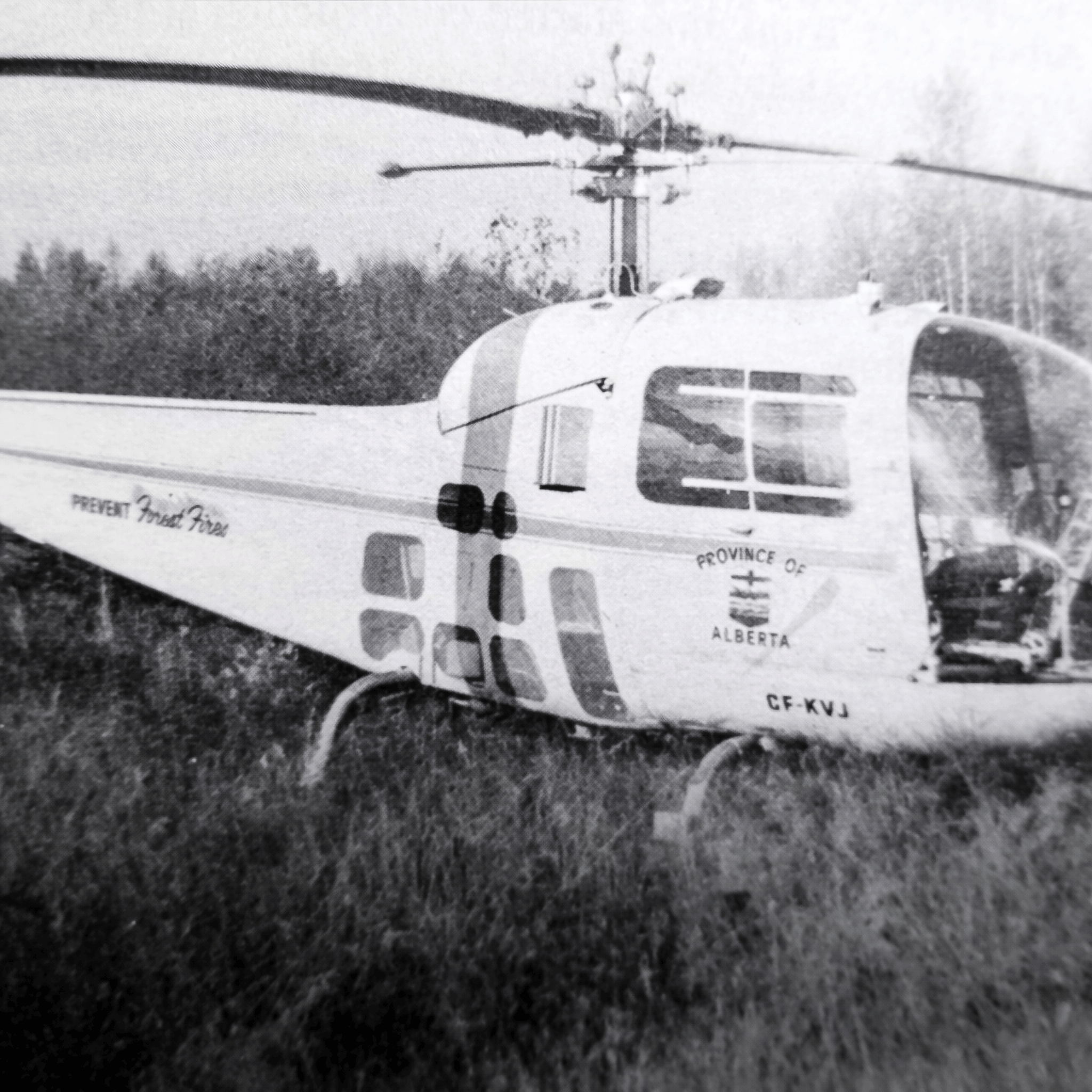
Meanwhile, my dad had called the RCMP and the Forestry to make them aware of the situation and to ask that they might possibly lend their assistance in the search. The RCMP promised a couple of constables and a tracking dog for the next morning. The Forestry people, who my dad had built a good working relationship with in recent years, thought they might be able to provide a helicopter if necessary.
Early the next morning, my dad set out on his way back to the hunting camp, planning to intercept the remaining men before they began another day of searching. However, as he approached the river crossing at the new dam site, he was met with an unexpected challenge. A watchman had been installed on the crossing, due to a change in construction plans, and had been instructed to turn away anyone attempting to cross. The watchman approached Dad’s pickup and informed him that he was not allowed to cross. My dad attempted to explain the situation to him, but the man was not prepared to make an exception to the orders he had been given. He even stepped in front of the vehicle and gestured to turn the truck around and head back toward the north. My dad was losing his patience, thinking about his father somewhere back in the woods. “You can stand there all you want “, hollered Dad, “but I’m coming through whether you stand there or not.” With that, he engaged the clutch and proceeded at a formidable speed across the dam. The watchman knew that my dad meant business and offered little resistance.
Later that morning, the RCMP constables arrived in camp with a tracking dog. As I remember having been told, other members of our rural community also showed up that day to assist in the search. The word had begun to spread and even the Edmonton Journal had started to cover the story. But, by nightfall, there was still no sign of my grandfather. Apparently there was not enough of a residual scent on any of my grandpa’s belongings to give the dog a baseline from which to pick up a trail, and none of the searchers had found any evidence whatsoever of his whereabouts. The last clue as to his presence in the area had been the rifle shots that the hunters had heard a couple of days earlier. The situation was looking dim, and the general speculation for finding my grandfather alive was tentative at best. However, a sizeable bonfire was once again kindled and kept stoked throughout the night by my dad and the group of men who stayed overnight in camp.
The RCMP had been in radio contact with their Drayton Valley office and with the Forestry to relate the news of the day’s search and to request that a helicopter be dispatched as early as possible the following morning. They had also been in contact with my mom, so that the rest of the family at home would be updated on the status of the situation. She was told to expect an undesirable outcome. But I would not accept the possibility that my grandpa might have perished out in the bush, carrying his rifle, a small hand-axe and a knife, in comparatively mild fall weather. It wasn’t possible for a man of his character and capability. I insisted that he was alive and that he would likely show up on his own accord.
The morning of the fourth day the helicopter arrived and a somewhat reduced ground crew resumed the search. The helicopter made a grid of passes over the area in question, flying as low as possible above the tall timber, some of which still grew tightly despite the logging operations of the past few years. The men in the ground crew tried their best to cover the areas that might not yet have been searched. The RCMP did their part to assist the woodsmen, many of whom had not left camp since the search had begun. Even the tracking dog had been returned, in the event that any new scent might be uncovered.
Forestry Helicopter
By late afternoon, many of the men had arrived back in camp, and the helicopter had ceased its surveillance. The pilot had radioed the policemen to inform them that there had been no new leads from overhead. A number of men were sitting around the fire eating some leftover sandwiches, drinking coffee and continuing to speculate on the fate and whereabouts of my grandfather. Beside a tree not far from the fire, my grandpa’s grub box was laying in the moss and out of the way of the heavy foot traffic of the past few days. Someone had left the lid of the wooden box open and its contents were clearly visible to passers by.
Among the staples that invariably made up part of my grandpa’s grub box supplies was a small bottle of whiskey. While sitting among the others, one of the RCMP officers had spotted the box and quietly moved around behind the rest of the group in the waning daylight. As he reached into the box and lifted out the bottle, he heard a rustling in the brush further behind him. Within seconds, a large scruffy looking bearded man appeared out of the woods. “You can put that right back where you found it,” retorted the stranger with the big hat and a big voice laced with a noticeably foreign accent.
It was as if the group of searchers had just seen a ghost as the newcomer walked into the light of the fire, and the inquisitive police officer learned in short order that the strange man who had uttered the words of warning about the whiskey was none other than the owner of the whiskey itself!
I guess nobody, including my grandfather, really knew the details of what transpired during those days in the bush. My grandpa did admit that he had heard a helicopter and a dog barking as he approached the camp. He also thought that he had wounded an elk sometime the first day and had been tracking it. But, between those two points in time, he seemed very vague as to the course of events. My grandfather was a proud man and, even if he did remember more of the details, he wasn’t readily sharing them. My dad was convinced that his father had probably passed out sometime during his search for the elk and may have wandered aimlessly for quite some time before gathering his senses. As far as we could figure out, he had sustained himself from the meagre supplies he had in his little backpack and on whatever plants and over-ripe berries that were available along his path. He had probably made a number of temporary shelters of spruce boughs, moss and grass as he wandered. Although it seems strange that searchers wouldn’t have seen signs of a fire or heard the sound of gunfire, he may have killed some smaller game and roasted it. He always carried a small waterproof container of matches and some snare wire in his backpack. It seems quite possible that he had walked a lot farther than everyone had expected before he regained his wits and sense of direction. He may even have become so disoriented that he found it necessary to walk westward to the river and then follow it downstream.
Nevertheless, he had arrived back in camp unassisted and in unusually good condition. The manhunt was over and, other than for a few remaining hunters, camp was broken and the men dispersed to their homes. My dad loaded his father and his gear into the truck and headed back to Drayton Valley. Although it is unlikely that he ever would admit it, I expect there were a few days and nights of recovery in the comfort of his little cabin on the farm!