Chapter 6

Work on clearing the dam site for the future Brazeau Power Station had been progressing well and my dad was one of six or seven sawmill owners operating in the area. By the fall of 1960, the pressure was increasing to get the area logged out before the dam was completed and flooding of the area could begin. Bigger timber berths were becoming available, and my dad was offered a choice from several new parcels. All of them were considerably larger than those he had been accustomed to, so, regardless of which one he chose, it would mean enlarging the size of his operation for the upcoming winter. After studying the maps and the synopses for the berths, he chose to investigate one about six miles upstream from the actual dam site that seemed most suitable, and plans were made for a trek into the bush to get a better look at the timber and the terrain. The quality of the timber and the relative ease of logging, combined with a suitable site for a camp were always primary criteria for the final choice.
Cruising the timber would involve driving as close as possible to the site and then walking the final distance to the berth, as well as walking around and through the timber to get a feel for the above-mentioned indicators. My dad would be accompanied on the trek by his two cousins, Vance and Percy, both experienced loggers in their own right, and their input would be valuable in making a decision. I was only ten years old, but adamant to join them, even though my short legs would be a definite drawback. However, the entire walk would likely be about eight miles and, even if they had to carry me on their shoulders part of the time, they conceded to my continuous pleading. We had a small supply of food along, and my dad always carried a knapsack containing the basic necessities such as matches, ammunition for the rifle and some minor first-aid supplies. After eating our lunch in the pickup, we would strike out on foot to our destination. It was a warm fall day, so we didn’t need to carry a lot of extra heavy clothing. Regular autumn clothing, good walking boots and an extra jacket would suffice, along with the token knapsack and its usual contents, two cans of Aylmer beans and a couple of Eat-more chocolate bars for a snack somewhere along the way. Some berries were still in season, and a handful or two now and again would provide some extra nourishment, if desired.
I loved being in the bush and was able to keep pace with the grownups almost all the way, aside from an occasional patch of wet, lower ground that demanded more leg muscle than the average 10-year-old was able to expend. But the patches were not terribly large, and I quickly recovered each time we returned to higher terrain. It was a great day to be on a hike and there were plenty of interesting sights for an inquisitive youngster. The elk were in the midst of rutting season and the calls of the bulls were frequent. At one point, while trekking along the river, we came across a large herd of elk, probably thirty or more. We stopped and watched them cross the river to a steep bank on the other side. It was fascinating to see the athletic, sure-footed animals swim ashore and then immediately scamper up the steep incline. I remember one youngster that was not as lucky as the others, who lost his footing and plunged backward down the embankment. He landed hard on the boulders at the bottom, and we were sure he had broken his back. But, within a few minutes, he was up, shaking himself off, and making a second more successful attempt at the climb, racing through the trees at the top to join the rest of the herd. As the day went by, we were able to watch the herd’s progress along flatter ground on the opposite side of the river. We also managed to catch the occasional glimpse of a timber wolf that followed the herd at a respectable distance, no doubt waiting for a mishap such as the one that we had witnessed earlier at the river crossing.
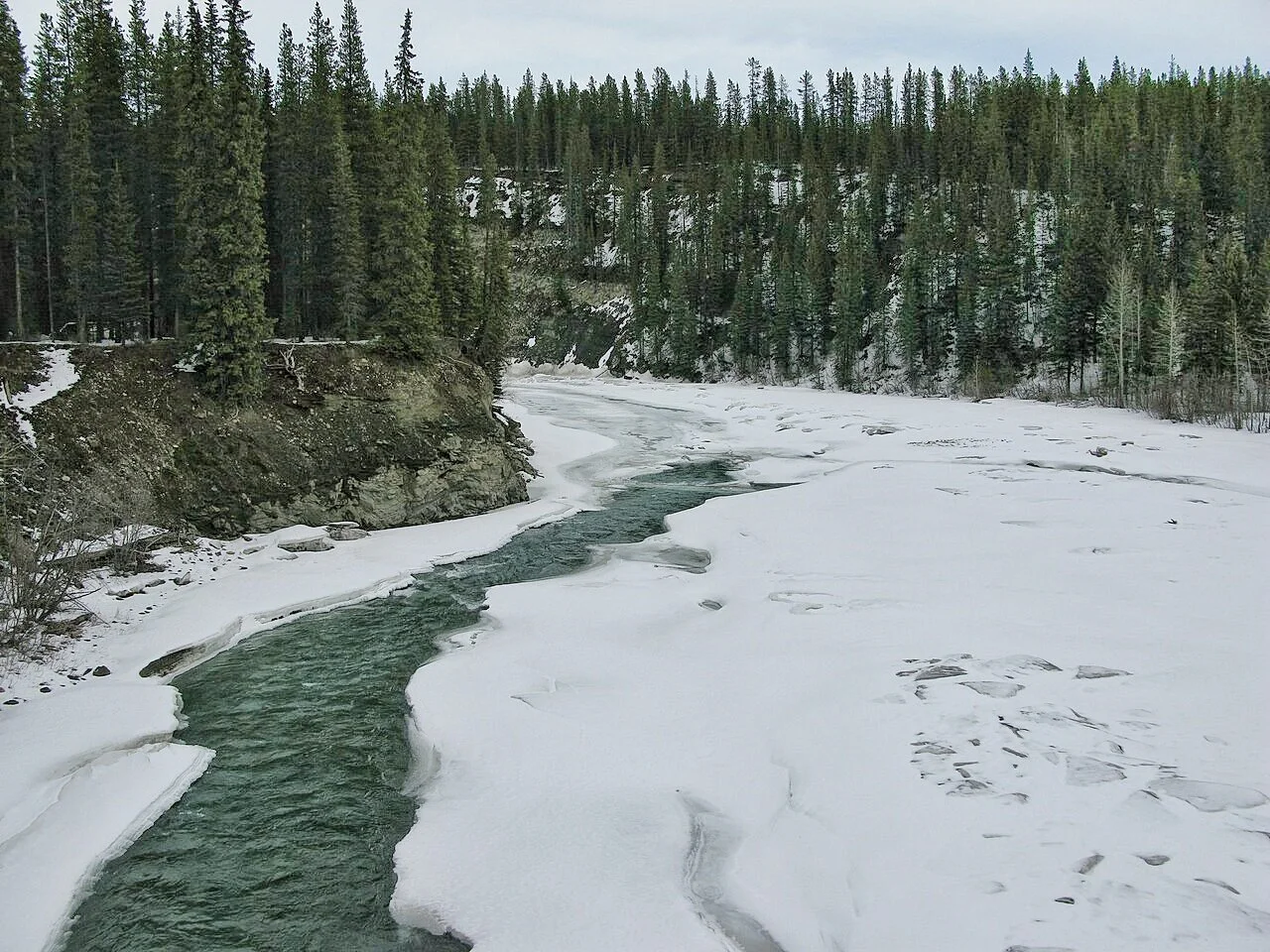
Brazeau River
By late afternoon, the men realized that they had made a mistake. The distances on the map did not coincide with the landscape and the timber was not what was expected for a berth the size of the one in question. After some review of the map, a bit of scouting and discussion, it was discovered that, when we had made a cross-country shortcut, we had ended up too far upstream on the river. The berth we were looking for had to be some distance downstream. My mind started drifting toward the knapsack with the two cans of my favourite beans and the two chocolate bars, but I didn’t dare mention that at this juncture. It was obvious that an important decision was at hand. It seemed ludicrous to have come all this way only to postpone the trip for another day in the near future. The weather was not always this nice in the foothills in the fall, and the next trip might not be so pleasant. It became quite clear – either abort the mission and come back later or prepare to stay the night along the river. The decision was really not that difficult, and it was apparent that there would be enough daylight for us to continue the trek to the timber berth before having to set up camp and consume our meagre supply of food.
As we continued to walk downstream, the men became more certain that their calculations had been correct and that we were, indeed, approaching our original destination. If that was the case, we could camp on the edge of the berth, spend a couple of hours the next morning looking it over, and still be back to the truck reasonably early the next day. An added bonus would be that, as we moved downstream inspecting the timber, we would be walking back toward the truck.
The temperature was beginning to drop, the smell of rain was in the air and, by the time we reached what we thought was the edge of the timber berth, it was starting to sprinkle. There was a nice, gradual slope down to the river, allowing much easier access than many places further upstream. A sizeable fire was lit on the edge of a sandy opening not far from the riverbank. We gathered dry poles and spruce boughs to build a lean-to facing the fire. Then the men gathered some large flat slabs of sandstone from the river and dragged them to our new makeshift camp and dumped them into the fire, where they were allowed to heat while we consumed our evening repast of beans and one of the two chocolate bars. When the stones were sufficiently warmed, they were removed from the fire and placed inside the lean-to and covered with more spruce boughs. Together with the additional heat from the fire itself and the thickly woven spruce boughs above our heads, the bed on the warm stones made for an adequate shelter for the night, despite the stronger drizzle and the typical chilly autumn night.
I don’t remember much more from the earlier part of the evening. It had turned out to be a much longer than expected walk, especially for a 10-year-old, and I must have drowsed off while the men were still discussing the events of the day and the corrections needed for the next morning. For some reason, I awakened sometime in the night. Maybe it was the sound of the rain around our makeshift shelter or the bugling of the elk in the distance, or maybe it was the light from the lingering coals of the fire. In any event, I was obviously the only one awake and I wasn’t particularly comfortable. Not far from the lean-to stood a massive old spruce tree with a trunk that was easily three feet across at the butt end and whose thick, swooping branches reached all the way to the ground. The squirrels had been harvesting its cones for many years and there was a thick layer of them piled around the base of the tree. I arose from my place on the bed of spruce boughs, pulled my jacket tighter around my torso and slipped quietly out from under the shelter. It seemed as though the rain had never developed into more than a heavy drizzle and it was a short and sheltered walk to the grizzled old spruce. As I crouched to find an opening among the heavy branches, I could still see the glowing embers from the campfire. I rustled among the pile of spruce cones and made myself a bed. There was plenty of material to work with and I was easily able to cover most of my body with the insulative material. The massive, thickly grown branches made a continuous circular wall all around me and the forest floor under the branches was completely dry. A lone wolf began to harmonize with his fellow bull elk members of the Brazeau chorus as I leaned my back against the tree trunk and admired my prickly new blanket. Now, with only the companionship of the old spruce, I was the most comfortable I had been all night. In minutes, I was asleep.
It didn’t take long to break camp. It seemed quite strange to start the day without breakfast, but a few drinks of cold, clear Brazeau River water filled up at least part of the void in our stomachs. We would pick a few handfuls of berries as we walked and save the remaining chocolate bar to share later in the morning. The fire had gone out during the night, and, with the warm bed of sandstone and spruce boughs, there had been no need to stoke it up again. So, the fire was safe to abandon, and the lean-to was left intact for any other unsuspecting soul that might happen along, human or otherwise. It was a cool, clear morning and any signs of further rain were not apparent. It was going to be a lovely day, with every indication of being much more fruitful for inspection of the potential timber berth. Almost immediately, we found some axe blazes and markers that indicated that we were, indeed, in the right place. Once we were sure on which corner of the berth we had camped, the remainder was easy. It was simply a matter of walking through the timber in a north-easterly direction until we had seen enough and then continuing onward to the pickup. It went well and my dad was impressed with what he saw. Most of the timber was far enough from the river so as not to be excessively full of sand, which is, of course, very hard on saw blades, and most of the trees were reasonably spaced and without an over-abundance of underbrush, a definite advantage for the fellers and skidders. In addition, except for the river bank itself, the topography was reasonably flat, also a bonus.
As we prepared to leave the berth and start out on the trek back to the truck, we shared the remaining chocolate bar, quite sure that there would be no further complications on the way back. The trek went well until we arrived at a section of muskeg about halfway back to the vehicle. My short legs were beginning to tire, and I was bogging down in the soft footing. Although I really wanted to continue on my own, it was obvious that I wouldn’t make it without an excess of rest stops. Besides, everybody undoubtedly had their sights set on the grub box back in the truck! So, for the remaining couple of miles, I was passed from the shoulders of one to the other. By that time, I was tired enough that even my pride was not too seriously damaged!
Almost immediately upon our return to the farm, a decision was made. My dad was pleased to have found a promising patch of timber on the first attempt, despite the inconvenience of our unexpected overnight stay in the bush. He submitted his bid, and it was accepted. From then on, it was a matter of getting all the necessary equipment and manpower ready to move onto the berth along the Brazeau as soon as the river and the temporary new bush road had frozen enough to handle the traffic. The timber limit was a large one, and there wouldn’t be room for many mistakes before breakup in the spring.
My grade five school year was a short one. It was so short, in fact, that my Grade 5 teacher’s name is the only one of six that I can’t remember. The only somewhat vivid memory I have was preparing the song, “On the Wings of a Dove”, a big hit that year by Ferlin Husky, with two of my female classmates, for the school Christmas concert. As I remember, it was only a marginal success, as my two friends knew virtually nothing about singing harmony while I, on the other hand, was probably the worst singer of the trio. Nevertheless, it filled the time. I tried my best to concentrate on my schoolwork, but it wasn’t easy knowing that I would soon be returning to the timber berth out along the river.
At home, my parents and a number of others were busy preparing for the winter’s activities. By the latter part of December, there was adequate snow cover and the ground had frozen enough to allow my dad and a couple of the men to start preparing a winter road through the timber and “freezing in” the necessary sections of the river. My dad was a skillful cat-skinner, and, in addition, a small Ferguson tractor equipped with half-tracks was used for the first vehicular passes over the ice. Everything seemed to be on schedule for the setup of camp early in the new year, and the first loads of equipment were on the way to the bush by the early days of January.
As usual, camp was set up as close to the river as the forest rangers would allow. Since the entire area was soon to be flooded by the new dam, I think the authorities might have been a bit more lenient than under more normal circumstances. Typically, both sawdust and slab piles had to be a specified distance from watercourses of any kind. The sawmill, cookhouse and a couple of bunkhouses were hauled in by truck, but at least a couple more bunk shacks and a small barn were nailed together with the first green lumber sawed on location, covered with tarpaper and edge boards from the newly sawn logs. Altogether, there would be about twenty men in camp, including mill and bush crews. That number grew somewhat as spring approached and the pressure was on to get the quota filled and everything out of the bush before break-up. Among new members of the crew not part of former years’ activities were my mom’s cousin, Jean, and her husband from the Alberta prairies. Irvin would be driving the arch truck, a new concept for my dad’s operation. It was a three-ton Ford mounted with a skidding arch and used for pulling bigger full-length trees to the mill from longer distances. A couple of smaller Caterpillars were used for shorter skids, and a team of horses was still in use for short skids in difficult locations. Jean would be helping my mom with the cooking and the camp chores and, since she was the academic type, was also the camp bookkeeper and my correspondence school supervisor.
Taking Grade 5 by correspondence turned out to be much easier than anticipated. Once I got the hang of it, I would separate the various subjects and complete large blocks of each one, instead of following the course outline. That way, once I was concentrated on one particular subject area, I would work through several units at once, before moving on to another subject. It was much easier and faster that way, and everything still got sent into the Correspondence School Branch in time, regardless of the order in which they had been completed. I was spending less than half the time that I would have used in a regular school setting, to get more done, and the unit evaluations from the authorities in Edmonton steadily confirmed that the results were above average. The situation couldn’t have been better, as I was left with plenty of time for the pursuit of other more interesting activities around camp. I tried “limbing” fallen trees with an axe for a few days, at the standard rate of seven cents per tree. But try as I did, I was simply not strong enough to make it worthwhile. Many of the trees in the berth were of a significant size, and it took many swings of the axe to dismember the larger limbs near the base of the tree. Around the mill, I was probably most helpful around the lumber piles. Despite my young age and small stature, I was able to neatly pile the 1x4s and other smaller boards.
However, my main job was as the camp “flunky”, helping my mom and Jean with chores around the camp. Peeling potatoes, washing and drying dishes and setting and clearing the long dining table became a regular routine. Among the more demanding tasks was hauling water from the river and supplying firewood to the heaters and stoves in the bunkhouses and the cookhouse. I was also expected to keep the fires going in the bunkhouses during the day when the men were all out working, either at the mill or in the bush. My dad had instructed me to use the petcock valve on the tank of the D2 Cat to drain off enough diesel fuel for lighting the bunkhouse fires when they had gone out. Only enough fuel was needed to ignite the small pieces of kindling; the rest, if loaded properly would continue to burn on its own. Usually, a couple of quarts (a half gallon or so) would suffice for the stoves in all of the bunkhouses.
On one particular day, I hadn’t made my rounds in time, and one of the fires had gone out before I returned. My fuel pail was empty, so I went to refill from the D2, only to find that it had been taken out on a skidding run. However, there were a couple of 45-gallon drums of fuel laying on their sides on some planks not far from the bunkhouse. I rolled one of them slightly sideways to see how much fuel was left in the barrel. It seemed less than half full and was reasonably manageable. If the fuel level was high enough, it would simply be a matter of removing the bung from the barrel, placing my one-gallon container under the opening and rolling the barrel until the necessary amount flowed into the can. My calculation proved to be correct, and I soon had my container half full of fuel, enough to relight a few fires.
I was proud that everything seemed to be going exactly as planned without having to bother asking for help from any of the adults. Unfortunately, there were a couple of lessons that I apparently hadn’t yet learned. Neither my sense of smell nor touch had learned to distinguish between the distinct odour or texture of various fluids, a skill taken pretty much for granted by anybody who works with machinery. The second lesson was really more the matter of a foolish oversight, as opposed to a lesson unlearned. I had eaten many meals beside an open campfire and knew all too well the importance of fully extinguishing the fire and dousing the coals with water before it was abandoned. But the dots did not connect between the campfires and the bunkhouse stove.
I tramped on the foot-lever and opened the stove’s lid, hurling enough fuel onto the remaining coals to facilitate starting a new fire once the wood was added and ignited. Poof! The coals ignited immediately, and the flames blasted through the open lid to my upper torso and face. It was like an explosion – short, but powerful. Luckily, I had dropped the fuel can on the floor right-side-up and on the opposite side of my body away from the fire. Once the initial blast from the fuel had been burned, the fire died to only the smoking charcoal. I ran to the cookhouse and my mom and Jean peeled off my parka, mitts and hat to find that they had protected me well. Although there was some minor burning on my face and ears and significantly more to the front of my hair and eyebrows and eyelashes, all other body parts had escaped a potentially much more serious outcome. Except for some charring, even my clothes were saved. My dad was not at all impressed when he discovered that I had mistakenly poured gasoline instead of diesel fuel onto a bed of coals that also hadn’t been checked for flammability.
My father ran a tight ship in camp. Schedules were closely regulated; starting and quitting times, meal and break times were all strictly adhered to. With spring breakup as a very conclusive deadline, it was completely necessary that the operation stay on track over the course of the winter. Dad treated his men well, but hard work and efficiency were expected. Almost all those who took on work in the lumber camps were acquainted with these basic principles, but occasionally one or two would be sent home with the next lumber truck heading out of the bush. Some would try their luck with one or more of the other camps before leaving the area, but word got around fast, even so far out in the boonies.
Another strictly enforced rule concerned the possession of alcohol in camp. Simply put, it was totally forbidden. Generally, this rule was both understood and accepted by the men. It really wasn’t too difficult to fathom the potential consequences, and all camps in the area adhered to the same principle. However, in most of the half dozen camps in the vicinity, there were always a few men who could not survive for extended lengths of time without a drink. Loggers were a rough and tumble breed and drinking was a staple part of their existence. My dad knew that it was unrealistic to expect these otherwise excellent workers to totally abstain from alcohol over the course of an entire winter, so he planned for a couple of “free weekends” whenever it worked out in the rigid schedule and when the weather and roads cooperated.
Most of the workers either didn’t own a vehicle or had chosen not to bring one over the rough terrain to camp. This made it necessary to arrange transportation to and from camp for those who needed a break. Often it would be as simple as catching a ride with one of the lumber trucks headed for town with a load, or maybe arranging for a lift with one of the married men who had vehicles and were taking advantage of the time off to see their wives and children. Despite potential complications, it usually worked out for those who needed to get out of camp and dispose of some of the winter’s wages.
Getting the stragglers back to camp was often the biggest challenge. It wasn’t uncommon for many of the men to use up all their accumulated earnings before even considering returning to the “dry” camp. My dad knew that the weekend would drag on until money and the resources of friends had run out and they were forced to return to the relative safety of camp. He always had the wherewithal to carefully plan the timing of the break and to organize a backup plan, if necessary, for their extended absence. As an added “bonus”, he was inevitably responsible for gathering up the stragglers who didn’t make it back to camp on their own.
I remember one trip to Edmonton in particular. I had accompanied my dad to find three tardy celebrants who had exceeded the expected return date by a couple of days. My father had a good idea of their potential whereabouts - the trick would be to assemble all of them into one place at the same time. So, we travelled from one downtown dive to another. Dad would go into the pub while I waited in the car, keeping an eye out for clues. A good part of the day went by before we finally managed to round up two of the missing three and, according to them, the remaining man had gone with some friends to the old St. Regis in the midst of the downtown area.
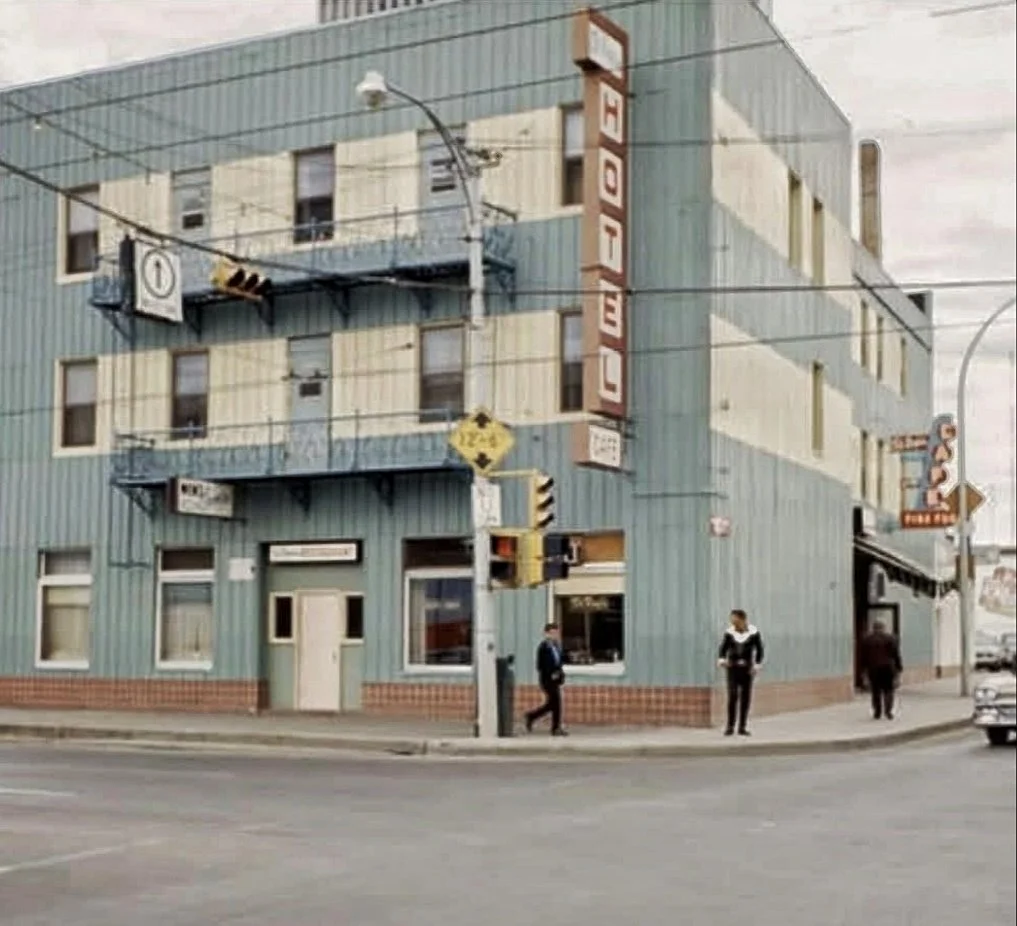
St. Regis Hotel
We parked outside the old hotel and Dad went inside, leaving the fatigued hungover loggers and me to wait in the vehicle. By this time, the two detainees were beginning to dry out and were feeling the pain of the past few days’ escapades. I can’t remember exactly what the delay had been inside the building, but it’s not usually very easy to drag a drinking man away from his last beer. Time lingered on and the two backseat passengers looked as though they might be falling asleep. Then, seemingly out of nowhere, an older man unknown to me approached the car flashing a ten-dollar bill at the men in the back seat. Before I knew what was going on, the two briskly awakened passengers opened the door, jumped out of the vehicle and followed their apparent comrade down the street. It would have been both scary and futile to try to follow. The only hope I had was to pay close attention to where they were headed.
So, when my dad arrived back at the car with what he thought was the last of the stragglers, he was confronted with the new challenge of having to again apprehend the two that he had rounded up not more than an hour earlier! Luckily, I had noticed the two go into another building only a few doors down the street. It was obvious that they had accompanied their newfound pal inside to make appropriate use of the remaining ten dollars. My father wasted no time in taking action, leaving me to babysit the newest arrival while he tromped decisively through the door of the nearby establishment. I could see from his gait that he was becoming a bit more agitated.
Meanwhile in the back seat, my latest assignee was dealing with problems of his own. It wasn’t the first time I’d seen somebody living the trauma of an infliction of the “snakes”, so I had a rough idea of what was happening. Fortunately, the attack had not yet reached the fully convulsive stage, but it was still not a pretty sight. The poor man was in a full-scale verbal battle with himself and his demons. It was as if there were a number of personalities there with him in the back of the car, each struggling to control the conversation. Occasionally, he would thrust himself into a contorted position to better confront his assailants.
Luckily for me, my dad returned in relatively short order with the two other escapees, just as my detainee was in the midst of one of his roughest verbal outbursts, cussing out one or more of his unseen opponents at full volume. When the other two stragglers climbed into the back seat, they unsuspectedly took on the identity of the ghostly participants, at least in the imagination of their afflicted companion. However, even in their hungover state, they were eventually able to calm the man down, at least to the point where he sat reasonably still. The verbal outbursts continued most of the way back to the farm at Drayton Valley but, after a night’s sleep and a decent breakfast, all three were reasonably ready for the trip back to camp where they would spend the remainder of the day resting up before getting back to work the next morning. What a shame that they were starting over with nothing but the clothes on their backs, only to quite possibly play out a similar episode at least once again before spring breakup.
But not everybody in camp was as challenging as these older men, many of whom, a mere twenty-five years earlier, had more than paid their dues to the country and wore the scars to prove it. There was a sizeable group of younger men, both married and single, who worked either in the bush or on the sawmill. One young man from the Carnwood area had pulled a house trailer over the rough road to camp and he and his new wife lived onsite during the course of the winter. Ron worked in the bush as a tree feller and he and his wife, Gloria, spent many of their evenings playing guitar and singing country and western songs in their trailer. Gloria picked up on my interest in music and, before long, she was teaching me some basic chords on the guitar. The timing couldn’t have been better, as I always had some free time when everything was running smoothly in camp and the men were busy either on the mill or in the bush. Gloria and Ron played in a number of different keys, so I began to learn the basic mathematics of musical structure. Very fortunate for me, I was able to add this new knowledge to my very small portfolio of scattered musical notes that was slowly beginning to accumulate.
During the early part of the winter, except for a few everyday glitches, things in camp were progressing more or less as expected. Snowfall was about average, enough to maintain a good ground cover for skidding and moving equipment, but seldom too deep to offer serious challenges, as long as the roads and skid trails were kept open. Most mornings there were a few inches of snow to be shovelled off the sawmill machinery and lumber piles, but the constant movement of manpower and equipment usually packed the snow enough to prevent any serious stoppages. Temperatures were moderate and we were not often shut down due to the cold. The one event that does stand out in my memory is that of a 100-pound propane tank exploding on one particularly cold day. I’m not sure whether it was a faulty valve or if it was the forty below temperature that induced the action, but the almost full tank jumped, hopped and rolled around the cookhouse yard, spewing out propane until it was empty. It reminded me of a two-year-old colt on its first trip to the rodeo!
As the sun started to rise higher in the southern sky and daylight came earlier in the mornings, it was becoming apparent that the size of the bush crew would have to be fortified. There was a lot of timber still to be logged out, and the existing men were simply too few to get the job done in time. Breakup could come quickly and my father wasn’t taking any chances.As usual, he had a backup plan. His cousin’s husband from the Keephills district had a small logging operation in that area and, as it turned out, they had insufficient timber for the season. So, within a few days of my dad’s visit to Keephills, a couple of extra bunkhouses were moved in and a new logging crew installed.
One of the new bunkhouses became the temporary home for a small group of younger men, at least a couple of them only teenagers. Although still considerably older than me, they were the closest I had to a peer group since the beginning of the winter. One in particular was probably about fifteen, and he and I struck up somewhat of a friendship. To pass the time in the evenings, I would sometimes go into their bunkhouse after supper and play cards or simply chat and get acquainted. One evening only a few days after their arrival, the young teenage lad decided it might be fun for the two of us to have a wrestling match. He knew that there was little chance for a ten-year-old against the superior strength of somebody five years older, but he meant no harm and I’m certain that he would never have let the scuffle get out of hand.
My dog, Nipper, was a crossbreed, part German Shepherd and part some other larger breed. He was a young, sturdy dog with powerful legs and torso. He was a good companion and often followed me around the camp as I tended to my various chores. In fact, he was seldom far from my side.
Unknown to any of us, Nipper had chosen to lay down outside while I was visiting with my new friends in the bunkhouse. Upon hearing the sudden commotion inside, he immediately rose to his feet and made one mighty jump at the door of the building, taking it with him as he leaped. Before anyone could react, he had pinned my youthful assailant against the wall. It was all I could do to call him off before he did serious damage to the young man. Fortunately, the only real damage to the youth was to his ego. But that was the end of the wrestling matches, either inside or outside the bunkhouse!
One middle-aged member of the new crew from Keephills apparently fancied himself of management calibre. My dad’s cousin was not able to be in the bush full time as he had other commitments at home on the farm. But my dad and he had a good, solid relationship and well established mutual foundation in the logging business. In addition, cousin Lorne also had a good working rapport with his crew, so everyone had a sound understanding of what was to be done and, more or less, how it was to be carried out. However, the self-proclaimed “manager” had different ideas, and he had a hat, a cigar and a better suit of clothing to show for it. Additionally, it soon became clear that he was neither particularly handy nor capable with the tools of the industry.
So, whenever my dad’s cousin was away, this self-appointed, well-dressed “foreman” felt himself obliged to take over. Occasionally he was actually out in the timber trying to give orders to men who wouldn’t listen, but most often he simply confined himself to the bunkhouse smoking his cigars. Apparently, the bunkhouse had become his makeshift office while the other men were out in the bush working. It wasn’t too long before my dad got wind of his antics and he was warned about keeping his nose out of the management of the operation and to confine his efforts to actually getting some work done. It even got to the point where my dad’s brother, who had temporarily joined us to run a skidding cat, would come into the cookhouse sporting a makeshift fancy hat and a cigar, doing his best imitation of the unbecoming “foreman”. Obviously, this action was carried out behind the back of the “foreman”, and it always got a good laugh!
My dad did not fully appreciate the humour in the situation and, in a few days the “foreman” was an unemployed and unwilling passenger on the next lumber truck heading to town. The “foreman” put up significant resistance, but arguing with my father, especially in those kinds of situations, was like arguing with a brick wall. The “foreman” was gone, never to be seen in camp again.
I had become accustomed to my routine around camp and my chores were beginning to seem more mundane than they had earlier in the winter. I was way ahead on my schoolwork and even the occasional stint of lumber piling or accompanying the horse loggers into the bush was losing its flair. The morning air was void of its crispness, the skidding trails were softening up some afternoons and the smell of spring was in the air. For my father and the crew, the race against spring breakup was imminent, and extra truckloads of lumber were being loaded and dispatched on the frost of the wee hours of the morning. Optimal use of freezing conditions were observed in order to protect the integrity of some parts of the road.
But for me, it was a time of melancholy. I sensed that our time in the bush was slipping away and, with the new intensity in camp, I sometimes felt that I was mostly in the way. I convinced my dad to let me use some of the discarded lumber scraps and a large pail of secondhand nails and went to work building a new doghouse for Nipper. He had been sleeping all winter in a makeshift lean-to attached to the wall of the cookhouse. My timing was far from ideal, but the project kept me occupied when there was nothing more rewarding or interesting to do.
The only tools I had available were a fairly dull handsaw, a claw hammer with a broken claw and part of an old tape measure so, coupled with my limited carpentry skills, progress was slow. Cutting the boards to length was especially cumbersome, partly due to the unsharpened state of the saw blade and partly because of the bigger-than-necessary dimensions of the green lumber. As I rummaged around through the pile of scrap wood, I realized that there seemed to be a relative abundance of material that was either eight feet in length or, with some minimal trimming, could be cut to that length. I also discovered that, if I used some of the longer twelve-foot pieces of two-by-four and two-by-six, I could have a doghouse with an attached deck at the entry without having to do an excessive amount of cutting. So, Nipper’s new home would be 4’x8’ with a solidly attached 4x4 deck, a bit excessive even for a dog of his stature. On the positive side, the framing material was largely rough sawn 2x6’s and 2x4’s and clad with rough one-inch boards, so there was, at least, little risk of the structure blowing away in the wind.
The biggest challenge for me was the roof but, with a few quick tips from my dad and Uncle Stanley, I figured out the necessary angles and how to attach the rafters along the top of the walls. A ten-foot piece of two-by-four would make one set of rafters. Next, I sheeted the roof with more scraps of one-inch lumber and covered it with some leftover rubberoid from one of the bunkhouses built onsite earlier in the winter. The final touch was a flexible two-way door made from a wooden lathe and a discarded piece of canvas. It was a masterpiece! Maybe not exactly a masterpiece in terms of doghouses, but it certainly displayed promise in the realm of exotic granaries or even smaller rail-side grain elevators. But, a masterpiece nonetheless.
Unfortunately, Nipper preferred his old lean-to on the side of the cookhouse and never spent a night in his shiny new abode. A couple of times, I was able to encourage him inside to check the place out but, as soon as I turned around, he would scamper through the canvas door and outside to less restrictive surroundings.
The next couple of weeks went by quickly. Within days, the huge lumber piles were reduced to a fraction of their former magnitude and some of the now empty bunkhouses were loaded onto truck beds, headed back to the farm at Drayton Valley. As the situation escalated, my dad acquired the temporary use of a vacant piece of land along the gravel highway about half way between the camp and the farm near Drayton Valley. Using this as a drop off point would mean having to load and reload everything an extra time, but would help reassure that everything got out of the bush in time. Mother Nature waits on no one, and time was of the essence.
My mother and I stayed until the last day, making sure that all the remaining men were fed, and I continued to look after miscellaneous chores that needed to be taken care of in preparation for the final cleanup. One of the last things to be done was to disassemble and extinguish the slab fire where all the remaining scrap was burned before leaving. I had fallen asleep to the crackling of that fire all winter and it was sad seeing it being flattened and its ashes spread out over the old mill-site.
At last, all the other trucks had left with their loads and my parents and I climbed into the last one, barely in time to make it over the stretch of road on the river before it would no longer carry our weight. We had saved my doghouse for a spot on one of the last loads, but it was simply too big and bulky to fit among all the other more valuable equipment. It had survived the slab fire, but was nevertheless now left to be at the mercy of the natural elements, waiting for the eventual flooding of the area for the new power dam. As we returned to the farm and the days turned into weeks and months, I often remembered my old masterpiece and had visions of it floating about on the future Brazeau Dam, sometimes dangerously approaching the spillway, but never quite being swept over the edge.