Chapter 1
Danny McDonald’s old tractor grumbled and puffed its way along, pulling the four-wheeled hay wagon over the rutted trail toward the Pembina River. Luckily, it hadn’t been a soggy summer as was usually the case, and tracks through the sod were comparatively dry. I believe it was early in the fall following my fourth birthday, and my first memory from my life on this planet.
Danny was a trapper and woodsman who owned a quarter section of land along the river north of our intended campsite, where we were to spend the next few days. He was a rugged bachelor, rough around the edges, strong as a bull, but much loved by everyone who knew him. His kindness and willingness to lend a hand whenever needed had become a trademark. This trip was only one of many he had made and would continue to make for families on their annual treks to the berry patches, since the days before his team of horses had been replaced by the old Massey.
I’m sure I can’t remember all the families who were on that trip. Some details escape the memory of a four-year-old. My grandmother Agnes Erickson and her family, the Brays, were avid berry-pickers, so she was there, along with my mom and dad and my grandma’s youngest sister, Daisy Hines, and several more of that part of the clan. The Hines kids were plentiful and most of them already seasoned berry- pickers. There were probably more of my Bray relatives there, but they are not clear in my memory. My Dad’s good friend and old school chum, Les Tucker along with his family, was there, as well as Les’s sister, May Urchyshyn, and her family. The “Brownbill Boys”, Chub Brownbill and Stan Pickavance, were also along. Uncle Chubby and Uncle Stanley, as they were affectionately known to us, were a pair of bachelor cousins from Lancashire, England who had come to the Drayton Valley district with their parents in the early days of settlement. I’m certain that our other neighbours and family friends, the Davis’s, were also there. Of course, my grandpa, Ed Erickson, was there. He and my grandmother had divorced many years earlier, but they still got along well, and he still looked after her better than many married husbands, even though Grandma had moved to Rocky Rapids and later to Edmonton and he had raised his two boys as a single parent. That was a rarity in those days. Again, if my memory serves me, there must have been close to a half dozen tents or more full of berry-pickers, with all their associated trappings, that had to be hauled, first to Danny’s cabin, then south to and through Glen’s Ranch, and finally further west through the muskeg, to the berry patches not far from the river. I remember that our camp was set up along the bank of the river, close to water for drinking and washing.
Not least important among the accessories hauled in on Danny’s wagon was the multitude of containers needed for picking and storing the berries. Once camp was set up, the usual procedure was to continue picking for the number of days necessary to fill every available pail, bowl, washtub, cream can or other vessel that could be used to transport the harvest back to the respective homes around Drayton Valley for cleaning, canning and preserving for the winter. Sometimes, in particularly bountiful years or lengthier stays, tarps, jackets, and other unlikely containers were put to use.
I don’t remember being a very active participant in the actual berry-picking, and my most vivid memories are of the actual camp along the Pembina. Sometimes our mindful senses are not the ones which impart the most vivid memories. I remember the smell of the campfire and the sound of its crackling as wood was added late into the night. Sometimes a piece of dry spruce or, maybe accidentally, a green spruce bough would be placed on the flames, creating a bright spark or flare in the darkness. It was countless dozens of memories such as these that affected me deeply and that would help to shape me into the person that I would become.
Toilet facilities were simple, but effective. The common practice was to find a couple of windfalls or other fallen logs of suitable height, in opposite directions from the camp. Dry twigs and branches would be removed as necessary and, in special instances, the bark might be removed from the selected portion of the fallen trunk. As I remember, the ladies were a bit pickier about the log chosen in their area. Such was also the case concerning toilet tissue. For those who had really come prepared, there may have been some soft paper left over from store-bought apples or pears or maybe even from Mandarin oranges from the previous Christmas. But most common were the pages of old newspapers or a discarded Eaton’s catalogue. With adequate scrubbing and massaging, even that crude material could be manipulated into a useable wipe, despite the newsprint, which sometimes discoloured the skin or underwear. Some simply resorted to the moss, which grew plentifully in the muskegs surrounding the blueberry patches. Besides its ready availability, the moss was always clean and sanitary and devoid of unhealthy chemicals. It was also less noticeable when disposed of; it blended right in with the topography from where it was taken. The downside of this option was the risk of eventually stepping into something blueish-brown and mushy which also blended in nicely with the moss. In more modern times, some folks tended to tarp off their toilet sites for increased privacy, but, as I remember it, common courtesy prevailed in our camps and the designated areas were well respected.
Another unforgettable memory from my first and subsequent trips to the area was the abundance of fur that Danny McDonald always had on hand. Due to a government bounty on wolves, Danny had secured a contract to remove significant numbers of them from the area. This, of course, paid extra dividends for the trapper since the hides also brought a decent price. Danny was always proud to show off his most recent catches and there was always an interesting lineup of hides to be viewed, including wolves, lynx, marten, mink and, of course, the usual beaver, muskrat, squirrels, and weasels. He had managed to set up his trapline so that much of it was situated within a day’s snowshoe trek from his cabin. The line was considerably more accessible than many others, where often a trip of several days was required just to cover each individual leg of the allotted area. Along with his excellent garden and a bit of subsistence farming and ranching, Danny lived well. Even the more modern and sophisticated oilfield newcomers who eventually came to call the area home recognized and appreciated his natural and gentle approach to living on the land.
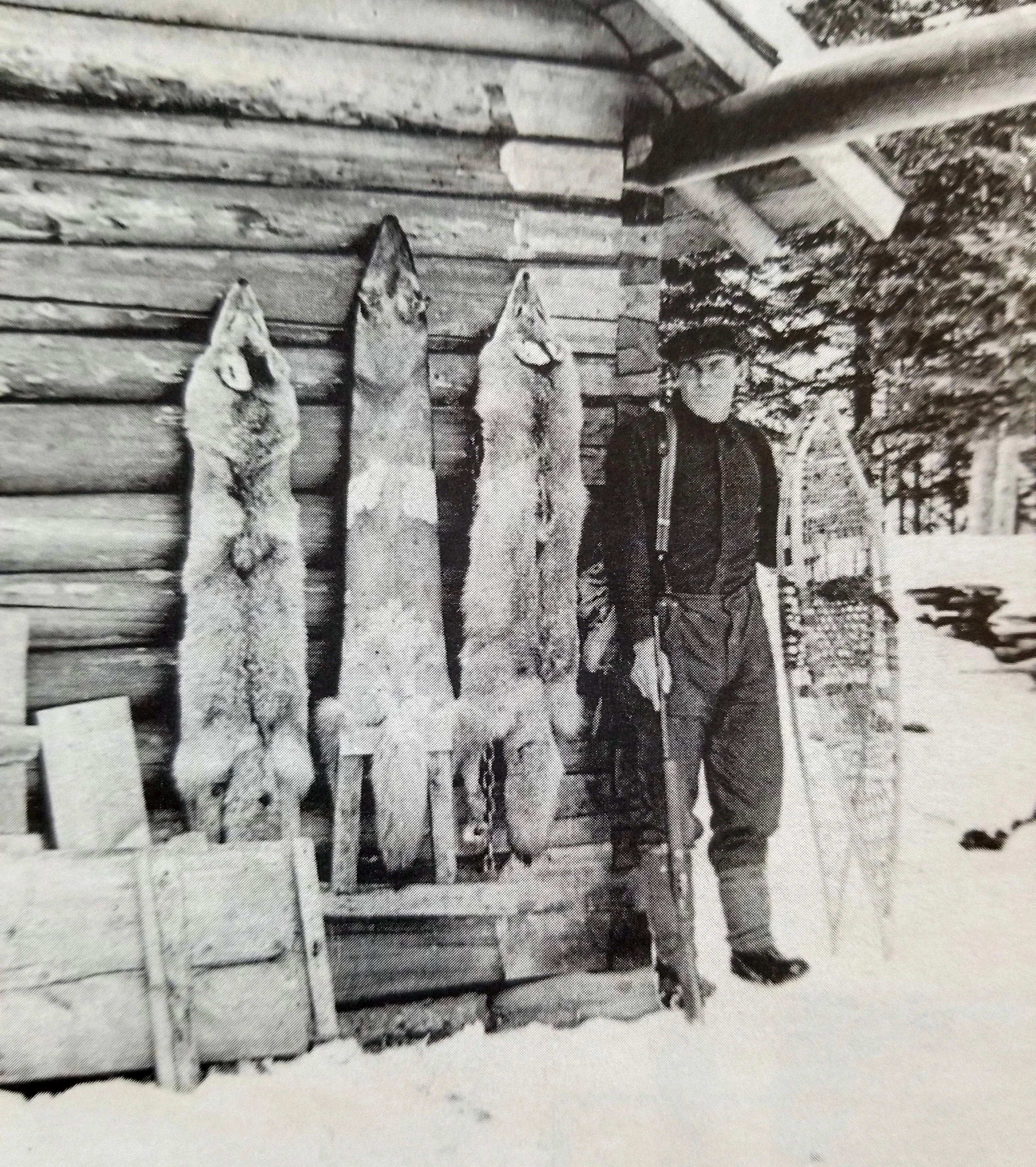
Danny McDonald
I’m not sure exactly how far into the area we were actually able to drive before transferring our gear into Danny’s wagon for the last leg of the trip. Likely, we would have had to stop at the ranch of the Johansons, Danny McDonald’s closest neighbours to the north. Helmer Johanson drove a late model Fargo pickup truck to and from “town” and even further afield, and I think the road ended at their place. The ranch was only a short way downstream from Danny’s cabin, so it would have been a suitable pickup spot, and the Johansons had plenty of open space to park a few vehicles for the duration of the stay. It is entirely possible that Helmer and Doris accompanied the entourage for a few days’ berry-picking. The Johansons were friendly and hospitable folks, and well-known to my parents and the others. Like my grandfather, Helmer had immigrated from Sweden, so those two enjoyed an added ethnic connection. I remember that Doris always had a fresh loaf of bread to share with both expected and unexpected visitors. Unfortunately, for some reason, the butter was often allowed to become sour, and my memories of the delicious bread usually went sour along with the butter! I remember my mom suggesting that maybe the cream separator didn’t get a very frequent cleaning. The Johansons worked hard, both inside and out, building their ranch, and I guess sometimes certain details just got overlooked.
Another old couple that we occasionally visited along the Pembina were the Kootenays. I am still not sure whether they were Stoney (Nakota) people or if they, as their name suggests, actually originated deeper in the mountains further west. It’s even possible that they had acquired their surname through some earlier involvement with the Kootenay people. Or maybe one of the pair was Stoney and the other was Kootenay. Regardless, they were grand old people who, like Danny, lived peacefully on the land. They lived in a little log cabin not far from the river and made their living by trapping, hunting, fishing, and reaping the plants and medicines that Nature had to offer. I think old Mr. Kootenay occasionally took on some periodic work with some of the various sawmill operators in the area. I remember not many years after my first trip into the Pembina, my dad was logging in the area south of present-day Lodgepole, not far from the soon to be built Brazeau Forestry Tower, and he sometimes offered members of whom I believed to be the second generation Kootenay family a ride to town in his 1949 Dodge Custom, equipped with fluid drive, quite a feature in its time! There were some Kootenay grandchildren about my age and, although I think we all would like to have become friends, we were all too shy to do anything about it. Besides, it didn’t seem like they spoke much English and my Cree/Stoney was much worse!
When we weren’t in the bush logging out a timber berth somewhere, my family made its home in a single-bedroom log house “in the jack pines” about halfway along the country road between the two pioneer communities of Violet Grove and Drayton Valley. My grandfather had bought the quarter-section from another homesteader and, aside from the reference to the pine trees, it was also commonly known as “the old Hendricks place.”
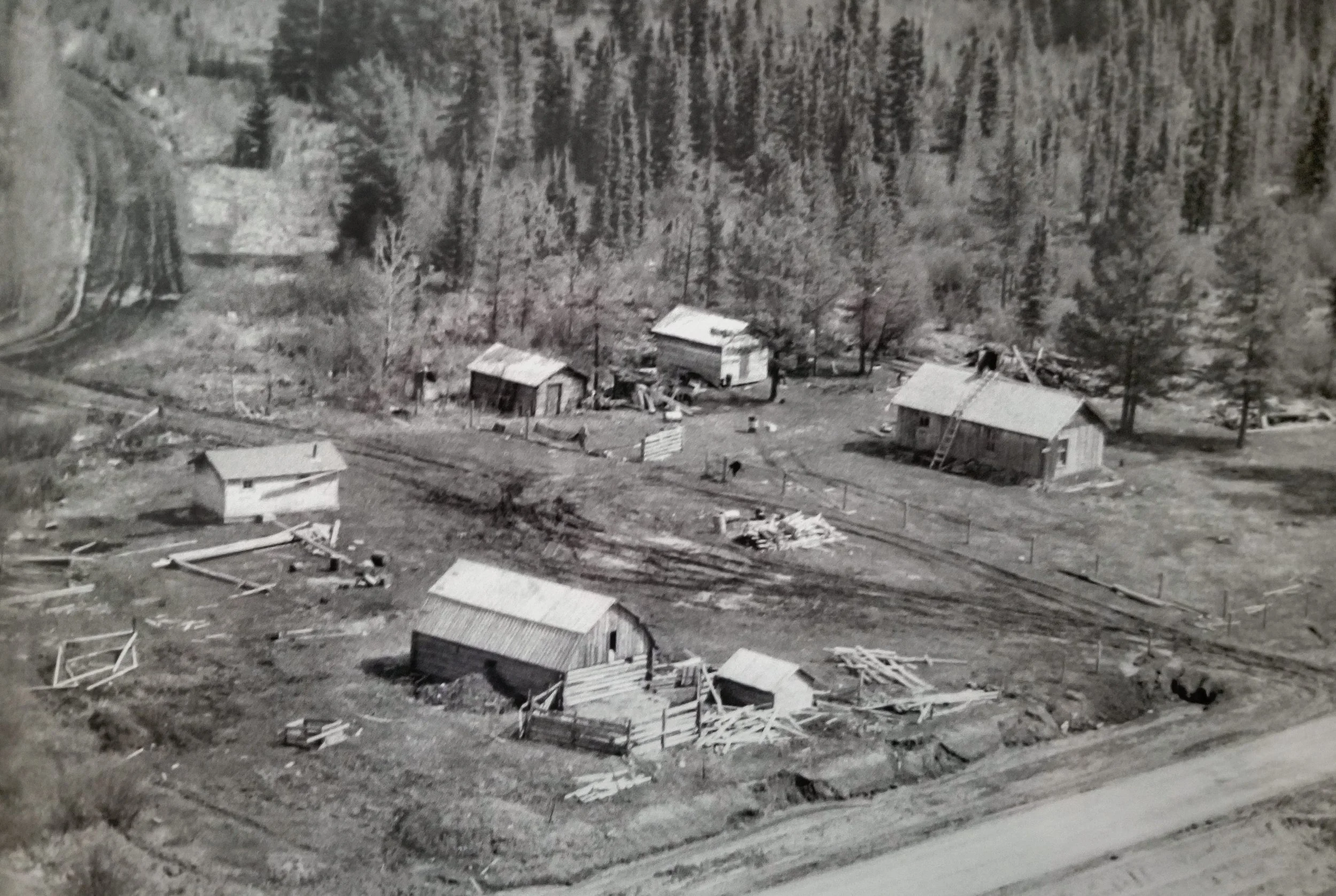
The Old Hendricks Place
The house, log barn and outbuildings were situated alongside a small creek running through a sizeable patch of muskeg. Due to the mossy nature of the muskeg soil, my folks were able to maintain an almost year-round dugout for the storage of milk, cream, butter, meat, and other household staples. With an adequate summertime covering of straw or other insulative material, it was not uncommon to find traces of ice amongst the moss late into the summer. Potatoes and other vegetables were usually stored in my grandpa’s root cellar on an adjoining quarter section where he lived. I loved my grandfather immensely. He was not only the senior patriarch of our family; he was my hero and idol. I spent as much time with him as I possibly could.
For most of my life, I have been a headstrong individual. I suspect that some less kindly folks may have referred to the trait as “phenomenally stubborn”, or something even stronger. For as long as I can remember, I have had my own specific attitudes as to how things should be done. My parents were not terribly unlike other parents in the area – hard-working homesteaders who knew the value of a day’s work – from both themselves and their family members. Everybody, including children, had chores that had to be done, and there were well-known methods for doing most of them, that had been tested and proven. Inevitably, I went head-to-head with my father and mother on a variety of issues from time to time.
I think I was also about four years old when I made my first attempt at running away from home. My short legs were a definite disadvantage, and I was usually apprehended before I even made it out of the yard. Another handicap was evident in the fact that everybody knew that my ultimate destination would certainly be my grandpa’s cabin and, so far, I hadn’t explored any other route than via the country road to get there. It was simply too easy for them to track me, and several additional flawed attempts ensued. What was even more frustrating was my dad’s teasing. He even started suggesting that it might be a good idea to pack a lunch to cover at least the first part of the journey to wherever it was I was headed! Obviously, he knew that I didn’t know that he knew where to find me if, indeed, I ever did succeed!
It was the better part of a mile to my grandfather’s place, and, except for the road, the only plausible exits were through a large, plowed field on a slope across the creek to the east, or via a 10-acre area of very thick willows and scrub brush directly to the north. The muskeg and tracts of bigger timber to the south were not an option, and even I knew that would take me in the opposite direction of my destination. Then one day, probably in the fall after I had turned five, a new unexpected opportunity arose. Although I can’t remember having had any significant altercation with my parents, I was lonesome for my grandpa. With no particular plan in mind, I wandered east across the wooden culvert on the creek, playing with the dog and enjoying the lovely fall weather and the colours and smells of the changing season. It had been a very good summer for growing and the formerly plowed field had yielded a beautiful tall crop of wheat, ripening nicely. I must have crept under the barbed wire and into the field of wheat. I don’t think it was my good sense of geography that led me to the northeast and toward my grandpa’s cabin – it must have been an intuitive sense linked to my strong connection to the old man I admired so much. Something was telling me that I had to head north through the grain field. The dog followed quietly and unaffected.
The grain stalks had grown taller than the height of my diminutive stature, although their heads and mine were a similar light-blond hue. To spot a five-year-old child under those conditions would not have been easy, even for people at home on the land. Once I was inside the perimeter of the 40-acre field, leaving scarce signs of my point of entry, tracking attempts would have been almost ludicrous, even if it had been known that I had taken that path. In addition, my parents had already become accustomed to my regular route along the road.
About halfway through the field, my sense of direction started to wane. It was a heavy crop, and I couldn’t see any further than the nearest stalks in any direction. Acting almost entirely through intuition and with no real knowledge of solar positioning and other natural directional signs, I began to travel in circles. I suspect that I inadvertently crossed my own trail more than once, maybe even several times. I really have no idea how long I wandered around and around in the wheat. I do not remember even sitting down or resting. I think I just kept wandering, optimistically anticipating the sight of my grandfather’s cabin in the distance. The dog had been following obediently all the while, letting me choose the path through the grain. Then, nonchalantly and unexpectedly, he pulled ahead of me and, since I was becoming disoriented and bewildered, I had little choice but to follow him. He didn’t seem to be in any particular hurry, so it wasn’t difficult to keep up, even though my little legs had already made many more steps than they were accustomed to!
I don’t know how long my parents had been searching for me, but it must have been a couple of hours. Apparently, they had considered the wheat field as a possible route but couldn’t see any sign of me having been there. After having exhausted the possibility of the road, they had concentrated more intensely on signs of torn clothing, etc. in the willow thickets. As I remember it, they finally spotted me following the dog along the northern part of the trail which separated the willow patch from the grain field. We were headed south, and the dog was leading me home!
My dad was a good hunter and game was plentiful, so there was seldom a shortage of meat. Elk was the perennial favourite for most of us, but there was always a ready supply of moose, as well as both whitetail and mule deer. In hunting season, the local men usually went out in groups and tented in favourite areas where access wasn’t too difficult and where they were most likely to fill all their tags. With a bit of cooperation and some creative tagging methods, that usually wasn’t hard to do. Although the trips often led out further into the west country, it wasn’t uncommon to bag one’s limit within a short distance of home. I remember one fall when my dad shot a couple of bull elk through his pickup window only a couple of miles from our house. The only real challenge was to round up somebody with a second elk tag before loading the carcasses into the vehicle. As far as domestic meat was concerned, aside from chicken, pork was a staple. We usually kept a pig or two to butcher in the fall, along with the wild game. Pork was especially good when mixed with the drier moose meat, and, when combined, the two made excellent hamburger.
During the same fall of my latest runaway attempt my parents had been fattening three pigs in the log barn and its adjoining pigpen. The barn was situated not more than a couple of hundred feet north of our house, and the pigs were able to roam freely between the open-air pen and the protection of the barn. Generally, the distance between house and barn was not so great that any significant goings-on would go unnoticed. The porcine trio was, itself, a relatively content lot, and not prone to a lot of noisemaking. The chickens were housed in another smaller building to the east of the house and locked in at night, so there was no interaction between the two species. Sometime during the early morning, the dog started making a racket in the yard. The sun had not yet made its appearance over the eastern horizon, and it was still pretty much pitch-dark. Of course, in those days the only possible means of outdoor illumination would have been via a coal-oil lantern, and there wasn’t always one of those readily on hand.
We never did catch sight of either the bear or the missing pig, but the next morning the bear tracks and the trail of blood leading to the nearby brush were clear indications of what had been going on in the darkness. Ironically, not more than a couple of weeks later, the remaining two pigs were struck and killed by lightning during a random fall thunderstorm. The moose meat was dry that winter.