PART ONE: From Bushland to Bandstand
Writing the story hasn’t been easy and, most of the time, it has been done in sporadic fits and starts with no discernible end in sight. As I grow older, I realize that there is a distinct possibility that I will never finish, so I have decided to take a bit of a shortcut. My aim is to present my story to a specific online audience in palatable segments, making it easier to read and easier for me to continue changing, adding and editing as I go along. Hopefully, by following this course, I will find ample time and inspiration to actually finish and publish at least the first half!
My intentions for writing this story are simple ones:
Acquaint and reacquaint people I grew up among or otherwise met along the journey with people, places, events and conditions whom/which they may have forgotten over the years
Leave an account for the younger generations as to how times and conditions have changed over the past 75 years
Lend an insight into the lives of people like me, who follow their inquisitive hearts and are not satisfied to follow the path most commonly travelled
I hope that you enjoy what I have to offer. A Song in the Spruce is being created under the banner of Buck Mountain Press, an independent publishing house which we developed a couple of years ago in conjunction with the release of my first book, Olaf & Me. Thanks for reading!
-
This story is dedicated to my children and grandchildren, Kerstin, Frans, Teya, Max and Ophelia, and to all our relatives, through blood and in spirit, who have come before us and blazed the trails to where we find ourselves today.
My wish is that these dear ones and others in following generations might use this account to help to understand the lives of those who preceded them and in some small way help to bridge the gap through the ages.
Chapter 1
Danny McDonald’s old tractor grumbled and puffed its way along, pulling the four-wheeled hay wagon over the rutted trail toward the Pembina River…
Danny McDonald’s old tractor grumbled and puffed its way along, pulling the four-wheeled hay wagon over the rutted trail toward the Pembina River. Luckily, it hadn’t been a soggy summer as was usually the case, and tracks through the sod were comparatively dry. I believe it was early in the fall following my fourth birthday, and my first memory from my life on this planet.
Danny was a trapper and woodsman who owned a quarter section of land along the river north of our intended campsite, where we were to spend the next few days. He was a rugged bachelor, rough around the edges, strong as a bull, but much loved by everyone who knew him. His kindness and willingness to lend a hand whenever needed had become a trademark. This trip was only one of many he had made and would continue to make for families on their annual treks to the berry patches, since the days before his team of horses had been replaced by the old Massey.
I’m sure I can’t remember all the families who were on that trip. Some details escape the memory of a four-year-old. My grandmother Agnes Erickson and her family, the Brays, were avid berry-pickers, so she was there, along with my mom and dad and my grandma’s youngest sister, Daisy Hines, and several more of that part of the clan. The Hines kids were plentiful and most of them already seasoned berry- pickers. There were probably more of my Bray relatives there, but they are not clear in my memory. My Dad’s good friend and old school chum, Les Tucker along with his family, was there, as well as Les’s sister, May Urchyshyn, and her family. The “Brownbill Boys”, Chub Brownbill and Stan Pickavance, were also along. Uncle Chubby and Uncle Stanley, as they were affectionately known to us, were a pair of bachelor cousins from Lancashire, England who had come to the Drayton Valley district with their parents in the early days of settlement. I’m certain that our other neighbours and family friends, the Davis’s, were also there. Of course, my grandpa, Ed Erickson, was there. He and my grandmother had divorced many years earlier, but they still got along well, and he still looked after her better than many married husbands, even though Grandma had moved to Rocky Rapids and later to Edmonton and he had raised his two boys as a single parent. That was a rarity in those days. Again, if my memory serves me, there must have been close to a half dozen tents or more full of berry-pickers, with all their associated trappings, that had to be hauled, first to Danny’s cabin, then south to and through Glen’s Ranch, and finally further west through the muskeg, to the berry patches not far from the river. I remember that our camp was set up along the bank of the river, close to water for drinking and washing.
Not least important among the accessories hauled in on Danny’s wagon was the multitude of containers needed for picking and storing the berries. Once camp was set up, the usual procedure was to continue picking for the number of days necessary to fill every available pail, bowl, washtub, cream can or other vessel that could be used to transport the harvest back to the respective homes around Drayton Valley for cleaning, canning and preserving for the winter. Sometimes, in particularly bountiful years or lengthier stays, tarps, jackets, and other unlikely containers were put to use.
I don’t remember being a very active participant in the actual berry-picking, and my most vivid memories are of the actual camp along the Pembina. Sometimes our mindful senses are not the ones which impart the most vivid memories. I remember the smell of the campfire and the sound of its crackling as wood was added late into the night. Sometimes a piece of dry spruce or, maybe accidentally, a green spruce bough would be placed on the flames, creating a bright spark or flare in the darkness. It was countless dozens of memories such as these that affected me deeply and that would help to shape me into the person that I would become.
Toilet facilities were simple, but effective. The common practice was to find a couple of windfalls or other fallen logs of suitable height, in opposite directions from the camp. Dry twigs and branches would be removed as necessary and, in special instances, the bark might be removed from the selected portion of the fallen trunk. As I remember, the ladies were a bit pickier about the log chosen in their area. Such was also the case concerning toilet tissue. For those who had really come prepared, there may have been some soft paper left over from store-bought apples or pears or maybe even from Mandarin oranges from the previous Christmas. But most common were the pages of old newspapers or a discarded Eaton’s catalogue. With adequate scrubbing and massaging, even that crude material could be manipulated into a useable wipe, despite the newsprint, which sometimes discoloured the skin or underwear. Some simply resorted to the moss, which grew plentifully in the muskegs surrounding the blueberry patches. Besides its ready availability, the moss was always clean and sanitary and devoid of unhealthy chemicals. It was also less noticeable when disposed of; it blended right in with the topography from where it was taken. The downside of this option was the risk of eventually stepping into something blueish-brown and mushy which also blended in nicely with the moss. In more modern times, some folks tended to tarp off their toilet sites for increased privacy, but, as I remember it, common courtesy prevailed in our camps and the designated areas were well respected.
Another unforgettable memory from my first and subsequent trips to the area was the abundance of fur that Danny McDonald always had on hand. Due to a government bounty on wolves, Danny had secured a contract to remove significant numbers of them from the area. This, of course, paid extra dividends for the trapper since the hides also brought a decent price. Danny was always proud to show off his most recent catches and there was always an interesting lineup of hides to be viewed, including wolves, lynx, marten, mink and, of course, the usual beaver, muskrat, squirrels, and weasels. He had managed to set up his trapline so that much of it was situated within a day’s snowshoe trek from his cabin. The line was considerably more accessible than many others, where often a trip of several days was required just to cover each individual leg of the allotted area. Along with his excellent garden and a bit of subsistence farming and ranching, Danny lived well. Even the more modern and sophisticated oilfield newcomers who eventually came to call the area home recognized and appreciated his natural and gentle approach to living on the land.
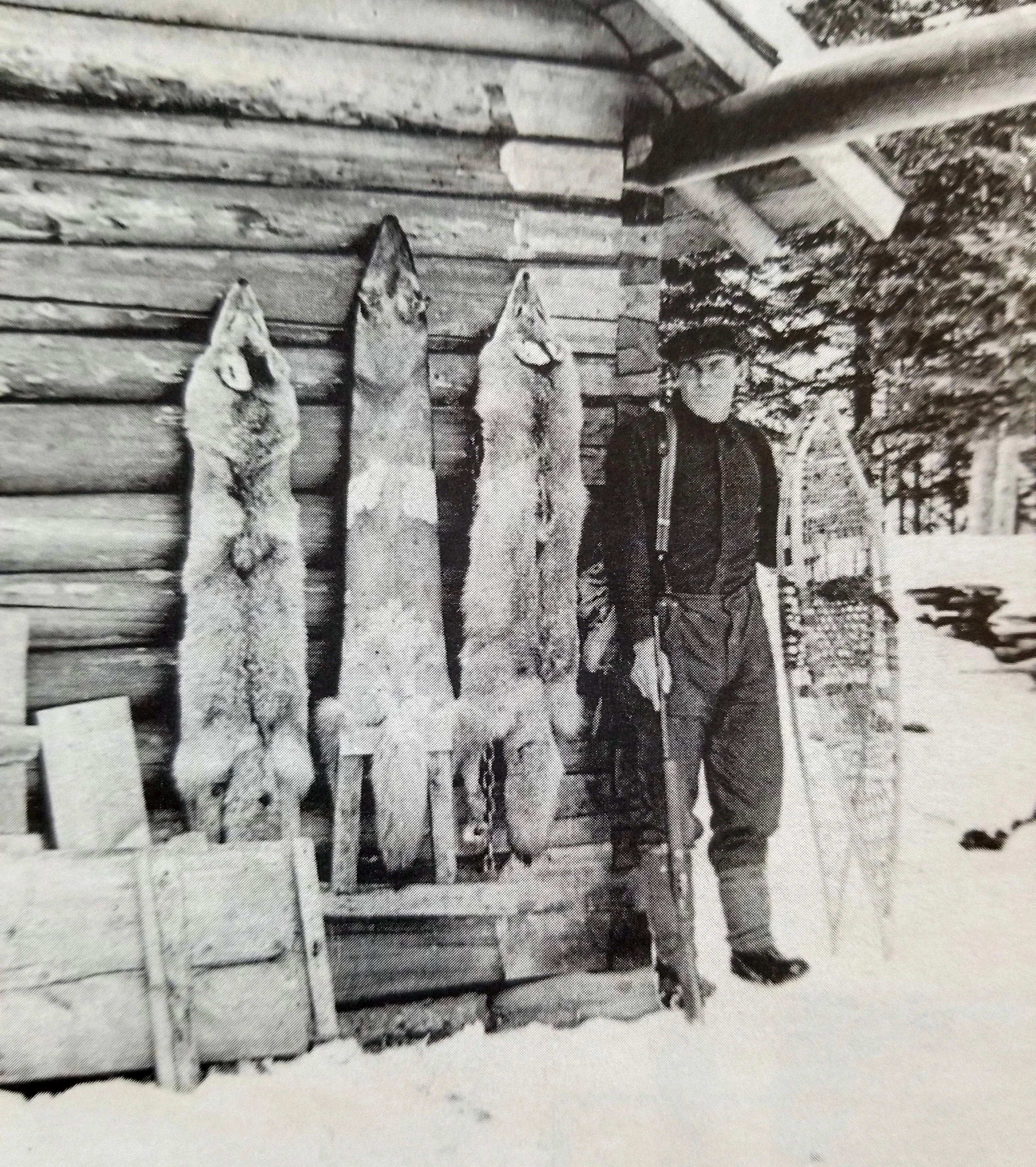
Danny McDonald
I’m not sure exactly how far into the area we were actually able to drive before transferring our gear into Danny’s wagon for the last leg of the trip. Likely, we would have had to stop at the ranch of the Johansons, Danny McDonald’s closest neighbours to the north. Helmer Johanson drove a late model Fargo pickup truck to and from “town” and even further afield, and I think the road ended at their place. The ranch was only a short way downstream from Danny’s cabin, so it would have been a suitable pickup spot, and the Johansons had plenty of open space to park a few vehicles for the duration of the stay. It is entirely possible that Helmer and Doris accompanied the entourage for a few days’ berry-picking. The Johansons were friendly and hospitable folks, and well-known to my parents and the others. Like my grandfather, Helmer had immigrated from Sweden, so those two enjoyed an added ethnic connection. I remember that Doris always had a fresh loaf of bread to share with both expected and unexpected visitors. Unfortunately, for some reason, the butter was often allowed to become sour, and my memories of the delicious bread usually went sour along with the butter! I remember my mom suggesting that maybe the cream separator didn’t get a very frequent cleaning. The Johansons worked hard, both inside and out, building their ranch, and I guess sometimes certain details just got overlooked.
Another old couple that we occasionally visited along the Pembina were the Kootenays. I am still not sure whether they were Stoney (Nakota) people or if they, as their name suggests, actually originated deeper in the mountains further west. It’s even possible that they had acquired their surname through some earlier involvement with the Kootenay people. Or maybe one of the pair was Stoney and the other was Kootenay. Regardless, they were grand old people who, like Danny, lived peacefully on the land. They lived in a little log cabin not far from the river and made their living by trapping, hunting, fishing, and reaping the plants and medicines that Nature had to offer. I think old Mr. Kootenay occasionally took on some periodic work with some of the various sawmill operators in the area. I remember not many years after my first trip into the Pembina, my dad was logging in the area south of present-day Lodgepole, not far from the soon to be built Brazeau Forestry Tower, and he sometimes offered members of whom I believed to be the second generation Kootenay family a ride to town in his 1949 Dodge Custom, equipped with fluid drive, quite a feature in its time! There were some Kootenay grandchildren about my age and, although I think we all would like to have become friends, we were all too shy to do anything about it. Besides, it didn’t seem like they spoke much English and my Cree/Stoney was much worse!
When we weren’t in the bush logging out a timber berth somewhere, my family made its home in a single-bedroom log house “in the jack pines” about halfway along the country road between the two pioneer communities of Violet Grove and Drayton Valley. My grandfather had bought the quarter-section from another homesteader and, aside from the reference to the pine trees, it was also commonly known as “the old Hendricks place.”
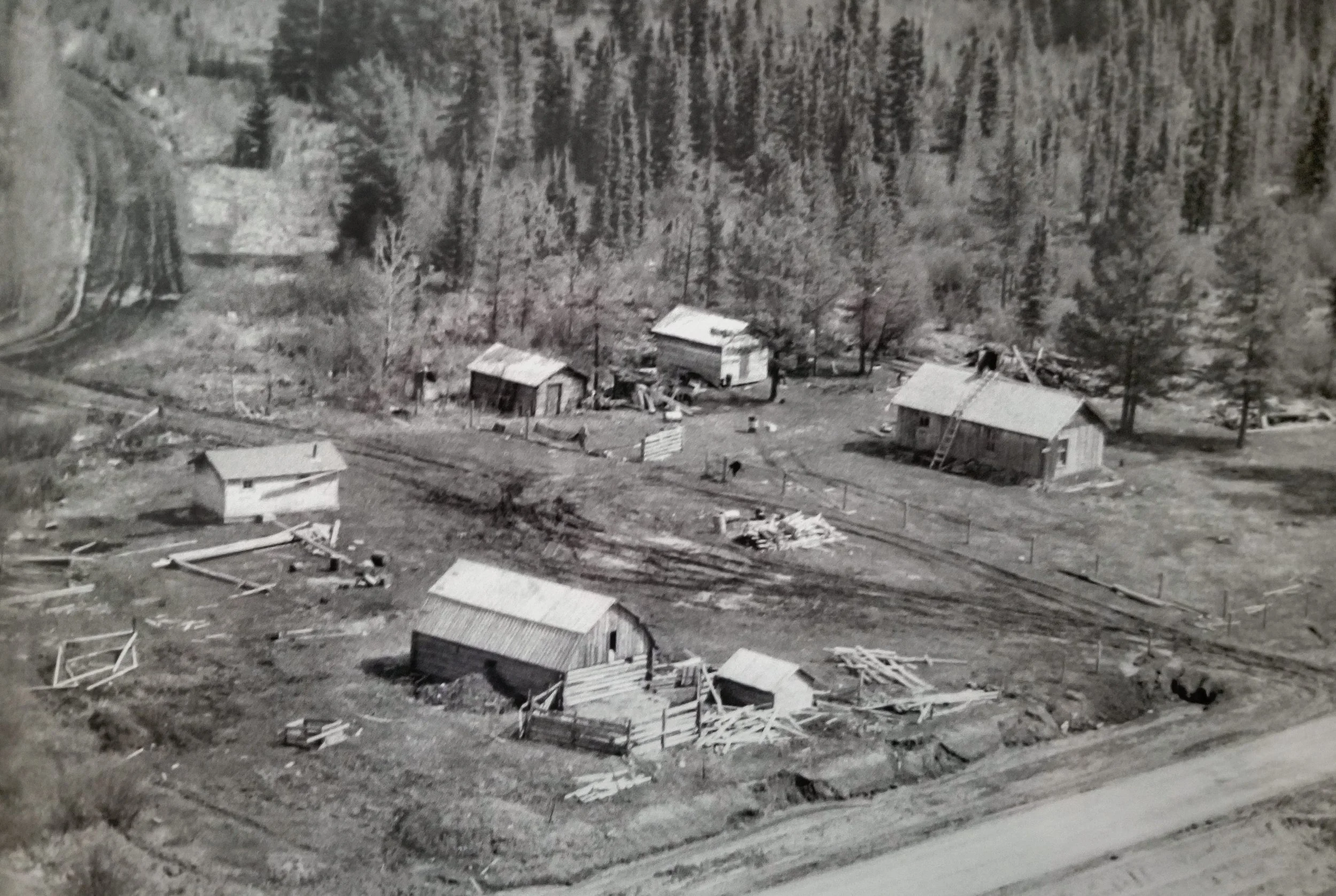
The Old Hendricks Place
The house, log barn and outbuildings were situated alongside a small creek running through a sizeable patch of muskeg. Due to the mossy nature of the muskeg soil, my folks were able to maintain an almost year-round dugout for the storage of milk, cream, butter, meat, and other household staples. With an adequate summertime covering of straw or other insulative material, it was not uncommon to find traces of ice amongst the moss late into the summer. Potatoes and other vegetables were usually stored in my grandpa’s root cellar on an adjoining quarter section where he lived. I loved my grandfather immensely. He was not only the senior patriarch of our family; he was my hero and idol. I spent as much time with him as I possibly could.
For most of my life, I have been a headstrong individual. I suspect that some less kindly folks may have referred to the trait as “phenomenally stubborn”, or something even stronger. For as long as I can remember, I have had my own specific attitudes as to how things should be done. My parents were not terribly unlike other parents in the area – hard-working homesteaders who knew the value of a day’s work – from both themselves and their family members. Everybody, including children, had chores that had to be done, and there were well-known methods for doing most of them, that had been tested and proven. Inevitably, I went head-to-head with my father and mother on a variety of issues from time to time.
I think I was also about four years old when I made my first attempt at running away from home. My short legs were a definite disadvantage, and I was usually apprehended before I even made it out of the yard. Another handicap was evident in the fact that everybody knew that my ultimate destination would certainly be my grandpa’s cabin and, so far, I hadn’t explored any other route than via the country road to get there. It was simply too easy for them to track me, and several additional flawed attempts ensued. What was even more frustrating was my dad’s teasing. He even started suggesting that it might be a good idea to pack a lunch to cover at least the first part of the journey to wherever it was I was headed! Obviously, he knew that I didn’t know that he knew where to find me if, indeed, I ever did succeed!
It was the better part of a mile to my grandfather’s place, and, except for the road, the only plausible exits were through a large, plowed field on a slope across the creek to the east, or via a 10-acre area of very thick willows and scrub brush directly to the north. The muskeg and tracts of bigger timber to the south were not an option, and even I knew that would take me in the opposite direction of my destination. Then one day, probably in the fall after I had turned five, a new unexpected opportunity arose. Although I can’t remember having had any significant altercation with my parents, I was lonesome for my grandpa. With no particular plan in mind, I wandered east across the wooden culvert on the creek, playing with the dog and enjoying the lovely fall weather and the colours and smells of the changing season. It had been a very good summer for growing and the formerly plowed field had yielded a beautiful tall crop of wheat, ripening nicely. I must have crept under the barbed wire and into the field of wheat. I don’t think it was my good sense of geography that led me to the northeast and toward my grandpa’s cabin – it must have been an intuitive sense linked to my strong connection to the old man I admired so much. Something was telling me that I had to head north through the grain field. The dog followed quietly and unaffected.
The grain stalks had grown taller than the height of my diminutive stature, although their heads and mine were a similar light-blond hue. To spot a five-year-old child under those conditions would not have been easy, even for people at home on the land. Once I was inside the perimeter of the 40-acre field, leaving scarce signs of my point of entry, tracking attempts would have been almost ludicrous, even if it had been known that I had taken that path. In addition, my parents had already become accustomed to my regular route along the road.
About halfway through the field, my sense of direction started to wane. It was a heavy crop, and I couldn’t see any further than the nearest stalks in any direction. Acting almost entirely through intuition and with no real knowledge of solar positioning and other natural directional signs, I began to travel in circles. I suspect that I inadvertently crossed my own trail more than once, maybe even several times. I really have no idea how long I wandered around and around in the wheat. I do not remember even sitting down or resting. I think I just kept wandering, optimistically anticipating the sight of my grandfather’s cabin in the distance. The dog had been following obediently all the while, letting me choose the path through the grain. Then, nonchalantly and unexpectedly, he pulled ahead of me and, since I was becoming disoriented and bewildered, I had little choice but to follow him. He didn’t seem to be in any particular hurry, so it wasn’t difficult to keep up, even though my little legs had already made many more steps than they were accustomed to!
I don’t know how long my parents had been searching for me, but it must have been a couple of hours. Apparently, they had considered the wheat field as a possible route but couldn’t see any sign of me having been there. After having exhausted the possibility of the road, they had concentrated more intensely on signs of torn clothing, etc. in the willow thickets. As I remember it, they finally spotted me following the dog along the northern part of the trail which separated the willow patch from the grain field. We were headed south, and the dog was leading me home!
My dad was a good hunter and game was plentiful, so there was seldom a shortage of meat. Elk was the perennial favourite for most of us, but there was always a ready supply of moose, as well as both whitetail and mule deer. In hunting season, the local men usually went out in groups and tented in favourite areas where access wasn’t too difficult and where they were most likely to fill all their tags. With a bit of cooperation and some creative tagging methods, that usually wasn’t hard to do. Although the trips often led out further into the west country, it wasn’t uncommon to bag one’s limit within a short distance of home. I remember one fall when my dad shot a couple of bull elk through his pickup window only a couple of miles from our house. The only real challenge was to round up somebody with a second elk tag before loading the carcasses into the vehicle. As far as domestic meat was concerned, aside from chicken, pork was a staple. We usually kept a pig or two to butcher in the fall, along with the wild game. Pork was especially good when mixed with the drier moose meat, and, when combined, the two made excellent hamburger.
During the same fall of my latest runaway attempt my parents had been fattening three pigs in the log barn and its adjoining pigpen. The barn was situated not more than a couple of hundred feet north of our house, and the pigs were able to roam freely between the open-air pen and the protection of the barn. Generally, the distance between house and barn was not so great that any significant goings-on would go unnoticed. The porcine trio was, itself, a relatively content lot, and not prone to a lot of noisemaking. The chickens were housed in another smaller building to the east of the house and locked in at night, so there was no interaction between the two species. Sometime during the early morning, the dog started making a racket in the yard. The sun had not yet made its appearance over the eastern horizon, and it was still pretty much pitch-dark. Of course, in those days the only possible means of outdoor illumination would have been via a coal-oil lantern, and there wasn’t always one of those readily on hand.
We never did catch sight of either the bear or the missing pig, but the next morning the bear tracks and the trail of blood leading to the nearby brush were clear indications of what had been going on in the darkness. Ironically, not more than a couple of weeks later, the remaining two pigs were struck and killed by lightning during a random fall thunderstorm. The moose meat was dry that winter.
Chapter 2
My parents must have figured out relatively early that I was going to need more interesting and demanding stimulation to keep me occupied…
My parents must have figured out relatively early that I was going to need more interesting and demanding stimulation to keep me occupied, so as not to eventually come up with the ultimate successful escape. Like most kids, I was keen to try my hand at driving. My grandpa sometimes let me hold on to the lines with him as he drove his team of horses to the barn for the night, and my dad and other relatives would sometimes let me sit on their knees and try to manipulate the steering wheel of their vehicles as they drove. My dad had bought a brand-new D2 caterpillar crawler a few years earlier, mostly for use in the logging camps. As fate would have it, Drayton Valley and district were about to be bombarded by the discovery of oil and gas in the area. Eventually, the little Cat, with my dad at the controls, ended up doing most of the backfill and landscaping work for the initial development of the soon-to-be new town.
While still in my fifth year, at the beginning of what might have been a conspiracy to keep my mind off the next attempt at running away to create a life of my own, my dad decided to give me a shot at driving the little D2. For me, it seemed like the perfect combination as, in relation to the bigger crawlers and related forestry and oilfield equipment and to the adult operators involved, the little Cat and I seemed to have a lot in common. My dad’s cousin, Ralph Wikander, had a Volkswagen Beetle, and I was allowed to sit on the edge of the driver’s seat almost every time he came for a visit, to check to see if my feet would yet reach to the clutch and brake pedals, but, when they finally did, I couldn’t see over the dashboard. The Cat had the definite advantage of being considerably higher off the ground, had a seat somewhat closer to the steering clutches (which I didn’t really have to reach at all), and was devoid of a windshield of any kind! Thus, I was able to look between the two steering levers, out over the hood, the A-frame and blade to the trail ahead. We started at the south end of the large hayfield that adjoined the infamous wheat field of the recent past. The hayfield was part of the adjoining quarter-section where my grandfather lived, and led almost all the way to his cabin, a distance of about a quarter mile. My dad installed me in the seat, and gave me steering directions, if needed. His most forceful instruction was in the use of the hand-clutch, located to the far left of the other controls. If anything at all dangerous or out-of-the-ordinary ensued, I was to immediately push that lever forward, and the machine would come to a stop. He then placed the little Cat in the lowest possible gear and instructed me to pull back on the clutch lever when I was ready to depart.
There is a reason that these machines were, and still are, referred to as crawlers. The low gear that Dad had chosen for my initial journey was so slow that one could have crawled along the ground and still managed to keep up, or possibly even pass the little D2. As it was, he and my mother walked along leisurely behind, behind my line of sight as I gazed intently at the trail ahead.
The trip was uneventful – even bordering on boring as I reached my destination at the opposite end of the field. The little crawler was well-balanced and maintained, so that any attempt to steer it would only have taken it off the path prescribed before takeoff. A couple of times, I pulled gently on one of the steering levers, but noticed no significant change in direction. Maybe I wasn’t pulling hard enough, but I didn’t dare apply more pressure, for fear of getting off the track and possibly compromising any future driving opportunities. Upon arrival I pushed the hand-clutch lever forward, exactly at the predetermined location. I sat quietly, evaluating my performance, before I looked around and noticed my parents approaching the machine. They both had grins on their faces, so I could only assume that my talents as a cat-skinner had been acceptable. With their help and with a larger, more triumphant smile on my own face, I jumped from the seat onto one of the cat-tracks, onto the A-frame and down onto the hayfield. My dad took the operator’s seat, threw the machine into a much higher gear, raced across the end of the field, and made a couple of sharp turns before parking the little Cat under a large spruce tree. Together we walked to my grandpa’s cabin. It had been a good day and running away anywhere was far from my mind.
About that same time, I made my first attempt at riding a bicycle. Most of the other kids my age had started to ride so one day my Dad came home from Edmonton with a brand new two wheeler for me. Being the first in my generation on my father’s side of the family and only the second among my maternal grandmother’s grandchildren, I guess I was lucky, as hand-me-downs were somewhat scarce. In any event, I became the proud owner of a 20” bicycle of the latest vintage. Many of my friends around the district had one or more training wheels attached to the back wheel of their bikes, but mine was devoid of those. First of all, the yard around our log house and outbuildings was not very level and my parents thought that training wheels would be useless. But, maybe even more importantly, in our discussions, I had made it quite clear that I wouldn’t be having any “baby wheels” on my bicycle! I had watched my Dad’s younger cousins riding, and they had done just fine without them.
Although smaller than many, my new bike was still too big for me. With my short legs, I had no chance of reaching the ground, even with the seat adjusted to its lowest position. So, if and when I lost my balance, the outcome was not likely to be optimal. But, as usual, my Dad came up with a reasonable training program. I would get mounted in a suitable position on the seat, with my feet on the pedals and my hands on the handlebars and my Dad would run along behind me holding onto the carrier mounted over the back wheel. Whenever he thought that I was doing quite well and maintaining my balance, he would let go of the carrier and let me ride on my own. Invariably I would eventually fall down, except for the times when he was able to catch up with me and grab onto the bike before I tumbled over. It was a bit scary, but I persevered, realizing that it wouldn’t be practical to have my dad running along behind me forever. With each attempt I became a bit more proficient and confident, and the periods of independence became increasingly lengthy. I was eventually able to ride a circle or two around the perimeter of the yard alone without falling. I also learned that it was possible to jump partway off the bike when I felt my balance start to wane, thus breaking my fall somewhat before hitting the ground.
But I wasn’t yet totally confident and I still needed my dad’s help to balance me as I was getting started with the pedalling. Throwing my leg over the frame of the bicycle was an ongoing struggle, although sometimes, if there was a downhill start, it went a lot easier. One particular day I was in a more courageous frame of mind and decided to try a run entirely on my own. I had noticed that there was a significant slope from about the middle of the yard going toward the eastern boundary of the property where the sodden driveway crossed the creek over a small wooden culvert. Mounting the bike at the top of the slope allowed me to gain enough momentum, throw my leg over the frame and get properly positioned before the bike either tumbled sideways or gained too much speed. At this point, I still hadn’t had much reason to use the brakes, as I had mostly been concerned with keeping the bike moving and in an upright position. However, this time everything seemed to be working better than usual and I started to pick up speed quite nicely as I proudly headed down the slope toward the culvert. I decided that I was going to cross the creek over the culvert and turn left on the dirt trail leading to the north end of the property. I was still gaining speed, but I realized that I would need some extra propulsion in order to make it up a slight rise on the opposite side of the creek. Considering my very limited experience in stopping or even slowing down, and not wanting to lose momentum before entering the upcoming turn on the other side of the creek, I didn’t apply the brakes at all. Besides, I was completely confident that I was fully in control of the situation.
But then I made a serious mistake. I was doing so well that I decided to look over my shoulder to check my progress. In doing so, I unknowingly pulled the handlebars to the left side and the bike drifted over to the side of the path. By the time I turned my head and regained my pedalling position, I was on an uncorrectable side trip over some deep ruts on the left side of the path and still gaining speed. By now, I had entirely forgotten about the availability of brakes at all and was hanging on, trying to maintain my balance. As I approached the crossing, the front wheel skipped over the deepest of the ruts and pulled the bicycle still further to the left and over the end of the wooden culvert. As I remember, the bike remained jammed up against the edge of the culvert and I was thrown over the end and into the creek beside a willow thicket growing out of the bank. After dragging myself out of the water, I found, surprisingly enough, that my bike had hardly been damaged at all, except for a badly bent chain guard and a bit of misalignment of the handlebars. I had some minor scratches from the willow thicket and a heavily soaked set of clothing from the waist down!
During the fourteen and a half years between my birth and my grandfather’s passing, we spent a lot of time together. Aside from various outings and his frequent visits with my family, I soon began staying overnight with him in his cabin. The cabin was a small one, with two tiny bedrooms and a larger combined kitchen and living area. One of the bedrooms was reserved for my Uncle Freddie, who occasionally came home to the cabin when he wasn’t away working in a logging camp somewhere. So, I slept with my grandpa in his bunk. He always tucked me in and seemed to have a special way to fix up my side of the bed so that it was warm and cozy, regardless of the conditions. The cabin was heated by a small coal-fired stove that needed to be tended often. He did his cooking on a propane stovetop, although there was electricity for lighting and for one of the district’s first television sets. The toilet facilities were ‘out back’ and my grandpa carried all the water for the household from a spring at the bottom of a long and steep creek-bank several hundred yards from his cabin. He had built himself a wooden neck-yoke to transport the water up to the cabin, two pails at a time, on his shoulders. He had also cut steps into the steepest part of the hill and lined them with flat rocks, so as to create a better footing and to decrease erosion of the bank. About halfway up the climb, there was a mid-sized spruce tree growing with a curved trunk, perfect as a resting place after the hardest part of the climb. There was no question about water conservation at my grandpa’s – every drop was precious and reuse, whenever possible, was a fact of life.
My grandfather was a big, powerful man with a strong voice and a loud laugh. He seemed to have no understanding of the concept of fear and there were very few challenges that he would not take on with a smile and a twinkle in his eyes. He commanded a lot of respect, both from his family and friends and from strangers. His very presence and body language told the story of a man who could handle himself and who wasn’t easily misled or taken for granted. There were some people who were even afraid of him. Small children often found his demeanour intimidating – until he dug out his seemingly bottomless supply of peppermint candies! On his infrequent trips, either on foot or at the wheel of his little Ferguson tractor, to the grocery store, he usually ended up treating all the children in the store to a round or two of peppermints. Except for during the warmest weeks of summer, he normally sported a roughly kept long white beard and a wide-brimmed hat and became known to many of them as Santa Claus. It wasn’t often possible for me to accompany him on these excursions, but, when I did, it made me feel very proud to be grandson of such a celebrity. Besides, my grandpa and I shared a secret, even in my pre-school years, that few others seemed to know about – we both knew there really was no Santa Claus!
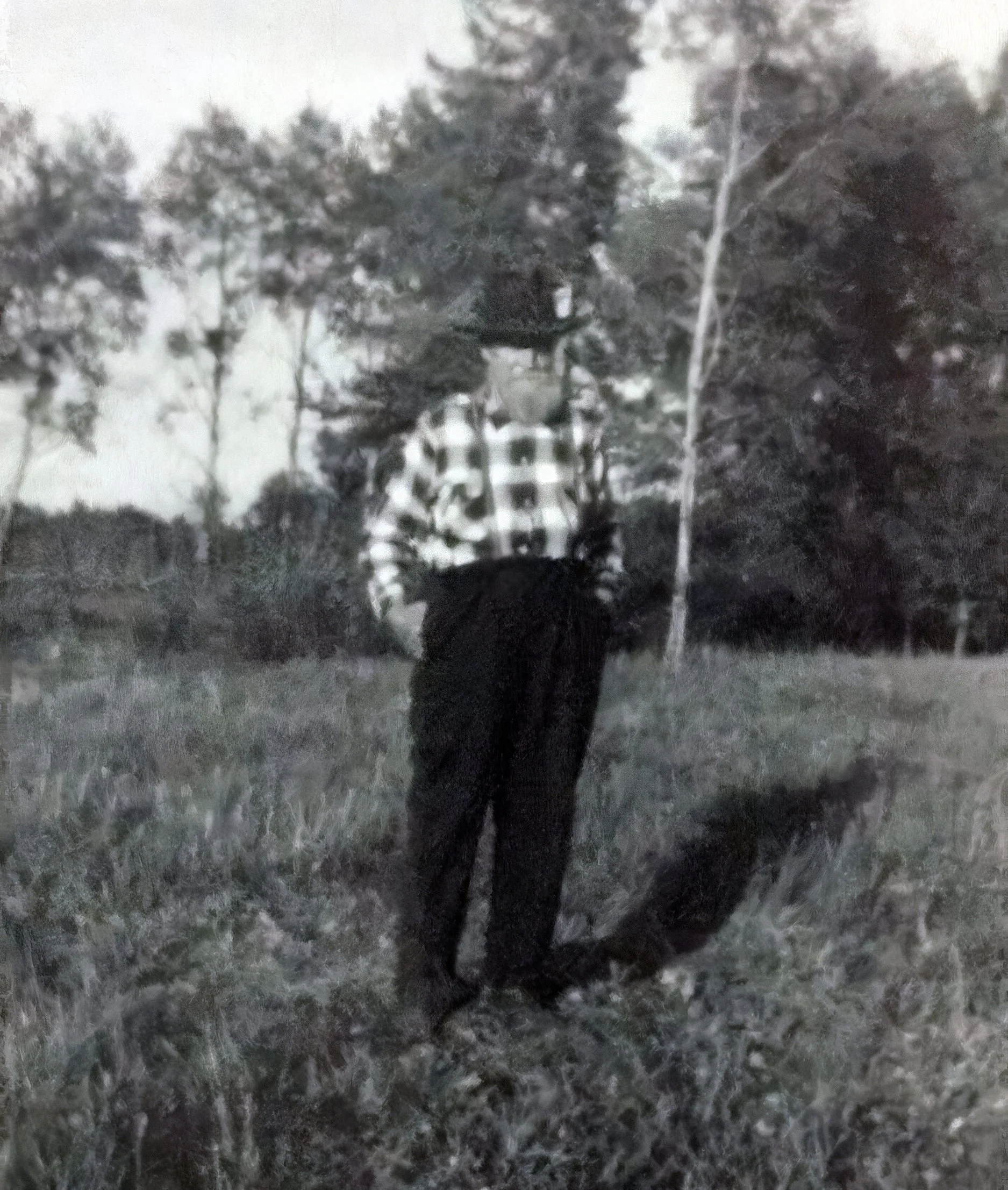
Grandpa
Grandpa was an early riser and around 5:00 a.m. every morning he was usually out of bed and heating water for porridge and cooking his first pot of coffee. When it was ready, he would call me, and we would eat our morning porridge together. Although he usually drank a couple of cups of coffee in the morning, my treat would be a one ounce shot glass of coffee, laden with a significant portion of cream and a dash of sugar. One morning I awakened even earlier than usual, complaining of a headache. Headaches were not a common phenomenon in our family, but, since it didn’t seem to be going away, my grandpa climbed out of the bunk, saying that he would be back to fix it in a few minutes. I laid in my place against the wall in the bunk, waiting for him to return with whatever it was that he had in mind. He rustled around in the kitchen area, and I wasn’t able to see what he was up to. So I was in complete shock when he returned a couple of minutes later, carrying in his hand the largest butcher-knife that I had ever seen. A multitude of thoughts rushed through my 5-year-old brain. Was the headache really all that serious? Wasn’t there a better way to deal with it? Was my grandpa really the kind and thoughtful man I thought he was? Hadn’t he considered other options for curing a simple headache? He instructed me to lay on my back in the bed and to remove my hands away from my upper body. I realized there was no point in putting up a fight. He seemed to have the same calm demeanour that I was accustomed to and, somehow, he didn’t seem to be as threatening as he had upon first entering the bedroom. He raised the knife to my forehead and, like the true man I was planning to become, I did not flinch. Much to my relief, he touched my flesh with the unsharpened flat side of the knife, and it glided softly across my brow. The most uncomfortable sensation was the numbing cold of the surface of the blade. He turned the knife to the opposite side and repeated his long gliding motion across my forehead. Then, a third time. I couldn’t believe what was happening – despite all the strain and worry, my headache seemed to be going away! After a couple more passes, he returned to the kitchen with the knife. I later learned that he had soaked the blade of the knife in the freezing cold water of the water pail before returning to the bed to administer his time-honoured treatment.
One other time, probably the following summer, Grandpa showed me one more of his skills related to sharp blades. Most people had their own chickens those days, and, along with his assortment of hens, he had a big, mean red rooster. I guess I seemed like fair game to the bird, because I was constantly at his mercy. On a couple of earlier occasions, he had jumped on my shoulders, dug his sharp spurs into my back and poked at the back of my head and neck with his beak. Since his attack was always from behind, I was defenceless. Besides, I was slight in stature, and he was probably almost half my size! However, one day his timing was not in its usual good form. My grandpa was cutting hay with a scythe not far from his cabin and I was walking past him on my way indoors. Big Red apparently didn’t see my grandpa over the long grass, and he ran toward me at full speed, ready to pounce on my shoulders for the umpteenth time. Unknown to the rooster, reaching to within ten feet or so from his impotent prey, he would also be within scythe’s reach of my grandfather. Seemingly unaffected, Grandpa continued nonchalantly cutting, until the rooster reached the optimal distance. Then, in a what seemed like a millisecond, the scythe appeared out of nowhere and Big Red’s head was lying bodiless on top of the freshly cut hay. Fried chicken was not a common treat on my grandfather’s menu, but that evening it seemed to be particularly tasty!
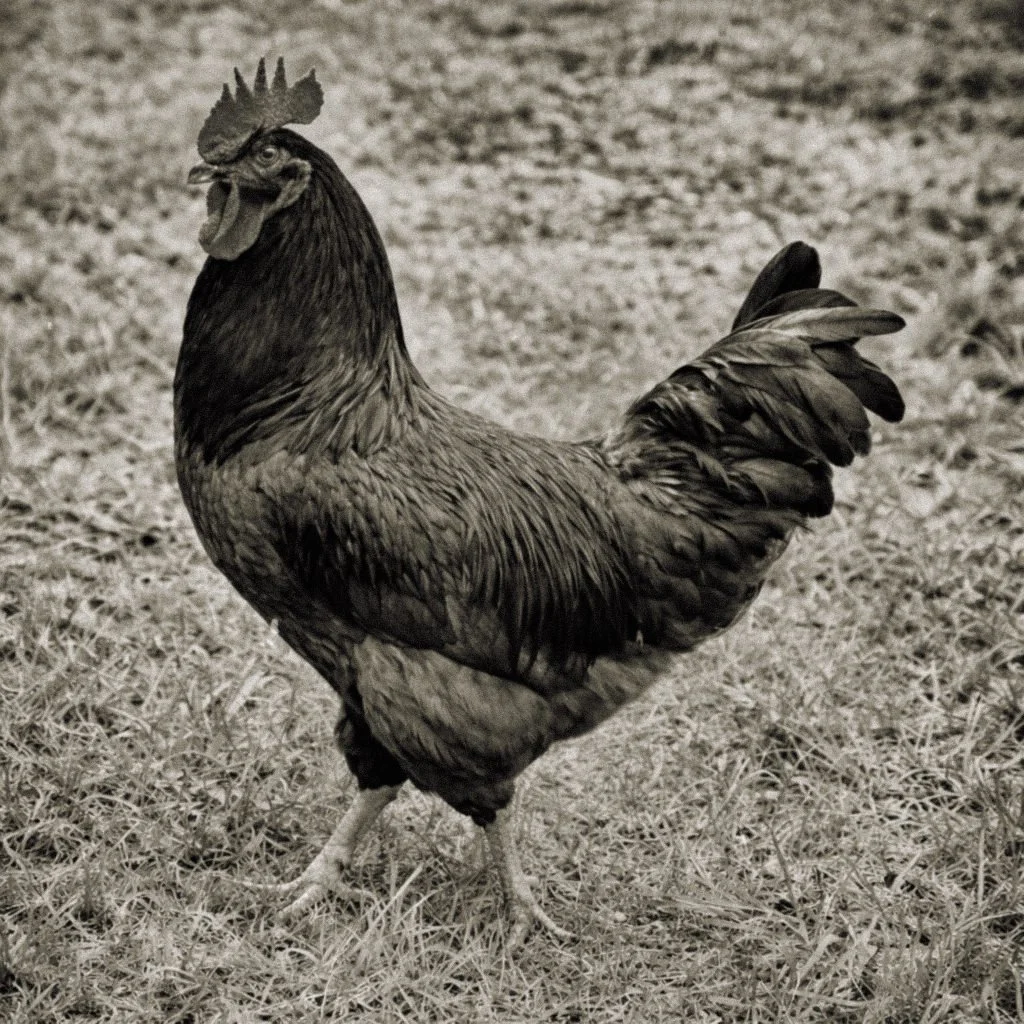
“Big Red”
The first oil was struck in the Pembina Oil Field in June of 1953, but it took a while before the real “boom” broke out. In the flood year of 1954, development was almost in full swing and new, unknown vehicles were everywhere, most of them stuck in the mud in the coulee separating the northwest corner of my grandfather’s quarter-section from the one across the road, owned by my uncle Lloyd and aunt Mary Cooper. It seemed like there was either a Cat or a team of horses on call there all summer long, pulling vehicles up both sides of the steep draw. I think Uncle Lloyd made quite a bit of unexpected cash with his tractor that summer and fall. Our neighbours and friends throughout the district were lending out or renting out every imaginable dwelling from barn lofts and stalls to empty skid-shacks and granaries. The nearby communities of Drayton Valley and Violet Grove were bursting at the seams.
Despite the influx of strange new people and activity with their associated disruption, the semi-annual caravan of indigenous Stoney People with their horses, wagons and multitude of dogs carried on making its regular trek past our little log house in the jack-pines, to and from the higher country in the west and the flatter region near Lake St.Anne. Sometimes there would be as many as 6 to 8 wagons, each with a team of horses and often a few spares. There were usually too many dogs to even consider counting. Although I can’t remember any of them ever stopping, they had a strong effect on me, and I really enjoyed watching them pass by. I always looked forward to their return trip, whether it be in the spring or fall. Altogether, it must have been at least a 2 – 3-day trip, but I don’t remember ever knowing where they camped en route to their destinations. My dad probably knew, but I was too shy to ask. I dreamed about what it would be like to travel with them, and I sometimes wonder if those mystical people and their seemingly carefree connection with the pulses of Mother Nature had played a role in my innate and incessant urge to search the unknown.
Chapter 3
From as early as I can remember, my dad was operating logging camps somewhere in the bush country every winter…
From as early as I can remember, my dad was operating logging camps somewhere in the bush country every winter. Some winters, my mom and I would remain on the farm, tending the livestock and other chores, but, when the operation was of a larger scale or if there was a crunch for time, Mom and I would join the men in the bush, typically occupied with trying to log out and saw into lumber the prescribed quota before break-up in the spring. My mom would take over the cooking responsibilities for the crew and I would be assigned to whatever light chores that could be expected of a youngster.
According to the adults who knew me, I was very slow at learning to speak. Rumour has it that I was well over two years old before I finally uttered my initial ‘’ da-da’’ and ‘’ma-ma’’. However, through an unexpected turn of events one winter, my vocabulary grew considerably. I had no problem in getting to know the men working in the camp – they were a kindly bunch, primarily bachelors who had no kids of their own, along with a mix of married men who probably missed their own children. Nevertheless, throughout the course of the winter, I befriended most of them. I can’t say for certain as to the nature of their motives (although I suspect it was all in the name of fun), but a few of them took it upon themselves to entertain me during lunch breaks or after the day’s work was finished. This often included a chat session somewhere out of sight behind one of the many piles of lumber that continued to grow over the course of the winter. Although my ability to speak improved significantly, the body of the course material was somewhat unorthodox and probably not in line with the educational standards of the day. To their credit, I think they did warn me that some of the language might not be acceptable in the public domain. Unfortunately, I was too young to fully comprehend the meaning of their advice. To me, it was great to finally be learning and pronouncing some new words, regardless of any underlying implications. As it turned out, those first lessons lingered a long time in my memory, causing a certain amount of consternation when I started Grade 1 in Drayton Valley.
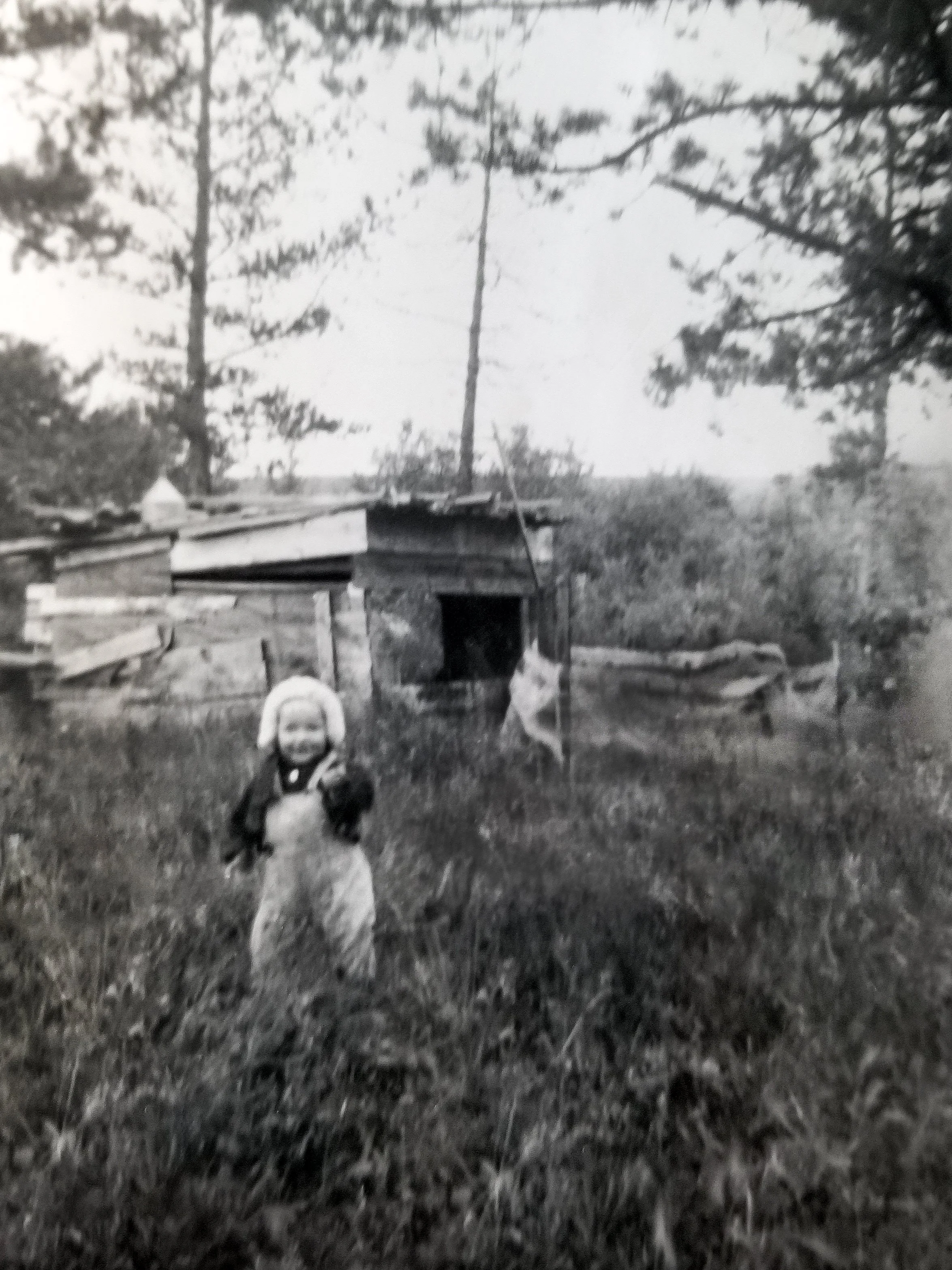
Early Days in the Jack-Pines
The typical routine was that, in the fall, my dad and one or two others would scout out and cruise one or more potential timber berths available for the upcoming winter. Dad would submit a bid to the Department of Forestry and, if accepted, the chosen area would become the location for his logging and sawmill activities through the winter until spring breakup. Most often, the selected berth would be located alongside a river or other watercourse, making roadbuilding and general access a lot easier. As soon as the ice started to set, they could start ‘’freezing in’’ the ice road, starting on foot, progressing to a team and sleigh or light tractor, until the ice was thick enough to carry bigger equipment and, eventually, large loads of lumber. The other advantage of setting up close to a watercourse was the obvious access to water. A hole was usually chopped in a convenient location in the river ice and kept open, from which water would be hauled, often by sleigh or sled, back to the camp cookhouse. Prior to the abandonment of horsepower in the camp, horses would be led to the same water hole two or three times per day, eliminating the need for the hauling of even more water to camp. As I grew older, one of my regular chores would be supplying the camp with water, but in my pre-school years, I was usually a ‘’flunky’’ for my mom, helping with dishwashing, setting the table for meals, supplying wood for the cookstove and other monotonous tasks around the camp kitchen. I learned a few tricks that, in today’s world, are certainly forgotten. One that was particularly useful was for the drying of kitchen cutlery, a seemingly endless endeavour if done in the traditional way. My mom made it easy – upon washing up the dishes after each meal, she simply spilled all the clean forks, knives, and spoons into a clean pillowcase, tied the open end and had me shake the case rigorously until the utensils were dry! In our mundane world, it was a great work-saver!
Everybody in camp worked hard and sometimes the efforts in the kitchen went unnoticed, but it was always a long day for my mother. Partly dependent on the length of the winter days, breakfast was never later than 7:00, so Mom was usually up and about by 5:00, getting prepared for breakfast and for the coffee breaks and meals that followed. As evening approached, it wasn’t uncommon for her to end the day, after finishing up from the supper meal, by helping my dad loading lumber trucks or attending to other undone outdoor chores. I remember many nights falling asleep late to the sound of the sparking slab-fire and the slap, slap, slap of planks hitting the deck of the next load of lumber.
The only chance Mom really had for a breather was in the mid afternoon before the 3:30 coffee break. So, around 2:00, upon cleaning up after the midday meal, she normally took a short nap on the bed in the back room of the cookhouse, during which time I was expected to find my own amusement. Whenever possible, I would don my winter clothes and walk down to the sawmill to watch the action. As I grew older, I eventually tried my hand at lumber-piling and logrolling, but, in the meantime, I usually had to be content with sitting at the small window in the cookhouse waiting for my mother to arise and resume her activities. One afternoon in particular stands out in my memory. My mom was taking her well-earned snooze and I was in my chair near the little window, casually surveying the frosty outside world or the fancy designs that old Jack Frost kept painting on the window panes. It was a cold and dreary day, and it was beginning to snow – one of those days that made one wonder if spring might never come. Staring out the window and sitting so quietly was making me groggy, too, and I was contemplating joining my mother on the bed. Then suddenly, from out of nowhere, a large grey form trotted past the window. I cocked my head aside far enough to see it disappear into the grove of spruce trees at the edge of the clearing. My mom was sleeping soundly, and I did not have the heart to wake her, even though I was bursting with excitement! It seemed like hours before she finally awoke, and, when she did, I couldn’t wait to tell her what I had seen. To my dismay, she said that she didn’t think it could be true. There was no way it could have been a wolf – none of the men had mentioned seeing wolves around this camp. It must have been a shadow, or maybe only a product of my own vivid invention. I knew my dad and the others would believe me, even if my mother didn’t. But, when I informed my dad, I got the same questioning response – he didn’t believe me either! When I brought up the subject at suppertime, a couple of the men thought that it could have been possible, but nobody would openly agree that it might be more than a figment of my imagination. To this day, it puzzles me that something as common as a timber-wolf would be so elusive in the minds of people who had spent most of their lives in the bush! Was it my fault that it had only been me who had seen it? The whole affair seemed bizarre, but there is one thing I know for sure – it was a wolf!
Johnny Jackknife was a popular fellow in the area. He was what everybody in those days called a half-breed, a mixture of Cree and Scottish blood. He was a kind and fun-loving man, slight in stature and quick on his feet. He was well-known as the best step-dancer around. Even at his advancing age, Johnny’s agility was remarkable. He was a conservative drinker, and I can’t remember ever seeing him drunk. He had his wits about him all the time, but whenever anybody pulled out a fiddle or other musical instrument, we knew it would be no time before he would break into one of his favourite steps. He really was a joy to watch, and I never missed a chance to study his movements. There was no shortage of parties in our little log house in the jack-pines, so the opportunities were plentiful. It was just a matter of time before I started trying to copy Johnny’s steps and, before long, he was coaching me and jigging alongside me. It was fun, not particularly difficult, and I loved the attention. Johnny seemed to enjoy my progress and kept egging me on.
My parents and my grandfather were impressed with my newfound talent. My grandpa got a kick out of showing me off in public whenever possible and didn’t miss an opportunity to either clear a space on somebody’s floor or to hoist me up onto a table to do my stuff. I obliged willingly, enjoying the limelight and maybe even more so, the collection of silver that usually accumulated with each performance. Restaurants and other public places were no exception – for my grandpa and me it was a case of “the more, the merrier”! With the advent of improved roads and vehicles, the geographic radius of my performance area grew along with it and I could be found dancing on tables in faraway places such as Entwistle, Seba Beach and Leduc – even as far away as Edmonton and Airdrie!
There were plenty of amateur musicians in the area, so, whenever a party was planned or when one sporadically broke out, there were always a few fiddlers, guitarists, and drummers who drummed on anything from washtubs to pie plates and kitchen cookware, and even the occasional accordionist or other less common instrumentalist. Pianos were expensive and rare, and generally unsuited for the irregularly heated buildings of the day. The few of them that could be found in some of the community halls were so badly out of tune that they were pretty much useless. Bass fiddles were also rare and too bulky to carry around, so the lower end of the musical spectrum was poorly represented. However, on the higher end of the scale, in addition to the fiddles and the occasional banjo, there seemed to be a significant number of mandolin players and there were several neighbours and friends who knew at least a few chords on the instrument.
My dad had an old mandolin that he had taken on trade from Danny McDonald for his Model A Ford a few years prior to my birth. The old car had become embedded in a creek crossing not far from Danny’s place and it wasn’t possible to get it out until the level of the water subsided. So, since Danny wasn’t really playing his mandolin anyway, and since he lived close to where the Model A was jammed, they struck up a deal – Danny took over ownership of the car, for future retrieval, and my dad took the mandolin. The mandolin hung on the wall of our log house and was available to anybody who wanted to play it. Gene Arthur was a relative newcomer to the district and had settled on what came to be known as “Gene Arthur’s Flat”, the flat on the North Saskatchewan River near where the present-day bridge now joins the river’s east and west sides. Gene was a regular attendee at the house parties in the jack-pines, and an enthusiastic mandolin player. He evidently noticed my interest in music and must have concluded that the instrument would be suitable for my small hands. In any event, Gene started to show me a few simple chords, so that I might be able to strum along with the other musicians. The thin strings were sharp on the fingers, and I was barely strong enough to push them down, but, after a few sessions, I was able to play along with some of the tunes. Many of the pieces were in the key of “G”, and that made the task simpler, as the chords in that key were more manageable than some others. It might not have been a great start, but it was more than enough to whet my appetite. It was the humble beginning of an unquenchable desire to make music.
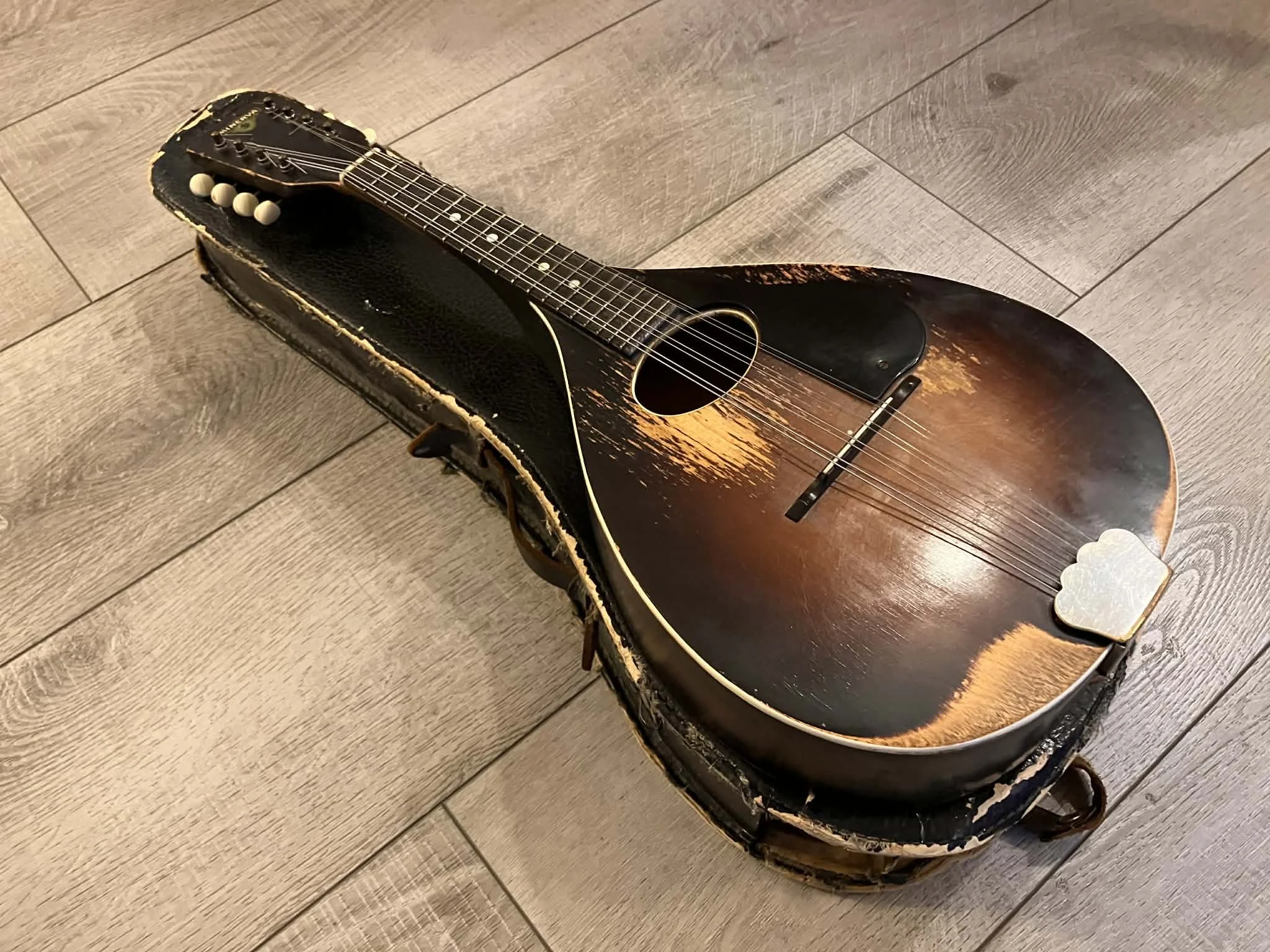
The Old Mandolin
Chapter 4
By 1956, the Pembina oil boom had evolved to an extraordinary level, and, when I started school that September, there were neither classrooms nor teachers to accommodate the enrolment…
By 1956, the Pembina oil boom had evolved to an extraordinary level, and, when I started school that September, there were neither classrooms nor teachers to accommodate the enrolment. Even with the added use of the nearby church parish and whatever other makeshift space that could be put into service, there was simply not enough room for the exploding student population. The problem was temporarily solved by dividing the roster into two separate groups, the members of which attended classes on alternate days of the week. Despite the innovation, class sizes were large and up to three grades were often taught at the same time. Later the same year, elementary students were moved into the first phase of a new, modern building at the opposite end of the school grounds and classes reconvened under less demanding conditions.
I started school in the old Eldorado School building that in 1933 had replaced the original burned-down building from 1915. It was the same classroom where my dad had attended in the 1930s, and his name can still be seen carved in the wall at the school’s present location on the grounds of the Drayton Valley Museum. The first days of school were not easy for me. The surroundings were unfamiliar, and the atmosphere seemed to be uncomfortably rigid. My first teacher was a young lady who lived with her father and his housekeeper just north of our place in the jack-pines and I had known her since I was a toddler. She had always been very nice to me and, only a few days before the start of school, she had picked me up and nurtured me tenderly after a nasty fall on my solar plexus that had knocked the wind out of me. Everybody liked her and she was known to all as Betty, so it was quite a shock to me, when, upon entering the school building, I was sternly directed to refer to her as Miss Whyte. Why would I suddenly be forced to constrain my good relationship with a dear friend by addressing her in such an impersonal way? It made absolutely no sense, and, very often, I slipped back into using the familiar name that I was accustomed to.
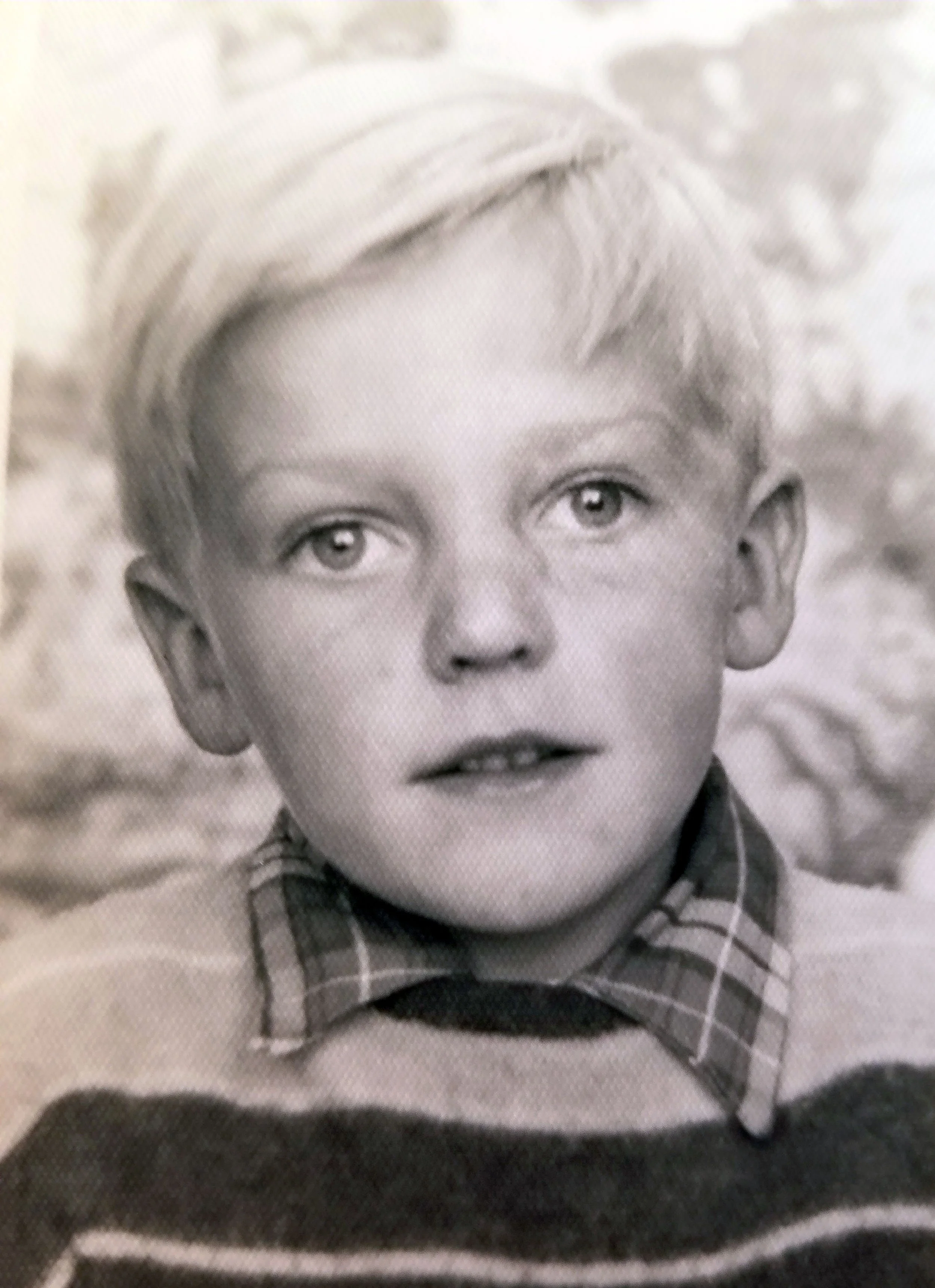
Grade 1
The problem with my teacher’s name was the first of a string of unfortunate complications. Within a few days, I started to get to know some of the other kids and we began to spend more time together. It was unavoidable that our new familiarity would stimulate discussions that concerned our lives outside the classroom. One day, the conversation turned to the upcoming Christmas season and the expected annual visit from Santa Claus. I was a bit surprised that so many people as old as six or seven still believed in that old story and I wasted little time straightening out the facts. My dad had illustrated how difficult it would be for a man of that size to climb down a skinny little chimney, and, if he ever did, how he would be devoured by the flames of the fire below. After all, amid the coldest part of the winter, wouldn’t almost everybody have a fire going? It didn’t strike a pleasant note among the other students and some of them even started to cry. To top it off, not more than a day or two later I felt obliged to share the true facts concerning the origins of newborn babies. That was also poorly received. It was beginning to seem like many of my ideas did not fit in well in academic circles.
Almost everybody we knew was a hunter. It was a simple fact of life – if you wanted to eat, you had to hunt. My father and most of his friends were good hunters and there was never a shortage of meat. In addition, beaver and coyote pelts provided some added income, and even muskrats and squirrels were worth hunting and trapping. As was the case with most young boys, I was eager to join the fold and I pestered my father until he agreed to let me get started. My grandfather had an excellent and compact Remington pump-action .22 calibre rifle with a peep sight that was known for its accuracy and ease of handling. Dad diligently taught me how to handle the gun and lectured me firmly on the dangers of recklessness. I was taught how to take the gun apart and how to clean it, and I was expected to perform that task after every usage, however short the duration. The most important lesson was to never, EVER, point the barrel in the direction of anything I didn’t intend to shoot. As an extra measure of caution, I was only permitted to load one cartridge at a time into the barrel, although the gun had a magazine that would accept a number of them at once. The stock was too long for my short arms, so I learned to shoot with the butt projecting over my left shoulder. As with many other manual endeavours, my left-handedness made the lessons even more complicated. Nevertheless, I shot my first muskrat, right through the eye, while it was swimming in the creek on Brownbill Flats, when I was seven years old. Turning in the cured hide at the Hudson’s Bay, I felt like I had won the lottery!
A year or so later, I was presented with my own Cooey single-shot bolt-action .22 calibre gun with an open sight that had been damaged and repaired. As a result of the work done to the sight, the gun shot consistently high and to the right, but, at the age of eight, I was becoming a seasoned veteran and it didn’t take many practice rounds before I had made the necessary adjustment to my aim. The newer rifle was void of a magazine of any kind, so that the singular option was to load only one cartridge at a time. In addition, the bolt action mechanism was much more quickly and easily removed for cleaning. So, the gun was safer and easier to maintain. My friend, Dale, had a similar gun, but a bit shorter than mine. Although two years my junior, he was a bigger boy than me and could already fit the butt of the stock against his shoulder, while I was still using my ‘stock-over- shoulder’ method. Nevertheless, we were soon allowed to go hunting together. By then, my family had moved from the old Hendricks place to our new home on the farm closer to town where my grandfather had originally homesteaded, so Dale’s family and mine became neighbours. Rabbits were rampant in the area in those years. They were everywhere, eating crops and anything else that might sustain their huge numbers. It was not at all uncommon to awaken to stacks of grain sheaves covered to the point of invisibility by ravenous rabbits. The farmers were irate and open bounty was declared. For young fellows like Dale and me, it was a perfect opportunity to get practised up on our hunting skills. Twenty-two calibre cartridges were sold in boxes of fifty, and we made it our mutual goal to make sure we had a rabbit to show for every cartridge. Sometimes we even hit two rabbits with one shot!
But before long, this kind of hunting proved to be too mundane, and we became bored with the whole idea. Besides, it wasn’t always easy to come up with the money for another box of shells. Maybe we could whittle a couple of longbows from poplar saplings, equipped with a drawstring of binder twine, for hunting rabbits. Arrow-making shouldn’t be a big challenge, since there were always plenty of light, dry spruce trimmings left over from the sawmill or planer. We simply drove a 4’’ nail into the end of a lathe of appropriate length and whittled it to the right thickness, and then sharpened the nail head to an acceptable point. Obviously, it was a shorter-range weapon and less powerful than the .22, but there were usually plenty of rabbits within close proximity. We practised until our shots were at least somewhat accurate, and, after a couple of days, decided that we were ready for our first bow hunt. We were pathetic! Most often, by the time we had strung our crude arrows, the potential game had scuttled away under some nearby bush. Sometimes our makeshift drawstrings succumbed to the pressure of the drawn arrow, and sometimes the poplar bows either lost their resilience and bent backwards or, if a bit too dry, simply snapped in two!
It was beginning to seem like a failed experiment, somewhat of a shock after the huge success we had had with the rifles. Before totally losing heart, I constructed one more improved set of bows and arrows and decided to give the conquest one more try before our planned hunt in a couple of days. I walked into the poplar and willow grove south of the barnyard with my newly constructed gear and took a couple of failed shots that weren’t even close to hitting their marks. But then I spotted another smaller rabbit within close range crouching behind a willow bush. I quietly and carefully nocked an arrow and pulled back on the new piece of twine, aimed a considerable distance above the animal’s body, and let the arrow fly.
Nobody had told me that a rabbit cries like a human baby when it is injured or in distress. With the rifles, Dale and I had never wounded a rabbit – we had either missed entirely or killed the animal outright. Once it was dead, it became a lifeless piece of carrion and of little consequence. My crude arrow point had been adequate to rupture the young rabbit’s stomach wall seriously enough to paralyze it, except for its ability to utter its loud and mournful cry. I was beside myself with remorse, and I impulsively threw down my bow with all its trappings, but the young rabbit’s cries only became louder and more mournful. I wanted to run away, but, as my mind cleared, I knew I couldn’t. I knew I had to put the dying animal out of its misery. I found the broken trunk of a small dry willow tree, freed it from the underbrush, and carried it to within a arm’s reach of the injured rabbit. With a couple or three heavy strikes with the butt end of the trunk, the animal’s life was ended. I laid down the club, left my bow and arrows, and walked slowly away to another secluded area of the woodlot. I would never forget that day nor the sound of the dying rabbit’s cry.
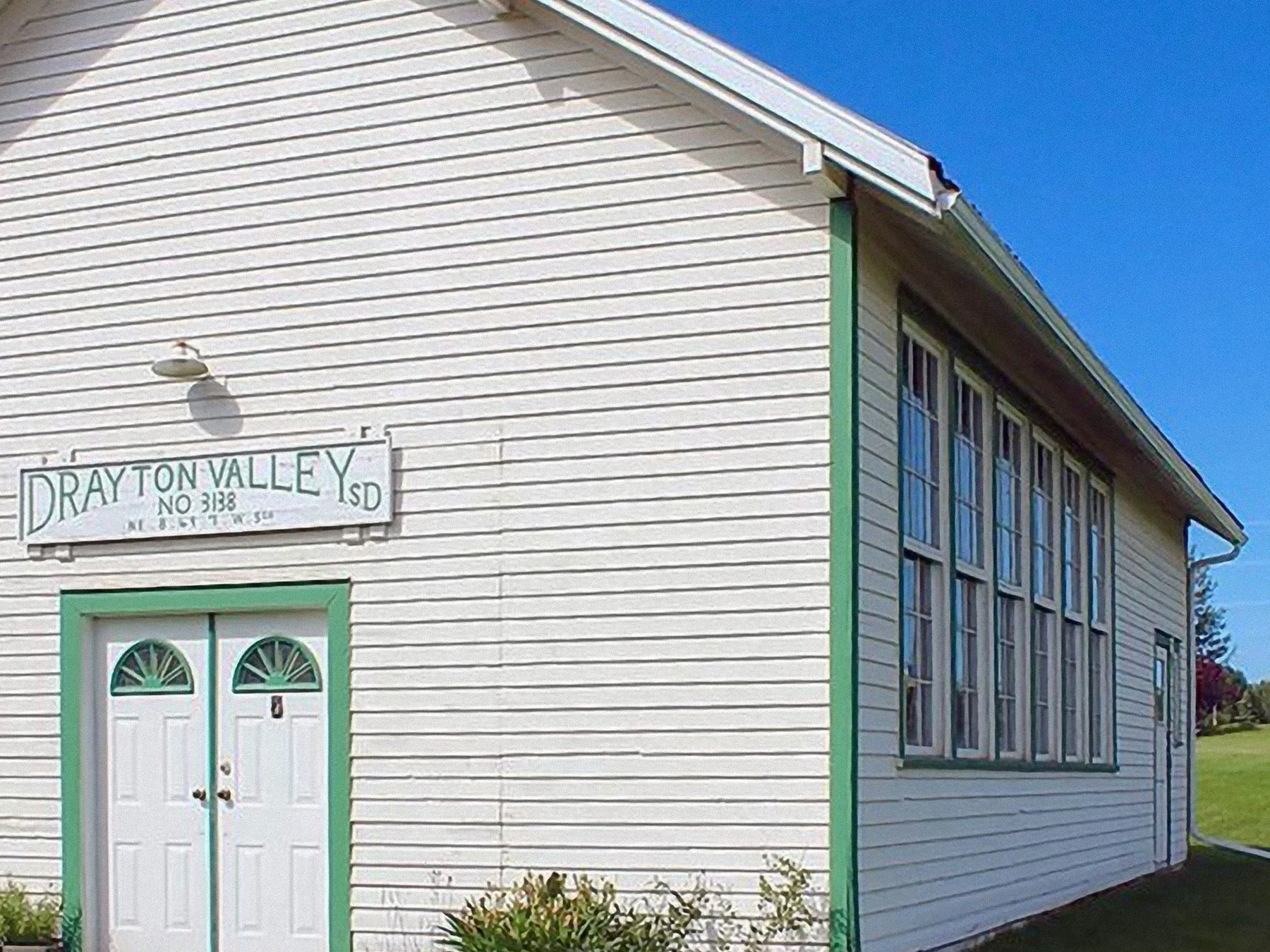
1933 Eldorado School
When I started Grade 2, we were moved from the shiny new elementary school wing and back to more rustic surroundings. The school board had been compelled to acquire several temporary classrooms to try to keep pace with the continued onslaught of new students. In reality, the buildings were nothing more than skid shacks with an entry, a cloakroom and a classroom. There was no running water and a large pot-bellied wood burner near the back of the classroom heated the entire building. Toilet facilities were ‘out back’, except for the occasional frantic run to one of the indoor toilets in the new main building. By comparison, the electric lighting was a definite luxury. My new teacher was a lovely older lady who could undoubtedly be considered ‘old school’ in the purest sense. Even her wardrobe depicted to a tee an era rapidly being replaced by a more modern, fast-paced society. Her dresses reached below mid-calf over her tall frame and were laced or buttoned at the neck and always adorned with various floral patterns and often augmented by a flashy brooch. She wore the old-fashioned dark-brown stockings that had been the go-to style only a few decades earlier, accompanied by the square-cut, heeled black shoes with laces that many of the grandmothers wore on Sundays. I never, ever saw her without her hair done up in a neat bun, usually supported by a couple of large hair clips. To many, she may have seemed boringly out-of-date but, to me, she was one very classy lady. Mrs. Forbes took a liking to me and, before long, she became acquainted with my inherent need for artistic expression. Ever since the early days of ‘’Fun with Dick and Jane’’ in Grade 1, I had thrived on written language and was always eager to try using it in one way or another. About midwinter, I started writing plays, mostly just to satisfy my own curiosity. Mrs. Forbes encouraged me to continue, and I started writing out the various parts on individual slips of paper. One day, somebody suggested that we try to perform one of them in a live setting and I broached the idea to our teacher. She never gave the idea a moment’s hesitation and the following Friday my first play was presented to the class, with each participant reading his or her script from the flimsy strips of paper. The performance was apparently a success and Mrs. Forbes asked if I would be interested in presenting a new play every Friday afternoon. My playwriting career began to blossom.
Unfortunately for Mrs. Forbes, things started getting somewhat out of hand in some of the sequences, possibly a result of the predominantly Western themes. There was a three-quarter length wall separating the classroom from the cloakroom, and some of the cowboys started using their acrobatic skills to scale and straddle the top of wall, firing invisible guns at their assailants down below. Regrettably, I have lost contact with most of my second-grade classmates, so I am not sure how many of them went on to pursue careers as bank robbers or movie stuntmen.
Part of the aftermath from the construction of the new elementary school wing, which was to be the first phase of an entirely new school, were a number of brush piles which hadn’t yet been cleared up, along with a sizeable slough that had been created as a result of the related earthmoving. Although apparently taboo and even dangerous, the brush piles made a great playground for many of us at recess time and during the daily lunch hour. We dug tunnels and made a collection of forts among the piles of dirt and discarded tree trunks. On another dirt-pile devoid of foliage not far from the slough, we played games of ‘’king of the castle,’’ but as the spring thaw approached, the melting snow on the slough presented new challenges. Most of us were familiar with the potential dangers of ‘’rotten’’ spring ice, so we kept our distance, although we had run and played football on the frozen pond all winter long. So, we limited our ball-playing to the area of partly melted snow between the brush piles and the slough.
All went well until, one afternoon recess, somebody with an extra strong throwing arm accidentally pitched a football into the open water near the shore. Not wanting to interrupt our game, especially in the short time we had until the class bell rang, I made a run after the ball, thinking that I might reach it from the water’s edge. However, as I approached it, I realized that the ball was beyond my reach, but only a couple of yards into the water. Earlier in the season, we had learned that the water was quite shallow near the edges, so I opted to take a couple of steps off the shore. The typical footwear for the spring season was high-top rubber boots, and mine were practically brand new and I had not yet folded down the tops as was the common trend. I felt safe in taking the couple of extra steps necessary to reach the ball, although the tops of my boots were within a couple of inches of being totally submersed. I made a hopeful lunge toward the ball, but suddenly lost my footing. The bottoms of my boots slid from under me, and I tumbled headlong into the slough. Before I knew it, my entire body was covered in the ice-cold water! Luckily, the depth of the pond near the shore was barely two feet, so I was able to regain my footing quickly and without difficulty. However, the temperature was barely above freezing, and my clothes were soaked through all their layers, and I knew I had to get out of them fast!
I made a mad dash for my classroom, which was only about 150 yards away. I rushed through the door to find Mrs. Forbes sitting alone at her desk, preparing material for the last couple of lessons of the day, and, no doubt, enjoying a bit of peace and quiet while her students were outside. She recognized my predicament and ushered me immediately into the cloakroom. There she stripped me down to my underwear, wrapped me into her heavy Borg-pile robe (another valued remnant from days gone by) and sat me in a tall chair in front of the pot-bellied heater at the rear of the classroom to thaw out and dry. My teeth had barely stopped chattering by the time the rest of my classmates began to return from the afternoon break. Some who had been nearby and had seen me fall into the slough were not particularly surprised to see me on my perch beside the heater, but a few others could not refrain from pointing and snickering at my unusual attire. The teasing didn’t bother me – I knew how lucky I was to be wrapped in Mrs. Forbes’ warm winter robe, underwear and all!
Chapter 5
By 1956, the Pembina oil boom had evolved to an extraordinary level, and, when I started school that September, there were neither classrooms nor teachers to accommodate the enrolment…
For the third grade, we were, once again, moved into the new building, and my classroom was just down the hallway from the Grade 1 area where I had spent the last part of my first school year. My teacher, Mrs. Mayhew, the wife of a prominent local businessman, and later mayor, of the bustling new oil town, was an up-to-date younger woman with a stricter demeanour than Mrs. Forbes. This younger woman was less artistically inclined and didn’t spend a lot of time catering to miscellaneous theatrical whims, so my blossoming career as a playwright was put on hold. It was a year in which higher level mathematical understanding such as multiplication and division were honed to near perfection, but where above-average English grammar and spelling were also high on the list of expectations. I liked language and was an excellent speller and often won the impromptu spelling bees that Mrs. Mayhew conducted. She was also an avid sports fan and very supportive of all endeavours in that realm, especially in track-meet season. Whether it was the 100-yard dash, the high-jump or broad-jump pits or a ball tournament, she was there to coach, encourage and keep diligent records of the results.
I have always been below average in height among my peers, and, at least during my childhood, I was slight in stature. When class photos were taken, I was usually among those who kneeled in the front row. I guess that might explain why I occasionally got overlooked altogether! At our new place closer to town, the school bus approached every morning from the south, so the drop-off every afternoon was from the north. Since our driveway was east of the highway, that meant having to exit the bus, walk around the front, quickly check for oncoming traffic (even though the bus’s flashing stop lights were activated) and then walk across the highway to the long driveway leading to our house. Such was the standard routine on one particularly warm fall afternoon. The driver turned on the warning signals, stopped, opened the folding door and I exited and started walking around the right-hand front fender to the front of the bus. Here is where the routine was abruptly broken, and, when I was about midway across its width, the bus began moving forward. It would have been impossible for the driver to see a short-legged 8-year-old that close in front of the bus. With both hands I clung to the bumper, desperately trying to figure out what to do. I was sure that, if I let go, I could probably clear the undercarriage of the bus, and, if lucky in my central position, could manage to let the bus pass over me without being run over by its dual wheels. The biggest problem was the potential of being hit by an unseen oncoming vehicle behind the bus. I knew it was only a matter of seconds before I would no longer be able to sustain my grip, so I allowed myself to be pushed toward the left fender. I knew that the only real chance of saving myself was to try to push myself around the driver’s side fender and out of the way of the bus. By now, the driver had picked up speed considerably, and it would be a risky move. With all the strength I could muster (and maybe even a bit more) I gave the left fender a vigorous shove, enough to create some space between my body and the bus. I rolled my body toward the open highway, hitting my shoulder hard against the outside of the fender on the way by. Somehow, I managed to maintain my footing. The bus passed by without making contact again, just in time for an oncoming vehicle coming from behind the bus to swerve and miss me. I ran like a shot across the road and into the driveway, never looking back until I reached the steps of the house.
I will never know what that bus driver was thinking, or why the driver of the oncoming car never tried to contact us. Maybe the adrenaline burst which had freed me from the assault of the bus had propelled me at such a speed in my run home, that he never saw where I had disappeared. In the case of the bus driver, I think his indifference was simply a case of absent-mindedness. A number of students had mentioned that he seemed to be forgetful at times, and he may even have forgotten where he was on his route. When I informed my parents about what had happened, my dad was adamant that he should confront the driver and the school the following day, but I managed to talk him out of it. I didn’t want to cause trouble for the old driver, and I was sure that the situation would be cleared up the following morning. So I was somewhat surprised as I climbed the entry steps, hesitated, and walked slowly past the old fellow the next day. He didn’t utter a word, but simply waited for me to take my seat and drove onward, apparently unaware that anything out of the ordinary had ever happened.
I do not come from a scholastic background. In fact, I don’t recall anybody in my immediate or extended family ever having acquired a high school diploma. My dad, like many of his schoolmates, had left school at the end of Grade 8 since he would have had to leave the community to pursue a higher education. Besides, he was anxious to get to work in one of the many logging camps in the area. My mom came from a poor and rather large family and left home at the age of fourteen and with only a Grade 5 education, to work for a bigger farmer in the district. My grandfather and patriarch of the family never hesitated to share his views on what he called “educated fools”, and how most of them wouldn’t last a day in the bush by themselves. So, I think it was a bit of a shock to all of them as I continued to excel in my schoolwork. It was easy for me; I was like a human sponge, soaking in all the knowledge I encountered and searching for more to learn. I had a good memory and it seemed like I was able to retain what I had learned with little effort. Homework was no issue for me, as I always completed it before the bell rang at the end of the day. Even my tough old grandpa was proud of my scholastic accomplishments.
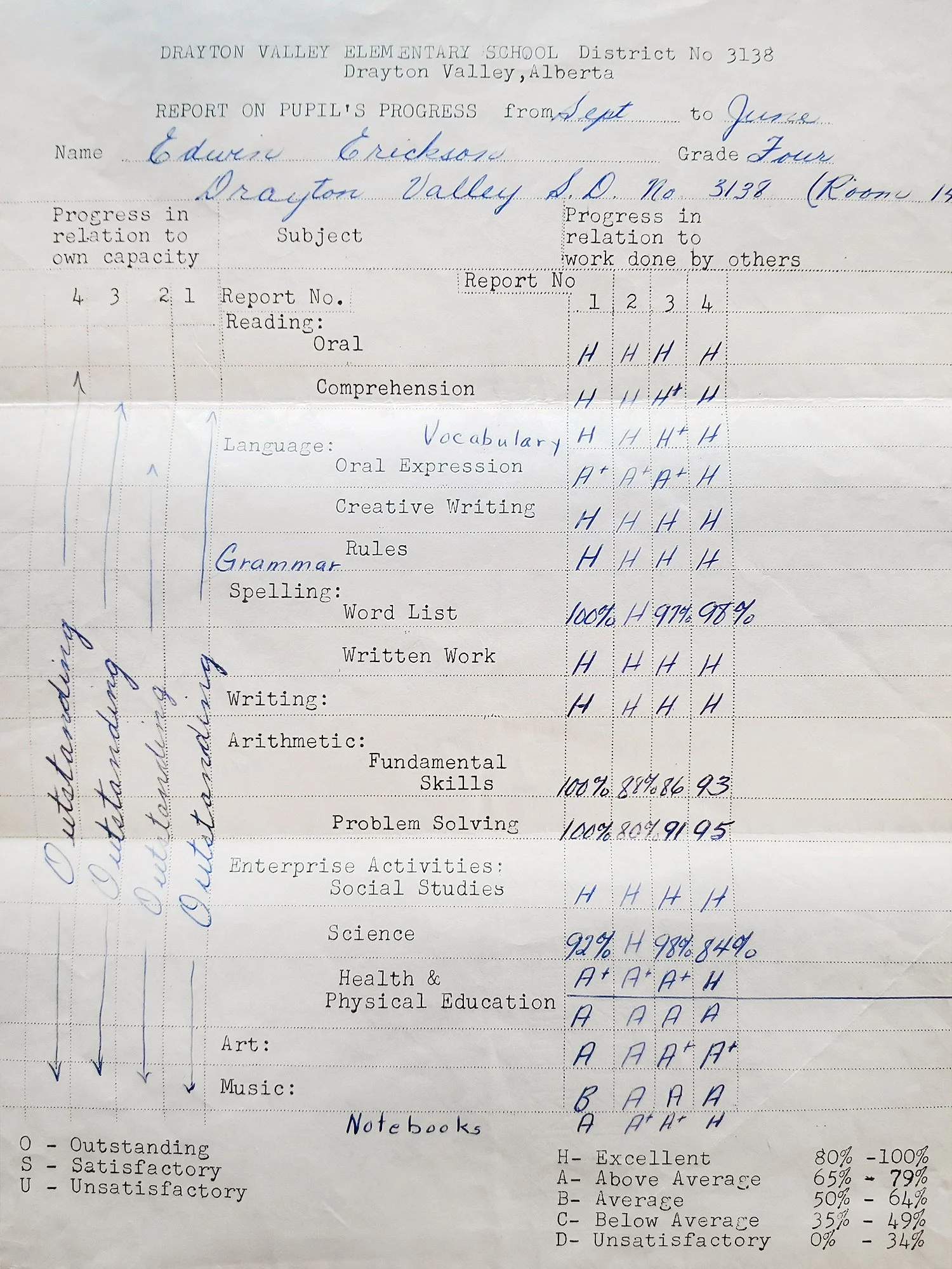
51 Hs
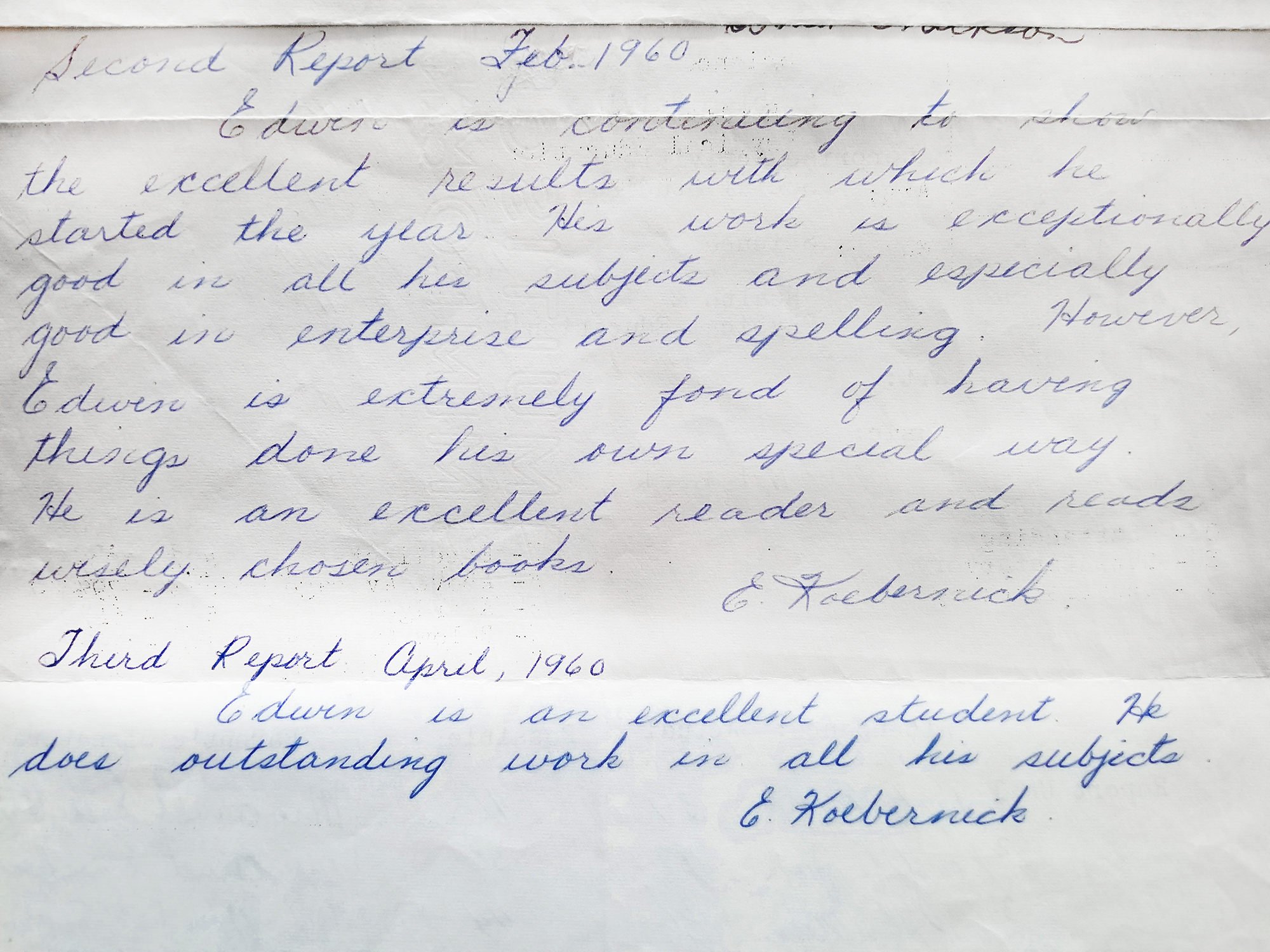
In those days, we were issued four report cards, more or less equally spaced, over the course of the school season. The highest evaluation possible was an H (honour) rating, followed by A, B, C and D ratings. The typical report card provided for these ratings to be attached to each subject in each of the four reporting periods. Grade 4 was undoubtedly the high point of my academic achievement, and at the end of the season I had accumulated a total of fifty-one H ratings throughout the year. The report grid was pretty much inundated by H’s, with only a scattering of A’s and one bashful B peeking precariously through the spaces. I always had a low mark in music – I couldn’t sing three notes in a row, I didn’t care about most of the silly lyrics, and I wasn’t very good at following the teacher/conductor. It seemed to be a waste of time and I preferred to work on my own.
At school, I really liked to talk. Maybe it was because I was often finished with my work ahead of time, or maybe it was just because I loved to entertain and, compared to my existence as an only child at home, the classroom provided a captive audience. As a result, my teachers were usually moving me from place to place in the room to try to alleviate the disruption. Those days, the yardstick was a common weapon for maintaining law and order for many of the teachers. One fateful day, my Grade 4 teacher, Mrs. Koebernick, had had enough of my ongoing antics and came after me with the yardstick. She walked sternly and briskly toward my desk, waving the stick. As she came nearer, I stepped up onto the seat of my desk. I had sharpened the point of my new 2H lead pencil only a few minutes earlier and held it ready along my left side. She came even closer, and I lifted the pencil to the height of my left ear and announced, “Come one step closer and I’m going to let you have it!” She was having nothing to do with my presumably empty threat and continued her approach. I had had plenty of practice hunting muskrats and rabbits and my aim was true. I let the pencil go twirling through the air toward her, finding its mark in the middle of her chest, just above and between her breasts. The sharp lead point was stuck firmly in her flesh, and she ceased her approach. I have often wondered why she didn’t report me to any higher authority, and, even more surprisingly, that we later enjoyed a trusting friendship that survived for many decades.

LETHAL WEAPON