Chapter 2
My parents must have figured out relatively early that I was going to need more interesting and demanding stimulation to keep me occupied, so as not to eventually come up with the ultimate successful escape. Like most kids, I was keen to try my hand at driving. My grandpa sometimes let me hold on to the lines with him as he drove his team of horses to the barn for the night, and my dad and other relatives would sometimes let me sit on their knees and try to manipulate the steering wheel of their vehicles as they drove. My dad had bought a brand-new D2 caterpillar crawler a few years earlier, mostly for use in the logging camps. As fate would have it, Drayton Valley and district were about to be bombarded by the discovery of oil and gas in the area. Eventually, the little Cat, with my dad at the controls, ended up doing most of the backfill and landscaping work for the initial development of the soon-to-be new town.
While still in my fifth year, at the beginning of what might have been a conspiracy to keep my mind off the next attempt at running away to create a life of my own, my dad decided to give me a shot at driving the little D2. For me, it seemed like the perfect combination as, in relation to the bigger crawlers and related forestry and oilfield equipment and to the adult operators involved, the little Cat and I seemed to have a lot in common. My dad’s cousin, Ralph Wikander, had a Volkswagen Beetle, and I was allowed to sit on the edge of the driver’s seat almost every time he came for a visit, to check to see if my feet would yet reach to the clutch and brake pedals, but, when they finally did, I couldn’t see over the dashboard. The Cat had the definite advantage of being considerably higher off the ground, had a seat somewhat closer to the steering clutches (which I didn’t really have to reach at all), and was devoid of a windshield of any kind! Thus, I was able to look between the two steering levers, out over the hood, the A-frame and blade to the trail ahead. We started at the south end of the large hayfield that adjoined the infamous wheat field of the recent past. The hayfield was part of the adjoining quarter-section where my grandfather lived, and led almost all the way to his cabin, a distance of about a quarter mile. My dad installed me in the seat, and gave me steering directions, if needed. His most forceful instruction was in the use of the hand-clutch, located to the far left of the other controls. If anything at all dangerous or out-of-the-ordinary ensued, I was to immediately push that lever forward, and the machine would come to a stop. He then placed the little Cat in the lowest possible gear and instructed me to pull back on the clutch lever when I was ready to depart.
There is a reason that these machines were, and still are, referred to as crawlers. The low gear that Dad had chosen for my initial journey was so slow that one could have crawled along the ground and still managed to keep up, or possibly even pass the little D2. As it was, he and my mother walked along leisurely behind, behind my line of sight as I gazed intently at the trail ahead.
The trip was uneventful – even bordering on boring as I reached my destination at the opposite end of the field. The little crawler was well-balanced and maintained, so that any attempt to steer it would only have taken it off the path prescribed before takeoff. A couple of times, I pulled gently on one of the steering levers, but noticed no significant change in direction. Maybe I wasn’t pulling hard enough, but I didn’t dare apply more pressure, for fear of getting off the track and possibly compromising any future driving opportunities. Upon arrival I pushed the hand-clutch lever forward, exactly at the predetermined location. I sat quietly, evaluating my performance, before I looked around and noticed my parents approaching the machine. They both had grins on their faces, so I could only assume that my talents as a cat-skinner had been acceptable. With their help and with a larger, more triumphant smile on my own face, I jumped from the seat onto one of the cat-tracks, onto the A-frame and down onto the hayfield. My dad took the operator’s seat, threw the machine into a much higher gear, raced across the end of the field, and made a couple of sharp turns before parking the little Cat under a large spruce tree. Together we walked to my grandpa’s cabin. It had been a good day and running away anywhere was far from my mind.
About that same time, I made my first attempt at riding a bicycle. Most of the other kids my age had started to ride so one day my Dad came home from Edmonton with a brand new two wheeler for me. Being the first in my generation on my father’s side of the family and only the second among my maternal grandmother’s grandchildren, I guess I was lucky, as hand-me-downs were somewhat scarce. In any event, I became the proud owner of a 20” bicycle of the latest vintage. Many of my friends around the district had one or more training wheels attached to the back wheel of their bikes, but mine was devoid of those. First of all, the yard around our log house and outbuildings was not very level and my parents thought that training wheels would be useless. But, maybe even more importantly, in our discussions, I had made it quite clear that I wouldn’t be having any “baby wheels” on my bicycle! I had watched my Dad’s younger cousins riding, and they had done just fine without them.
Although smaller than many, my new bike was still too big for me. With my short legs, I had no chance of reaching the ground, even with the seat adjusted to its lowest position. So, if and when I lost my balance, the outcome was not likely to be optimal. But, as usual, my Dad came up with a reasonable training program. I would get mounted in a suitable position on the seat, with my feet on the pedals and my hands on the handlebars and my Dad would run along behind me holding onto the carrier mounted over the back wheel. Whenever he thought that I was doing quite well and maintaining my balance, he would let go of the carrier and let me ride on my own. Invariably I would eventually fall down, except for the times when he was able to catch up with me and grab onto the bike before I tumbled over. It was a bit scary, but I persevered, realizing that it wouldn’t be practical to have my dad running along behind me forever. With each attempt I became a bit more proficient and confident, and the periods of independence became increasingly lengthy. I was eventually able to ride a circle or two around the perimeter of the yard alone without falling. I also learned that it was possible to jump partway off the bike when I felt my balance start to wane, thus breaking my fall somewhat before hitting the ground.
But I wasn’t yet totally confident and I still needed my dad’s help to balance me as I was getting started with the pedalling. Throwing my leg over the frame of the bicycle was an ongoing struggle, although sometimes, if there was a downhill start, it went a lot easier. One particular day I was in a more courageous frame of mind and decided to try a run entirely on my own. I had noticed that there was a significant slope from about the middle of the yard going toward the eastern boundary of the property where the sodden driveway crossed the creek over a small wooden culvert. Mounting the bike at the top of the slope allowed me to gain enough momentum, throw my leg over the frame and get properly positioned before the bike either tumbled sideways or gained too much speed. At this point, I still hadn’t had much reason to use the brakes, as I had mostly been concerned with keeping the bike moving and in an upright position. However, this time everything seemed to be working better than usual and I started to pick up speed quite nicely as I proudly headed down the slope toward the culvert. I decided that I was going to cross the creek over the culvert and turn left on the dirt trail leading to the north end of the property. I was still gaining speed, but I realized that I would need some extra propulsion in order to make it up a slight rise on the opposite side of the creek. Considering my very limited experience in stopping or even slowing down, and not wanting to lose momentum before entering the upcoming turn on the other side of the creek, I didn’t apply the brakes at all. Besides, I was completely confident that I was fully in control of the situation.
But then I made a serious mistake. I was doing so well that I decided to look over my shoulder to check my progress. In doing so, I unknowingly pulled the handlebars to the left side and the bike drifted over to the side of the path. By the time I turned my head and regained my pedalling position, I was on an uncorrectable side trip over some deep ruts on the left side of the path and still gaining speed. By now, I had entirely forgotten about the availability of brakes at all and was hanging on, trying to maintain my balance. As I approached the crossing, the front wheel skipped over the deepest of the ruts and pulled the bicycle still further to the left and over the end of the wooden culvert. As I remember, the bike remained jammed up against the edge of the culvert and I was thrown over the end and into the creek beside a willow thicket growing out of the bank. After dragging myself out of the water, I found, surprisingly enough, that my bike had hardly been damaged at all, except for a badly bent chain guard and a bit of misalignment of the handlebars. I had some minor scratches from the willow thicket and a heavily soaked set of clothing from the waist down!
During the fourteen and a half years between my birth and my grandfather’s passing, we spent a lot of time together. Aside from various outings and his frequent visits with my family, I soon began staying overnight with him in his cabin. The cabin was a small one, with two tiny bedrooms and a larger combined kitchen and living area. One of the bedrooms was reserved for my Uncle Freddie, who occasionally came home to the cabin when he wasn’t away working in a logging camp somewhere. So, I slept with my grandpa in his bunk. He always tucked me in and seemed to have a special way to fix up my side of the bed so that it was warm and cozy, regardless of the conditions. The cabin was heated by a small coal-fired stove that needed to be tended often. He did his cooking on a propane stovetop, although there was electricity for lighting and for one of the district’s first television sets. The toilet facilities were ‘out back’ and my grandpa carried all the water for the household from a spring at the bottom of a long and steep creek-bank several hundred yards from his cabin. He had built himself a wooden neck-yoke to transport the water up to the cabin, two pails at a time, on his shoulders. He had also cut steps into the steepest part of the hill and lined them with flat rocks, so as to create a better footing and to decrease erosion of the bank. About halfway up the climb, there was a mid-sized spruce tree growing with a curved trunk, perfect as a resting place after the hardest part of the climb. There was no question about water conservation at my grandpa’s – every drop was precious and reuse, whenever possible, was a fact of life.
My grandfather was a big, powerful man with a strong voice and a loud laugh. He seemed to have no understanding of the concept of fear and there were very few challenges that he would not take on with a smile and a twinkle in his eyes. He commanded a lot of respect, both from his family and friends and from strangers. His very presence and body language told the story of a man who could handle himself and who wasn’t easily misled or taken for granted. There were some people who were even afraid of him. Small children often found his demeanour intimidating – until he dug out his seemingly bottomless supply of peppermint candies! On his infrequent trips, either on foot or at the wheel of his little Ferguson tractor, to the grocery store, he usually ended up treating all the children in the store to a round or two of peppermints. Except for during the warmest weeks of summer, he normally sported a roughly kept long white beard and a wide-brimmed hat and became known to many of them as Santa Claus. It wasn’t often possible for me to accompany him on these excursions, but, when I did, it made me feel very proud to be grandson of such a celebrity. Besides, my grandpa and I shared a secret, even in my pre-school years, that few others seemed to know about – we both knew there really was no Santa Claus!
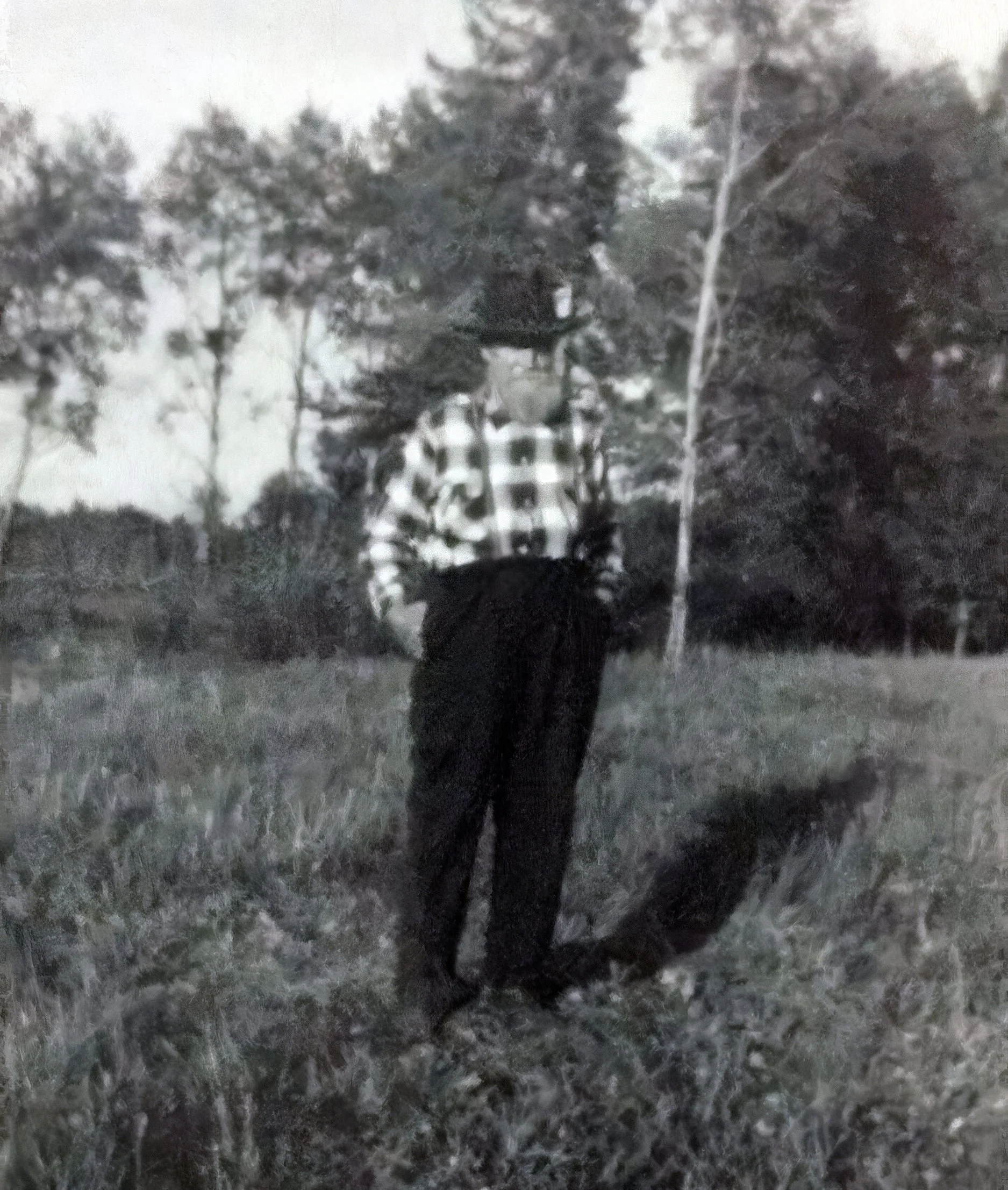
Grandpa
Grandpa was an early riser and around 5:00 a.m. every morning he was usually out of bed and heating water for porridge and cooking his first pot of coffee. When it was ready, he would call me, and we would eat our morning porridge together. Although he usually drank a couple of cups of coffee in the morning, my treat would be a one ounce shot glass of coffee, laden with a significant portion of cream and a dash of sugar. One morning I awakened even earlier than usual, complaining of a headache. Headaches were not a common phenomenon in our family, but, since it didn’t seem to be going away, my grandpa climbed out of the bunk, saying that he would be back to fix it in a few minutes. I laid in my place against the wall in the bunk, waiting for him to return with whatever it was that he had in mind. He rustled around in the kitchen area, and I wasn’t able to see what he was up to. So I was in complete shock when he returned a couple of minutes later, carrying in his hand the largest butcher-knife that I had ever seen. A multitude of thoughts rushed through my 5-year-old brain. Was the headache really all that serious? Wasn’t there a better way to deal with it? Was my grandpa really the kind and thoughtful man I thought he was? Hadn’t he considered other options for curing a simple headache? He instructed me to lay on my back in the bed and to remove my hands away from my upper body. I realized there was no point in putting up a fight. He seemed to have the same calm demeanour that I was accustomed to and, somehow, he didn’t seem to be as threatening as he had upon first entering the bedroom. He raised the knife to my forehead and, like the true man I was planning to become, I did not flinch. Much to my relief, he touched my flesh with the unsharpened flat side of the knife, and it glided softly across my brow. The most uncomfortable sensation was the numbing cold of the surface of the blade. He turned the knife to the opposite side and repeated his long gliding motion across my forehead. Then, a third time. I couldn’t believe what was happening – despite all the strain and worry, my headache seemed to be going away! After a couple more passes, he returned to the kitchen with the knife. I later learned that he had soaked the blade of the knife in the freezing cold water of the water pail before returning to the bed to administer his time-honoured treatment.
One other time, probably the following summer, Grandpa showed me one more of his skills related to sharp blades. Most people had their own chickens those days, and, along with his assortment of hens, he had a big, mean red rooster. I guess I seemed like fair game to the bird, because I was constantly at his mercy. On a couple of earlier occasions, he had jumped on my shoulders, dug his sharp spurs into my back and poked at the back of my head and neck with his beak. Since his attack was always from behind, I was defenceless. Besides, I was slight in stature, and he was probably almost half my size! However, one day his timing was not in its usual good form. My grandpa was cutting hay with a scythe not far from his cabin and I was walking past him on my way indoors. Big Red apparently didn’t see my grandpa over the long grass, and he ran toward me at full speed, ready to pounce on my shoulders for the umpteenth time. Unknown to the rooster, reaching to within ten feet or so from his impotent prey, he would also be within scythe’s reach of my grandfather. Seemingly unaffected, Grandpa continued nonchalantly cutting, until the rooster reached the optimal distance. Then, in a what seemed like a millisecond, the scythe appeared out of nowhere and Big Red’s head was lying bodiless on top of the freshly cut hay. Fried chicken was not a common treat on my grandfather’s menu, but that evening it seemed to be particularly tasty!
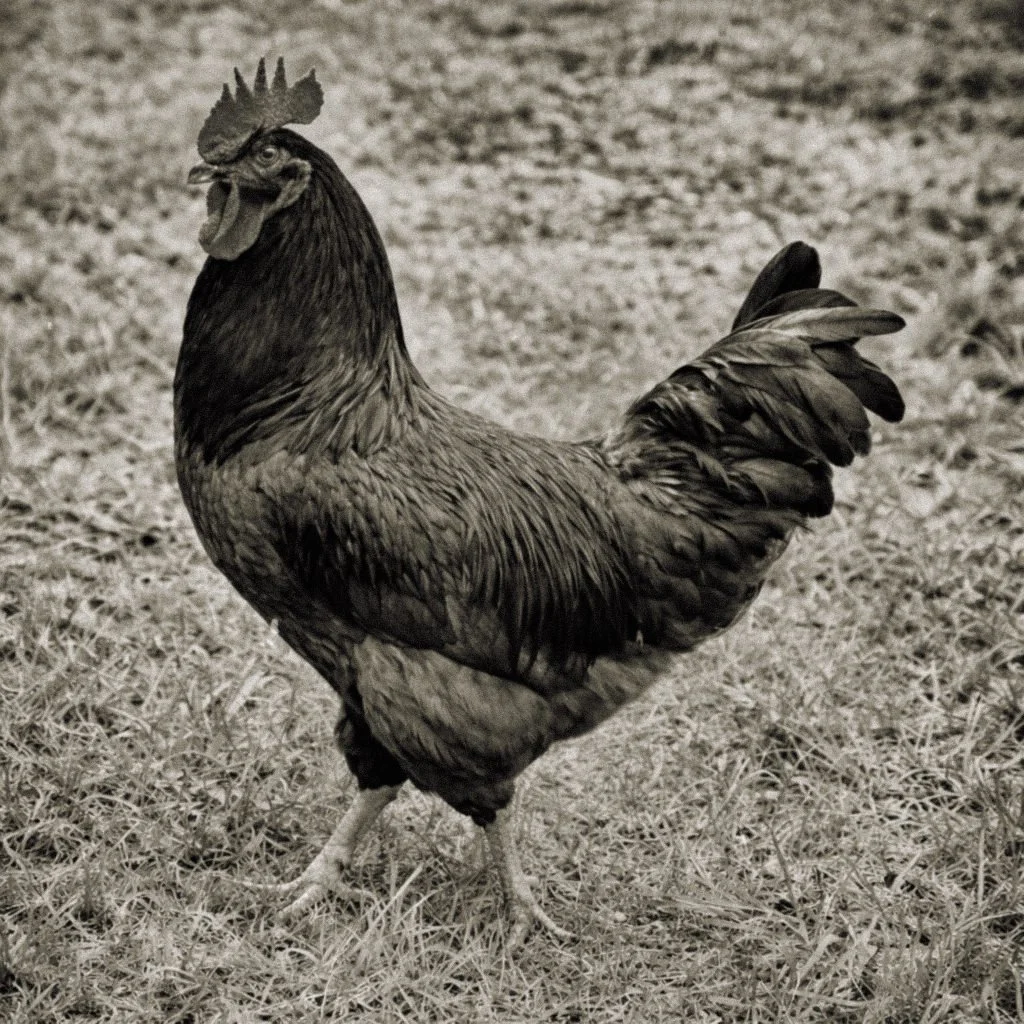
“Big Red”
The first oil was struck in the Pembina Oil Field in June of 1953, but it took a while before the real “boom” broke out. In the flood year of 1954, development was almost in full swing and new, unknown vehicles were everywhere, most of them stuck in the mud in the coulee separating the northwest corner of my grandfather’s quarter-section from the one across the road, owned by my uncle Lloyd and aunt Mary Cooper. It seemed like there was either a Cat or a team of horses on call there all summer long, pulling vehicles up both sides of the steep draw. I think Uncle Lloyd made quite a bit of unexpected cash with his tractor that summer and fall. Our neighbours and friends throughout the district were lending out or renting out every imaginable dwelling from barn lofts and stalls to empty skid-shacks and granaries. The nearby communities of Drayton Valley and Violet Grove were bursting at the seams.
Despite the influx of strange new people and activity with their associated disruption, the semi-annual caravan of indigenous Stoney People with their horses, wagons and multitude of dogs carried on making its regular trek past our little log house in the jack-pines, to and from the higher country in the west and the flatter region near Lake St.Anne. Sometimes there would be as many as 6 to 8 wagons, each with a team of horses and often a few spares. There were usually too many dogs to even consider counting. Although I can’t remember any of them ever stopping, they had a strong effect on me, and I really enjoyed watching them pass by. I always looked forward to their return trip, whether it be in the spring or fall. Altogether, it must have been at least a 2 – 3-day trip, but I don’t remember ever knowing where they camped en route to their destinations. My dad probably knew, but I was too shy to ask. I dreamed about what it would be like to travel with them, and I sometimes wonder if those mystical people and their seemingly carefree connection with the pulses of Mother Nature had played a role in my innate and incessant urge to search the unknown.