Chapter 3
From as early as I can remember, my dad was operating logging camps somewhere in the bush country every winter. Some winters, my mom and I would remain on the farm, tending the livestock and other chores, but, when the operation was of a larger scale or if there was a crunch for time, Mom and I would join the men in the bush, typically occupied with trying to log out and saw into lumber the prescribed quota before break-up in the spring. My mom would take over the cooking responsibilities for the crew and I would be assigned to whatever light chores that could be expected of a youngster.
According to the adults who knew me, I was very slow at learning to speak. Rumour has it that I was well over two years old before I finally uttered my initial ‘’ da-da’’ and ‘’ma-ma’’. However, through an unexpected turn of events one winter, my vocabulary grew considerably. I had no problem in getting to know the men working in the camp – they were a kindly bunch, primarily bachelors who had no kids of their own, along with a mix of married men who probably missed their own children. Nevertheless, throughout the course of the winter, I befriended most of them. I can’t say for certain as to the nature of their motives (although I suspect it was all in the name of fun), but a few of them took it upon themselves to entertain me during lunch breaks or after the day’s work was finished. This often included a chat session somewhere out of sight behind one of the many piles of lumber that continued to grow over the course of the winter. Although my ability to speak improved significantly, the body of the course material was somewhat unorthodox and probably not in line with the educational standards of the day. To their credit, I think they did warn me that some of the language might not be acceptable in the public domain. Unfortunately, I was too young to fully comprehend the meaning of their advice. To me, it was great to finally be learning and pronouncing some new words, regardless of any underlying implications. As it turned out, those first lessons lingered a long time in my memory, causing a certain amount of consternation when I started Grade 1 in Drayton Valley.
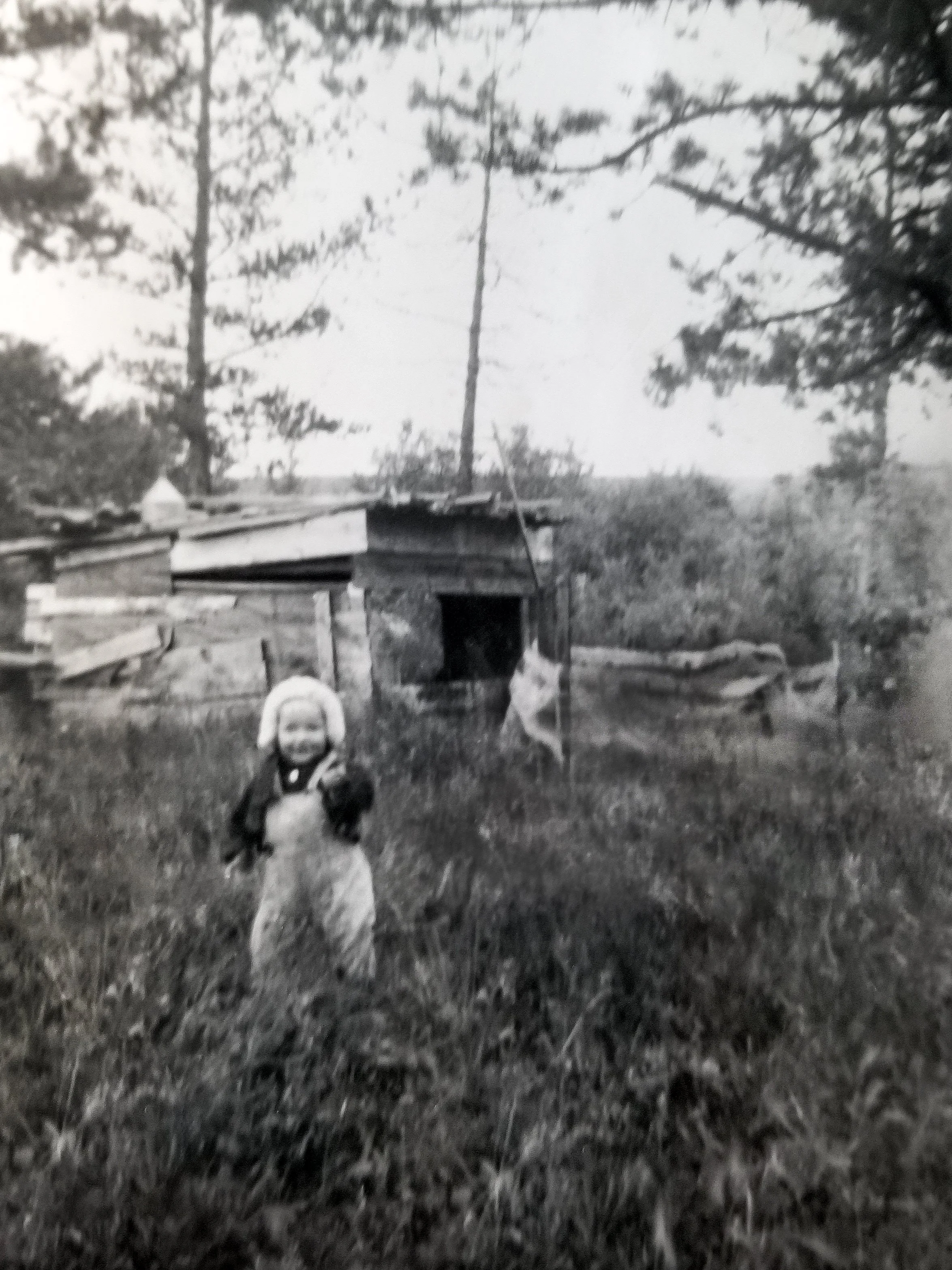
Early Days in the Jack-Pines
The typical routine was that, in the fall, my dad and one or two others would scout out and cruise one or more potential timber berths available for the upcoming winter. Dad would submit a bid to the Department of Forestry and, if accepted, the chosen area would become the location for his logging and sawmill activities through the winter until spring breakup. Most often, the selected berth would be located alongside a river or other watercourse, making roadbuilding and general access a lot easier. As soon as the ice started to set, they could start ‘’freezing in’’ the ice road, starting on foot, progressing to a team and sleigh or light tractor, until the ice was thick enough to carry bigger equipment and, eventually, large loads of lumber. The other advantage of setting up close to a watercourse was the obvious access to water. A hole was usually chopped in a convenient location in the river ice and kept open, from which water would be hauled, often by sleigh or sled, back to the camp cookhouse. Prior to the abandonment of horsepower in the camp, horses would be led to the same water hole two or three times per day, eliminating the need for the hauling of even more water to camp. As I grew older, one of my regular chores would be supplying the camp with water, but in my pre-school years, I was usually a ‘’flunky’’ for my mom, helping with dishwashing, setting the table for meals, supplying wood for the cookstove and other monotonous tasks around the camp kitchen. I learned a few tricks that, in today’s world, are certainly forgotten. One that was particularly useful was for the drying of kitchen cutlery, a seemingly endless endeavour if done in the traditional way. My mom made it easy – upon washing up the dishes after each meal, she simply spilled all the clean forks, knives, and spoons into a clean pillowcase, tied the open end and had me shake the case rigorously until the utensils were dry! In our mundane world, it was a great work-saver!
Everybody in camp worked hard and sometimes the efforts in the kitchen went unnoticed, but it was always a long day for my mother. Partly dependent on the length of the winter days, breakfast was never later than 7:00, so Mom was usually up and about by 5:00, getting prepared for breakfast and for the coffee breaks and meals that followed. As evening approached, it wasn’t uncommon for her to end the day, after finishing up from the supper meal, by helping my dad loading lumber trucks or attending to other undone outdoor chores. I remember many nights falling asleep late to the sound of the sparking slab-fire and the slap, slap, slap of planks hitting the deck of the next load of lumber.
The only chance Mom really had for a breather was in the mid afternoon before the 3:30 coffee break. So, around 2:00, upon cleaning up after the midday meal, she normally took a short nap on the bed in the back room of the cookhouse, during which time I was expected to find my own amusement. Whenever possible, I would don my winter clothes and walk down to the sawmill to watch the action. As I grew older, I eventually tried my hand at lumber-piling and logrolling, but, in the meantime, I usually had to be content with sitting at the small window in the cookhouse waiting for my mother to arise and resume her activities. One afternoon in particular stands out in my memory. My mom was taking her well-earned snooze and I was in my chair near the little window, casually surveying the frosty outside world or the fancy designs that old Jack Frost kept painting on the window panes. It was a cold and dreary day, and it was beginning to snow – one of those days that made one wonder if spring might never come. Staring out the window and sitting so quietly was making me groggy, too, and I was contemplating joining my mother on the bed. Then suddenly, from out of nowhere, a large grey form trotted past the window. I cocked my head aside far enough to see it disappear into the grove of spruce trees at the edge of the clearing. My mom was sleeping soundly, and I did not have the heart to wake her, even though I was bursting with excitement! It seemed like hours before she finally awoke, and, when she did, I couldn’t wait to tell her what I had seen. To my dismay, she said that she didn’t think it could be true. There was no way it could have been a wolf – none of the men had mentioned seeing wolves around this camp. It must have been a shadow, or maybe only a product of my own vivid invention. I knew my dad and the others would believe me, even if my mother didn’t. But, when I informed my dad, I got the same questioning response – he didn’t believe me either! When I brought up the subject at suppertime, a couple of the men thought that it could have been possible, but nobody would openly agree that it might be more than a figment of my imagination. To this day, it puzzles me that something as common as a timber-wolf would be so elusive in the minds of people who had spent most of their lives in the bush! Was it my fault that it had only been me who had seen it? The whole affair seemed bizarre, but there is one thing I know for sure – it was a wolf!
Johnny Jackknife was a popular fellow in the area. He was what everybody in those days called a half-breed, a mixture of Cree and Scottish blood. He was a kind and fun-loving man, slight in stature and quick on his feet. He was well-known as the best step-dancer around. Even at his advancing age, Johnny’s agility was remarkable. He was a conservative drinker, and I can’t remember ever seeing him drunk. He had his wits about him all the time, but whenever anybody pulled out a fiddle or other musical instrument, we knew it would be no time before he would break into one of his favourite steps. He really was a joy to watch, and I never missed a chance to study his movements. There was no shortage of parties in our little log house in the jack-pines, so the opportunities were plentiful. It was just a matter of time before I started trying to copy Johnny’s steps and, before long, he was coaching me and jigging alongside me. It was fun, not particularly difficult, and I loved the attention. Johnny seemed to enjoy my progress and kept egging me on.
My parents and my grandfather were impressed with my newfound talent. My grandpa got a kick out of showing me off in public whenever possible and didn’t miss an opportunity to either clear a space on somebody’s floor or to hoist me up onto a table to do my stuff. I obliged willingly, enjoying the limelight and maybe even more so, the collection of silver that usually accumulated with each performance. Restaurants and other public places were no exception – for my grandpa and me it was a case of “the more, the merrier”! With the advent of improved roads and vehicles, the geographic radius of my performance area grew along with it and I could be found dancing on tables in faraway places such as Entwistle, Seba Beach and Leduc – even as far away as Edmonton and Airdrie!
There were plenty of amateur musicians in the area, so, whenever a party was planned or when one sporadically broke out, there were always a few fiddlers, guitarists, and drummers who drummed on anything from washtubs to pie plates and kitchen cookware, and even the occasional accordionist or other less common instrumentalist. Pianos were expensive and rare, and generally unsuited for the irregularly heated buildings of the day. The few of them that could be found in some of the community halls were so badly out of tune that they were pretty much useless. Bass fiddles were also rare and too bulky to carry around, so the lower end of the musical spectrum was poorly represented. However, on the higher end of the scale, in addition to the fiddles and the occasional banjo, there seemed to be a significant number of mandolin players and there were several neighbours and friends who knew at least a few chords on the instrument.
My dad had an old mandolin that he had taken on trade from Danny McDonald for his Model A Ford a few years prior to my birth. The old car had become embedded in a creek crossing not far from Danny’s place and it wasn’t possible to get it out until the level of the water subsided. So, since Danny wasn’t really playing his mandolin anyway, and since he lived close to where the Model A was jammed, they struck up a deal – Danny took over ownership of the car, for future retrieval, and my dad took the mandolin. The mandolin hung on the wall of our log house and was available to anybody who wanted to play it. Gene Arthur was a relative newcomer to the district and had settled on what came to be known as “Gene Arthur’s Flat”, the flat on the North Saskatchewan River near where the present-day bridge now joins the river’s east and west sides. Gene was a regular attendee at the house parties in the jack-pines, and an enthusiastic mandolin player. He evidently noticed my interest in music and must have concluded that the instrument would be suitable for my small hands. In any event, Gene started to show me a few simple chords, so that I might be able to strum along with the other musicians. The thin strings were sharp on the fingers, and I was barely strong enough to push them down, but, after a few sessions, I was able to play along with some of the tunes. Many of the pieces were in the key of “G”, and that made the task simpler, as the chords in that key were more manageable than some others. It might not have been a great start, but it was more than enough to whet my appetite. It was the humble beginning of an unquenchable desire to make music.
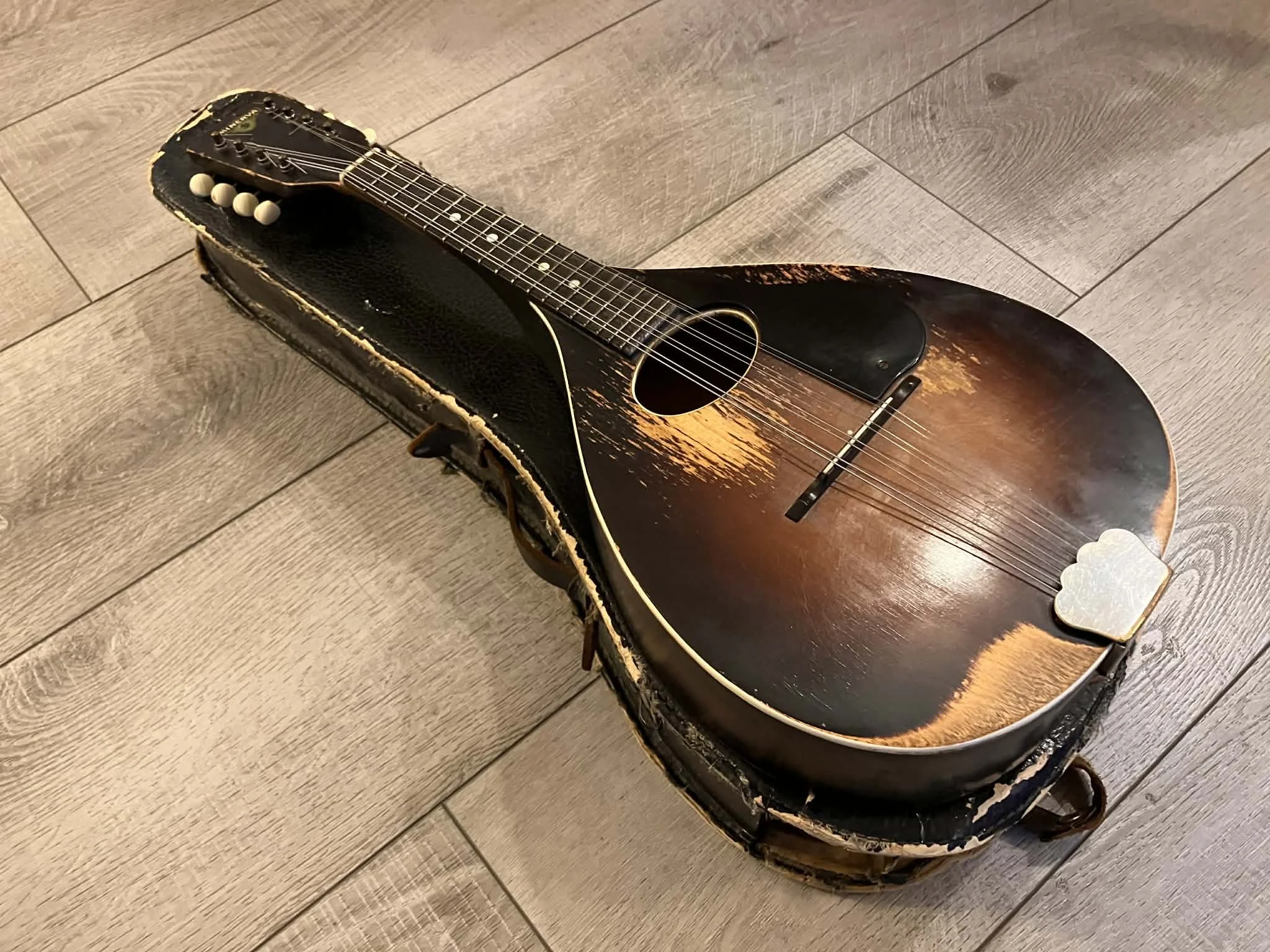
The Old Mandolin