PART ONE: From Bushland to Bandstand
Writing the story hasn’t been easy and, most of the time, it has been done in sporadic fits and starts with no discernible end in sight. As I grow older, I realize that there is a distinct possibility that I will never finish, so I have decided to take a bit of a shortcut. My aim is to present my story to a specific online audience in palatable segments, making it easier to read and easier for me to continue changing, adding and editing as I go along. Hopefully, by following this course, I will find ample time and inspiration to actually finish and publish at least the first half!
My intentions for writing this story are simple ones:
Acquaint and reacquaint people I grew up among or otherwise met along the journey with people, places, events and conditions whom/which they may have forgotten over the years
Leave an account for the younger generations as to how times and conditions have changed over the past 75 years
Lend an insight into the lives of people like me, who follow their inquisitive hearts and are not satisfied to follow the path most commonly travelled
I hope that you enjoy what I have to offer. A Song in the Spruce is being created under the banner of Buck Mountain Press, an independent publishing house which we developed a couple of years ago in conjunction with the release of my first book, Olaf & Me. Thanks for reading!
-
This story is dedicated to my children and grandchildren, Kerstin, Frans, Teya, Max and Ophelia, and to all our relatives, through blood and in spirit, who have come before us and blazed the trails to where we find ourselves today.
My wish is that these dear ones and others in following generations might use this account to help to understand the lives of those who preceded them and in some small way help to bridge the gap through the ages.
Chapter 1
Danny McDonald’s old tractor grumbled and puffed its way along, pulling the four-wheeled hay wagon over the rutted trail toward the Pembina River…
Danny McDonald’s old tractor grumbled and puffed its way along, pulling the four-wheeled hay wagon over the rutted trail toward the Pembina River. Luckily, it hadn’t been a soggy summer as was usually the case, and tracks through the sod were comparatively dry. I believe it was early in the fall following my fourth birthday, and my first memory from my life on this planet.
Danny was a trapper and woodsman who owned a quarter section of land along the river north of our intended campsite, where we were to spend the next few days. He was a rugged bachelor, rough around the edges, strong as a bull, but much loved by everyone who knew him. His kindness and willingness to lend a hand whenever needed had become a trademark. This trip was only one of many he had made and would continue to make for families on their annual treks to the berry patches, since the days before his team of horses had been replaced by the old Massey.
I’m sure I can’t remember all the families who were on that trip. Some details escape the memory of a four-year-old. My grandmother Agnes Erickson and her family, the Brays, were avid berry-pickers, so she was there, along with my mom and dad and my grandma’s youngest sister, Daisy Hines, and several more of that part of the clan. The Hines kids were plentiful and most of them already seasoned berry- pickers. There were probably more of my Bray relatives there, but they are not clear in my memory. My Dad’s good friend and old school chum, Les Tucker along with his family, was there, as well as Les’s sister, May Urchyshyn, and her family. The “Brownbill Boys”, Chub Brownbill and Stan Pickavance, were also along. Uncle Chubby and Uncle Stanley, as they were affectionately known to us, were a pair of bachelor cousins from Lancashire, England who had come to the Drayton Valley district with their parents in the early days of settlement. I’m certain that our other neighbours and family friends, the Davis’s, were also there. Of course, my grandpa, Ed Erickson, was there. He and my grandmother had divorced many years earlier, but they still got along well, and he still looked after her better than many married husbands, even though Grandma had moved to Rocky Rapids and later to Edmonton and he had raised his two boys as a single parent. That was a rarity in those days. Again, if my memory serves me, there must have been close to a half dozen tents or more full of berry-pickers, with all their associated trappings, that had to be hauled, first to Danny’s cabin, then south to and through Glen’s Ranch, and finally further west through the muskeg, to the berry patches not far from the river. I remember that our camp was set up along the bank of the river, close to water for drinking and washing.
Not least important among the accessories hauled in on Danny’s wagon was the multitude of containers needed for picking and storing the berries. Once camp was set up, the usual procedure was to continue picking for the number of days necessary to fill every available pail, bowl, washtub, cream can or other vessel that could be used to transport the harvest back to the respective homes around Drayton Valley for cleaning, canning and preserving for the winter. Sometimes, in particularly bountiful years or lengthier stays, tarps, jackets, and other unlikely containers were put to use.
I don’t remember being a very active participant in the actual berry-picking, and my most vivid memories are of the actual camp along the Pembina. Sometimes our mindful senses are not the ones which impart the most vivid memories. I remember the smell of the campfire and the sound of its crackling as wood was added late into the night. Sometimes a piece of dry spruce or, maybe accidentally, a green spruce bough would be placed on the flames, creating a bright spark or flare in the darkness. It was countless dozens of memories such as these that affected me deeply and that would help to shape me into the person that I would become.
Toilet facilities were simple, but effective. The common practice was to find a couple of windfalls or other fallen logs of suitable height, in opposite directions from the camp. Dry twigs and branches would be removed as necessary and, in special instances, the bark might be removed from the selected portion of the fallen trunk. As I remember, the ladies were a bit pickier about the log chosen in their area. Such was also the case concerning toilet tissue. For those who had really come prepared, there may have been some soft paper left over from store-bought apples or pears or maybe even from Mandarin oranges from the previous Christmas. But most common were the pages of old newspapers or a discarded Eaton’s catalogue. With adequate scrubbing and massaging, even that crude material could be manipulated into a useable wipe, despite the newsprint, which sometimes discoloured the skin or underwear. Some simply resorted to the moss, which grew plentifully in the muskegs surrounding the blueberry patches. Besides its ready availability, the moss was always clean and sanitary and devoid of unhealthy chemicals. It was also less noticeable when disposed of; it blended right in with the topography from where it was taken. The downside of this option was the risk of eventually stepping into something blueish-brown and mushy which also blended in nicely with the moss. In more modern times, some folks tended to tarp off their toilet sites for increased privacy, but, as I remember it, common courtesy prevailed in our camps and the designated areas were well respected.
Another unforgettable memory from my first and subsequent trips to the area was the abundance of fur that Danny McDonald always had on hand. Due to a government bounty on wolves, Danny had secured a contract to remove significant numbers of them from the area. This, of course, paid extra dividends for the trapper since the hides also brought a decent price. Danny was always proud to show off his most recent catches and there was always an interesting lineup of hides to be viewed, including wolves, lynx, marten, mink and, of course, the usual beaver, muskrat, squirrels, and weasels. He had managed to set up his trapline so that much of it was situated within a day’s snowshoe trek from his cabin. The line was considerably more accessible than many others, where often a trip of several days was required just to cover each individual leg of the allotted area. Along with his excellent garden and a bit of subsistence farming and ranching, Danny lived well. Even the more modern and sophisticated oilfield newcomers who eventually came to call the area home recognized and appreciated his natural and gentle approach to living on the land.
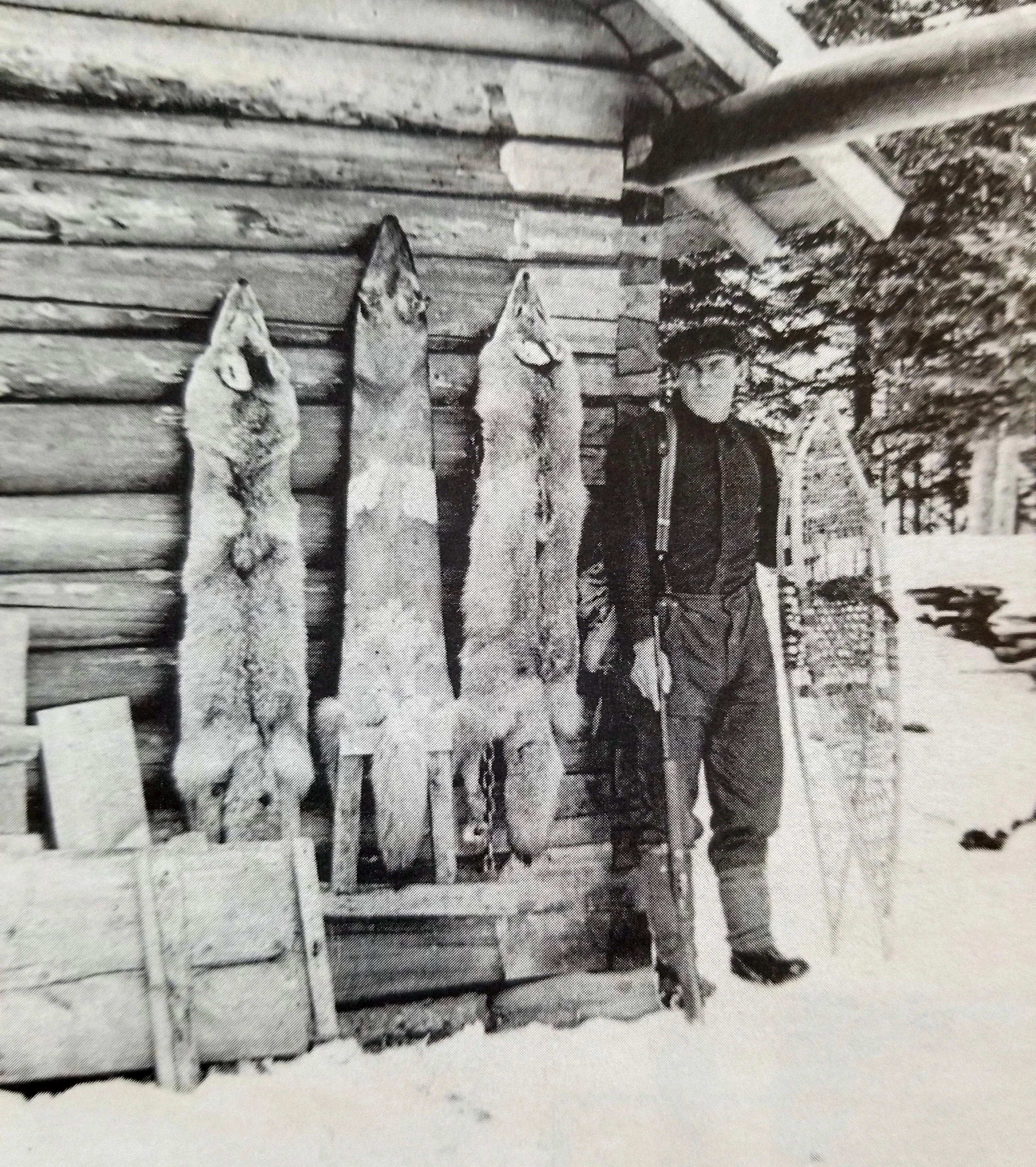
Danny McDonald
I’m not sure exactly how far into the area we were actually able to drive before transferring our gear into Danny’s wagon for the last leg of the trip. Likely, we would have had to stop at the ranch of the Johansons, Danny McDonald’s closest neighbours to the north. Helmer Johanson drove a late model Fargo pickup truck to and from “town” and even further afield, and I think the road ended at their place. The ranch was only a short way downstream from Danny’s cabin, so it would have been a suitable pickup spot, and the Johansons had plenty of open space to park a few vehicles for the duration of the stay. It is entirely possible that Helmer and Doris accompanied the entourage for a few days’ berry-picking. The Johansons were friendly and hospitable folks, and well-known to my parents and the others. Like my grandfather, Helmer had immigrated from Sweden, so those two enjoyed an added ethnic connection. I remember that Doris always had a fresh loaf of bread to share with both expected and unexpected visitors. Unfortunately, for some reason, the butter was often allowed to become sour, and my memories of the delicious bread usually went sour along with the butter! I remember my mom suggesting that maybe the cream separator didn’t get a very frequent cleaning. The Johansons worked hard, both inside and out, building their ranch, and I guess sometimes certain details just got overlooked.
Another old couple that we occasionally visited along the Pembina were the Kootenays. I am still not sure whether they were Stoney (Nakota) people or if they, as their name suggests, actually originated deeper in the mountains further west. It’s even possible that they had acquired their surname through some earlier involvement with the Kootenay people. Or maybe one of the pair was Stoney and the other was Kootenay. Regardless, they were grand old people who, like Danny, lived peacefully on the land. They lived in a little log cabin not far from the river and made their living by trapping, hunting, fishing, and reaping the plants and medicines that Nature had to offer. I think old Mr. Kootenay occasionally took on some periodic work with some of the various sawmill operators in the area. I remember not many years after my first trip into the Pembina, my dad was logging in the area south of present-day Lodgepole, not far from the soon to be built Brazeau Forestry Tower, and he sometimes offered members of whom I believed to be the second generation Kootenay family a ride to town in his 1949 Dodge Custom, equipped with fluid drive, quite a feature in its time! There were some Kootenay grandchildren about my age and, although I think we all would like to have become friends, we were all too shy to do anything about it. Besides, it didn’t seem like they spoke much English and my Cree/Stoney was much worse!
When we weren’t in the bush logging out a timber berth somewhere, my family made its home in a single-bedroom log house “in the jack pines” about halfway along the country road between the two pioneer communities of Violet Grove and Drayton Valley. My grandfather had bought the quarter-section from another homesteader and, aside from the reference to the pine trees, it was also commonly known as “the old Hendricks place.”
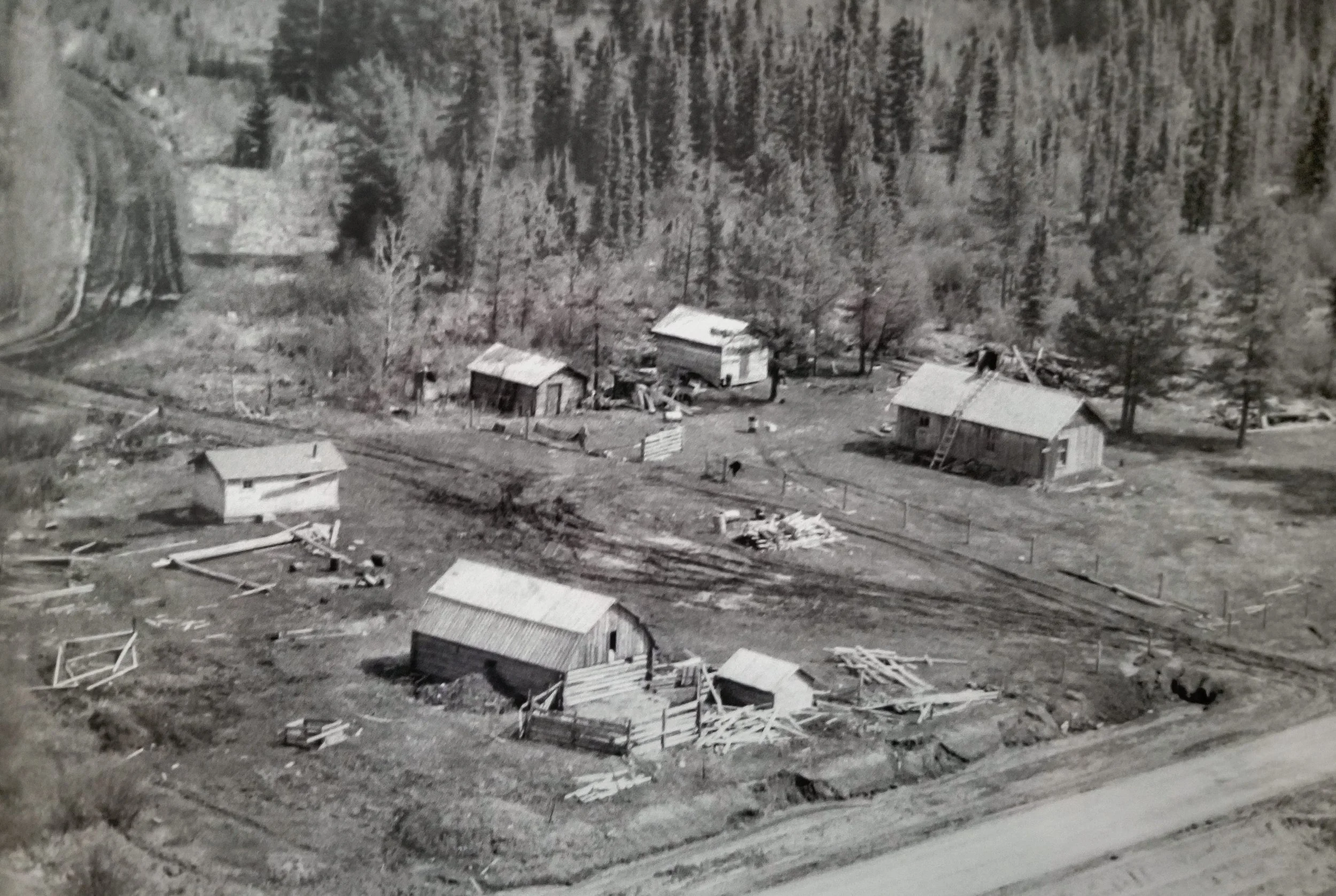
The Old Hendricks Place
The house, log barn and outbuildings were situated alongside a small creek running through a sizeable patch of muskeg. Due to the mossy nature of the muskeg soil, my folks were able to maintain an almost year-round dugout for the storage of milk, cream, butter, meat, and other household staples. With an adequate summertime covering of straw or other insulative material, it was not uncommon to find traces of ice amongst the moss late into the summer. Potatoes and other vegetables were usually stored in my grandpa’s root cellar on an adjoining quarter section where he lived. I loved my grandfather immensely. He was not only the senior patriarch of our family; he was my hero and idol. I spent as much time with him as I possibly could.
For most of my life, I have been a headstrong individual. I suspect that some less kindly folks may have referred to the trait as “phenomenally stubborn”, or something even stronger. For as long as I can remember, I have had my own specific attitudes as to how things should be done. My parents were not terribly unlike other parents in the area – hard-working homesteaders who knew the value of a day’s work – from both themselves and their family members. Everybody, including children, had chores that had to be done, and there were well-known methods for doing most of them, that had been tested and proven. Inevitably, I went head-to-head with my father and mother on a variety of issues from time to time.
I think I was also about four years old when I made my first attempt at running away from home. My short legs were a definite disadvantage, and I was usually apprehended before I even made it out of the yard. Another handicap was evident in the fact that everybody knew that my ultimate destination would certainly be my grandpa’s cabin and, so far, I hadn’t explored any other route than via the country road to get there. It was simply too easy for them to track me, and several additional flawed attempts ensued. What was even more frustrating was my dad’s teasing. He even started suggesting that it might be a good idea to pack a lunch to cover at least the first part of the journey to wherever it was I was headed! Obviously, he knew that I didn’t know that he knew where to find me if, indeed, I ever did succeed!
It was the better part of a mile to my grandfather’s place, and, except for the road, the only plausible exits were through a large, plowed field on a slope across the creek to the east, or via a 10-acre area of very thick willows and scrub brush directly to the north. The muskeg and tracts of bigger timber to the south were not an option, and even I knew that would take me in the opposite direction of my destination. Then one day, probably in the fall after I had turned five, a new unexpected opportunity arose. Although I can’t remember having had any significant altercation with my parents, I was lonesome for my grandpa. With no particular plan in mind, I wandered east across the wooden culvert on the creek, playing with the dog and enjoying the lovely fall weather and the colours and smells of the changing season. It had been a very good summer for growing and the formerly plowed field had yielded a beautiful tall crop of wheat, ripening nicely. I must have crept under the barbed wire and into the field of wheat. I don’t think it was my good sense of geography that led me to the northeast and toward my grandpa’s cabin – it must have been an intuitive sense linked to my strong connection to the old man I admired so much. Something was telling me that I had to head north through the grain field. The dog followed quietly and unaffected.
The grain stalks had grown taller than the height of my diminutive stature, although their heads and mine were a similar light-blond hue. To spot a five-year-old child under those conditions would not have been easy, even for people at home on the land. Once I was inside the perimeter of the 40-acre field, leaving scarce signs of my point of entry, tracking attempts would have been almost ludicrous, even if it had been known that I had taken that path. In addition, my parents had already become accustomed to my regular route along the road.
About halfway through the field, my sense of direction started to wane. It was a heavy crop, and I couldn’t see any further than the nearest stalks in any direction. Acting almost entirely through intuition and with no real knowledge of solar positioning and other natural directional signs, I began to travel in circles. I suspect that I inadvertently crossed my own trail more than once, maybe even several times. I really have no idea how long I wandered around and around in the wheat. I do not remember even sitting down or resting. I think I just kept wandering, optimistically anticipating the sight of my grandfather’s cabin in the distance. The dog had been following obediently all the while, letting me choose the path through the grain. Then, nonchalantly and unexpectedly, he pulled ahead of me and, since I was becoming disoriented and bewildered, I had little choice but to follow him. He didn’t seem to be in any particular hurry, so it wasn’t difficult to keep up, even though my little legs had already made many more steps than they were accustomed to!
I don’t know how long my parents had been searching for me, but it must have been a couple of hours. Apparently, they had considered the wheat field as a possible route but couldn’t see any sign of me having been there. After having exhausted the possibility of the road, they had concentrated more intensely on signs of torn clothing, etc. in the willow thickets. As I remember it, they finally spotted me following the dog along the northern part of the trail which separated the willow patch from the grain field. We were headed south, and the dog was leading me home!
My dad was a good hunter and game was plentiful, so there was seldom a shortage of meat. Elk was the perennial favourite for most of us, but there was always a ready supply of moose, as well as both whitetail and mule deer. In hunting season, the local men usually went out in groups and tented in favourite areas where access wasn’t too difficult and where they were most likely to fill all their tags. With a bit of cooperation and some creative tagging methods, that usually wasn’t hard to do. Although the trips often led out further into the west country, it wasn’t uncommon to bag one’s limit within a short distance of home. I remember one fall when my dad shot a couple of bull elk through his pickup window only a couple of miles from our house. The only real challenge was to round up somebody with a second elk tag before loading the carcasses into the vehicle. As far as domestic meat was concerned, aside from chicken, pork was a staple. We usually kept a pig or two to butcher in the fall, along with the wild game. Pork was especially good when mixed with the drier moose meat, and, when combined, the two made excellent hamburger.
During the same fall of my latest runaway attempt my parents had been fattening three pigs in the log barn and its adjoining pigpen. The barn was situated not more than a couple of hundred feet north of our house, and the pigs were able to roam freely between the open-air pen and the protection of the barn. Generally, the distance between house and barn was not so great that any significant goings-on would go unnoticed. The porcine trio was, itself, a relatively content lot, and not prone to a lot of noisemaking. The chickens were housed in another smaller building to the east of the house and locked in at night, so there was no interaction between the two species. Sometime during the early morning, the dog started making a racket in the yard. The sun had not yet made its appearance over the eastern horizon, and it was still pretty much pitch-dark. Of course, in those days the only possible means of outdoor illumination would have been via a coal-oil lantern, and there wasn’t always one of those readily on hand.
We never did catch sight of either the bear or the missing pig, but the next morning the bear tracks and the trail of blood leading to the nearby brush were clear indications of what had been going on in the darkness. Ironically, not more than a couple of weeks later, the remaining two pigs were struck and killed by lightning during a random fall thunderstorm. The moose meat was dry that winter.
Chapter 2
My parents must have figured out relatively early that I was going to need more interesting and demanding stimulation to keep me occupied…
My parents must have figured out relatively early that I was going to need more interesting and demanding stimulation to keep me occupied, so as not to eventually come up with the ultimate successful escape. Like most kids, I was keen to try my hand at driving. My grandpa sometimes let me hold on to the lines with him as he drove his team of horses to the barn for the night, and my dad and other relatives would sometimes let me sit on their knees and try to manipulate the steering wheel of their vehicles as they drove. My dad had bought a brand-new D2 caterpillar crawler a few years earlier, mostly for use in the logging camps. As fate would have it, Drayton Valley and district were about to be bombarded by the discovery of oil and gas in the area. Eventually, the little Cat, with my dad at the controls, ended up doing most of the backfill and landscaping work for the initial development of the soon-to-be new town.
While still in my fifth year, at the beginning of what might have been a conspiracy to keep my mind off the next attempt at running away to create a life of my own, my dad decided to give me a shot at driving the little D2. For me, it seemed like the perfect combination as, in relation to the bigger crawlers and related forestry and oilfield equipment and to the adult operators involved, the little Cat and I seemed to have a lot in common. My dad’s cousin, Ralph Wikander, had a Volkswagen Beetle, and I was allowed to sit on the edge of the driver’s seat almost every time he came for a visit, to check to see if my feet would yet reach to the clutch and brake pedals, but, when they finally did, I couldn’t see over the dashboard. The Cat had the definite advantage of being considerably higher off the ground, had a seat somewhat closer to the steering clutches (which I didn’t really have to reach at all), and was devoid of a windshield of any kind! Thus, I was able to look between the two steering levers, out over the hood, the A-frame and blade to the trail ahead. We started at the south end of the large hayfield that adjoined the infamous wheat field of the recent past. The hayfield was part of the adjoining quarter-section where my grandfather lived, and led almost all the way to his cabin, a distance of about a quarter mile. My dad installed me in the seat, and gave me steering directions, if needed. His most forceful instruction was in the use of the hand-clutch, located to the far left of the other controls. If anything at all dangerous or out-of-the-ordinary ensued, I was to immediately push that lever forward, and the machine would come to a stop. He then placed the little Cat in the lowest possible gear and instructed me to pull back on the clutch lever when I was ready to depart.
There is a reason that these machines were, and still are, referred to as crawlers. The low gear that Dad had chosen for my initial journey was so slow that one could have crawled along the ground and still managed to keep up, or possibly even pass the little D2. As it was, he and my mother walked along leisurely behind, behind my line of sight as I gazed intently at the trail ahead.
The trip was uneventful – even bordering on boring as I reached my destination at the opposite end of the field. The little crawler was well-balanced and maintained, so that any attempt to steer it would only have taken it off the path prescribed before takeoff. A couple of times, I pulled gently on one of the steering levers, but noticed no significant change in direction. Maybe I wasn’t pulling hard enough, but I didn’t dare apply more pressure, for fear of getting off the track and possibly compromising any future driving opportunities. Upon arrival I pushed the hand-clutch lever forward, exactly at the predetermined location. I sat quietly, evaluating my performance, before I looked around and noticed my parents approaching the machine. They both had grins on their faces, so I could only assume that my talents as a cat-skinner had been acceptable. With their help and with a larger, more triumphant smile on my own face, I jumped from the seat onto one of the cat-tracks, onto the A-frame and down onto the hayfield. My dad took the operator’s seat, threw the machine into a much higher gear, raced across the end of the field, and made a couple of sharp turns before parking the little Cat under a large spruce tree. Together we walked to my grandpa’s cabin. It had been a good day and running away anywhere was far from my mind.
About that same time, I made my first attempt at riding a bicycle. Most of the other kids my age had started to ride so one day my Dad came home from Edmonton with a brand new two wheeler for me. Being the first in my generation on my father’s side of the family and only the second among my maternal grandmother’s grandchildren, I guess I was lucky, as hand-me-downs were somewhat scarce. In any event, I became the proud owner of a 20” bicycle of the latest vintage. Many of my friends around the district had one or more training wheels attached to the back wheel of their bikes, but mine was devoid of those. First of all, the yard around our log house and outbuildings was not very level and my parents thought that training wheels would be useless. But, maybe even more importantly, in our discussions, I had made it quite clear that I wouldn’t be having any “baby wheels” on my bicycle! I had watched my Dad’s younger cousins riding, and they had done just fine without them.
Although smaller than many, my new bike was still too big for me. With my short legs, I had no chance of reaching the ground, even with the seat adjusted to its lowest position. So, if and when I lost my balance, the outcome was not likely to be optimal. But, as usual, my Dad came up with a reasonable training program. I would get mounted in a suitable position on the seat, with my feet on the pedals and my hands on the handlebars and my Dad would run along behind me holding onto the carrier mounted over the back wheel. Whenever he thought that I was doing quite well and maintaining my balance, he would let go of the carrier and let me ride on my own. Invariably I would eventually fall down, except for the times when he was able to catch up with me and grab onto the bike before I tumbled over. It was a bit scary, but I persevered, realizing that it wouldn’t be practical to have my dad running along behind me forever. With each attempt I became a bit more proficient and confident, and the periods of independence became increasingly lengthy. I was eventually able to ride a circle or two around the perimeter of the yard alone without falling. I also learned that it was possible to jump partway off the bike when I felt my balance start to wane, thus breaking my fall somewhat before hitting the ground.
But I wasn’t yet totally confident and I still needed my dad’s help to balance me as I was getting started with the pedalling. Throwing my leg over the frame of the bicycle was an ongoing struggle, although sometimes, if there was a downhill start, it went a lot easier. One particular day I was in a more courageous frame of mind and decided to try a run entirely on my own. I had noticed that there was a significant slope from about the middle of the yard going toward the eastern boundary of the property where the sodden driveway crossed the creek over a small wooden culvert. Mounting the bike at the top of the slope allowed me to gain enough momentum, throw my leg over the frame and get properly positioned before the bike either tumbled sideways or gained too much speed. At this point, I still hadn’t had much reason to use the brakes, as I had mostly been concerned with keeping the bike moving and in an upright position. However, this time everything seemed to be working better than usual and I started to pick up speed quite nicely as I proudly headed down the slope toward the culvert. I decided that I was going to cross the creek over the culvert and turn left on the dirt trail leading to the north end of the property. I was still gaining speed, but I realized that I would need some extra propulsion in order to make it up a slight rise on the opposite side of the creek. Considering my very limited experience in stopping or even slowing down, and not wanting to lose momentum before entering the upcoming turn on the other side of the creek, I didn’t apply the brakes at all. Besides, I was completely confident that I was fully in control of the situation.
But then I made a serious mistake. I was doing so well that I decided to look over my shoulder to check my progress. In doing so, I unknowingly pulled the handlebars to the left side and the bike drifted over to the side of the path. By the time I turned my head and regained my pedalling position, I was on an uncorrectable side trip over some deep ruts on the left side of the path and still gaining speed. By now, I had entirely forgotten about the availability of brakes at all and was hanging on, trying to maintain my balance. As I approached the crossing, the front wheel skipped over the deepest of the ruts and pulled the bicycle still further to the left and over the end of the wooden culvert. As I remember, the bike remained jammed up against the edge of the culvert and I was thrown over the end and into the creek beside a willow thicket growing out of the bank. After dragging myself out of the water, I found, surprisingly enough, that my bike had hardly been damaged at all, except for a badly bent chain guard and a bit of misalignment of the handlebars. I had some minor scratches from the willow thicket and a heavily soaked set of clothing from the waist down!
During the fourteen and a half years between my birth and my grandfather’s passing, we spent a lot of time together. Aside from various outings and his frequent visits with my family, I soon began staying overnight with him in his cabin. The cabin was a small one, with two tiny bedrooms and a larger combined kitchen and living area. One of the bedrooms was reserved for my Uncle Freddie, who occasionally came home to the cabin when he wasn’t away working in a logging camp somewhere. So, I slept with my grandpa in his bunk. He always tucked me in and seemed to have a special way to fix up my side of the bed so that it was warm and cozy, regardless of the conditions. The cabin was heated by a small coal-fired stove that needed to be tended often. He did his cooking on a propane stovetop, although there was electricity for lighting and for one of the district’s first television sets. The toilet facilities were ‘out back’ and my grandpa carried all the water for the household from a spring at the bottom of a long and steep creek-bank several hundred yards from his cabin. He had built himself a wooden neck-yoke to transport the water up to the cabin, two pails at a time, on his shoulders. He had also cut steps into the steepest part of the hill and lined them with flat rocks, so as to create a better footing and to decrease erosion of the bank. About halfway up the climb, there was a mid-sized spruce tree growing with a curved trunk, perfect as a resting place after the hardest part of the climb. There was no question about water conservation at my grandpa’s – every drop was precious and reuse, whenever possible, was a fact of life.
My grandfather was a big, powerful man with a strong voice and a loud laugh. He seemed to have no understanding of the concept of fear and there were very few challenges that he would not take on with a smile and a twinkle in his eyes. He commanded a lot of respect, both from his family and friends and from strangers. His very presence and body language told the story of a man who could handle himself and who wasn’t easily misled or taken for granted. There were some people who were even afraid of him. Small children often found his demeanour intimidating – until he dug out his seemingly bottomless supply of peppermint candies! On his infrequent trips, either on foot or at the wheel of his little Ferguson tractor, to the grocery store, he usually ended up treating all the children in the store to a round or two of peppermints. Except for during the warmest weeks of summer, he normally sported a roughly kept long white beard and a wide-brimmed hat and became known to many of them as Santa Claus. It wasn’t often possible for me to accompany him on these excursions, but, when I did, it made me feel very proud to be grandson of such a celebrity. Besides, my grandpa and I shared a secret, even in my pre-school years, that few others seemed to know about – we both knew there really was no Santa Claus!
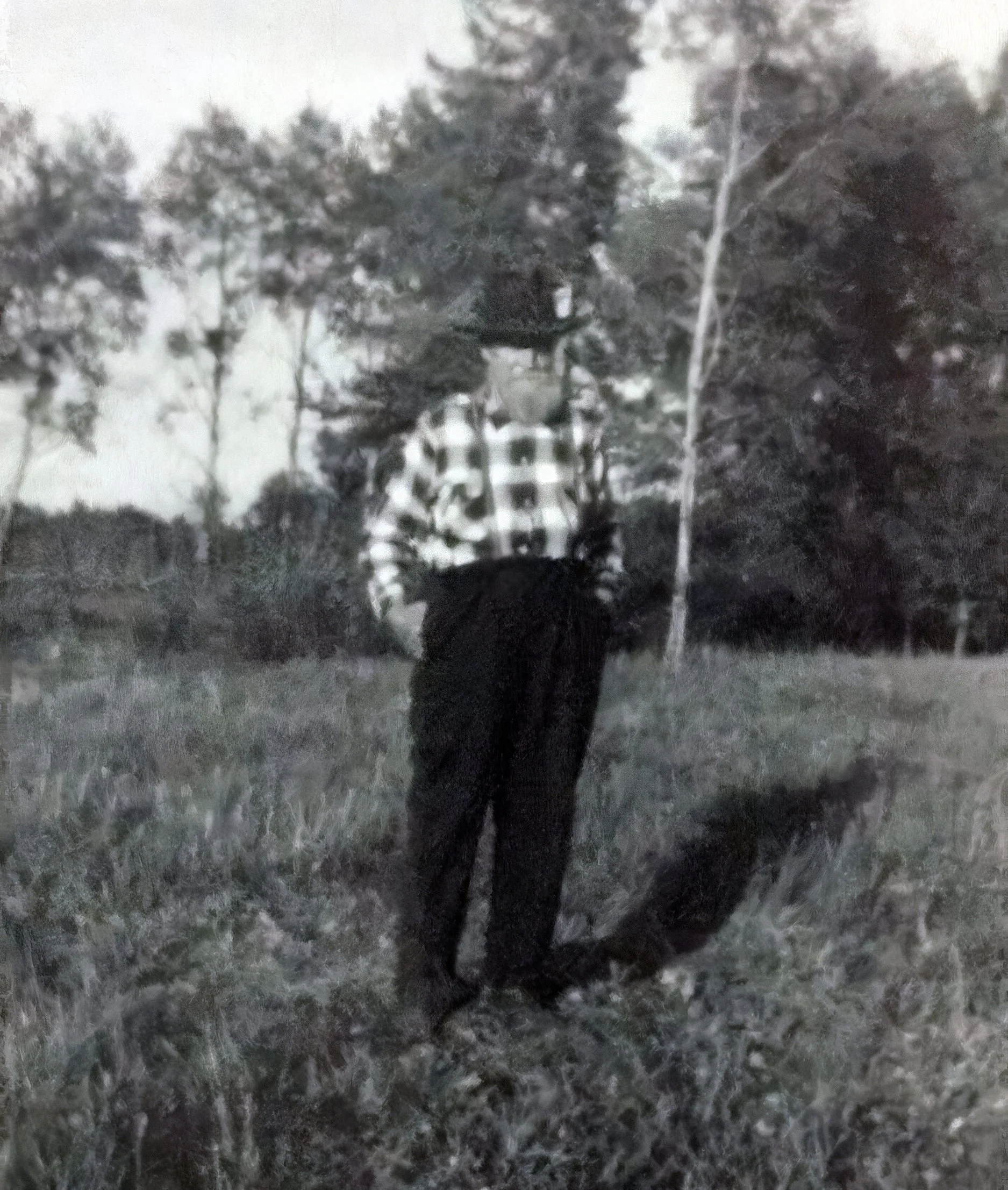
Grandpa
Grandpa was an early riser and around 5:00 a.m. every morning he was usually out of bed and heating water for porridge and cooking his first pot of coffee. When it was ready, he would call me, and we would eat our morning porridge together. Although he usually drank a couple of cups of coffee in the morning, my treat would be a one ounce shot glass of coffee, laden with a significant portion of cream and a dash of sugar. One morning I awakened even earlier than usual, complaining of a headache. Headaches were not a common phenomenon in our family, but, since it didn’t seem to be going away, my grandpa climbed out of the bunk, saying that he would be back to fix it in a few minutes. I laid in my place against the wall in the bunk, waiting for him to return with whatever it was that he had in mind. He rustled around in the kitchen area, and I wasn’t able to see what he was up to. So I was in complete shock when he returned a couple of minutes later, carrying in his hand the largest butcher-knife that I had ever seen. A multitude of thoughts rushed through my 5-year-old brain. Was the headache really all that serious? Wasn’t there a better way to deal with it? Was my grandpa really the kind and thoughtful man I thought he was? Hadn’t he considered other options for curing a simple headache? He instructed me to lay on my back in the bed and to remove my hands away from my upper body. I realized there was no point in putting up a fight. He seemed to have the same calm demeanour that I was accustomed to and, somehow, he didn’t seem to be as threatening as he had upon first entering the bedroom. He raised the knife to my forehead and, like the true man I was planning to become, I did not flinch. Much to my relief, he touched my flesh with the unsharpened flat side of the knife, and it glided softly across my brow. The most uncomfortable sensation was the numbing cold of the surface of the blade. He turned the knife to the opposite side and repeated his long gliding motion across my forehead. Then, a third time. I couldn’t believe what was happening – despite all the strain and worry, my headache seemed to be going away! After a couple more passes, he returned to the kitchen with the knife. I later learned that he had soaked the blade of the knife in the freezing cold water of the water pail before returning to the bed to administer his time-honoured treatment.
One other time, probably the following summer, Grandpa showed me one more of his skills related to sharp blades. Most people had their own chickens those days, and, along with his assortment of hens, he had a big, mean red rooster. I guess I seemed like fair game to the bird, because I was constantly at his mercy. On a couple of earlier occasions, he had jumped on my shoulders, dug his sharp spurs into my back and poked at the back of my head and neck with his beak. Since his attack was always from behind, I was defenceless. Besides, I was slight in stature, and he was probably almost half my size! However, one day his timing was not in its usual good form. My grandpa was cutting hay with a scythe not far from his cabin and I was walking past him on my way indoors. Big Red apparently didn’t see my grandpa over the long grass, and he ran toward me at full speed, ready to pounce on my shoulders for the umpteenth time. Unknown to the rooster, reaching to within ten feet or so from his impotent prey, he would also be within scythe’s reach of my grandfather. Seemingly unaffected, Grandpa continued nonchalantly cutting, until the rooster reached the optimal distance. Then, in a what seemed like a millisecond, the scythe appeared out of nowhere and Big Red’s head was lying bodiless on top of the freshly cut hay. Fried chicken was not a common treat on my grandfather’s menu, but that evening it seemed to be particularly tasty!
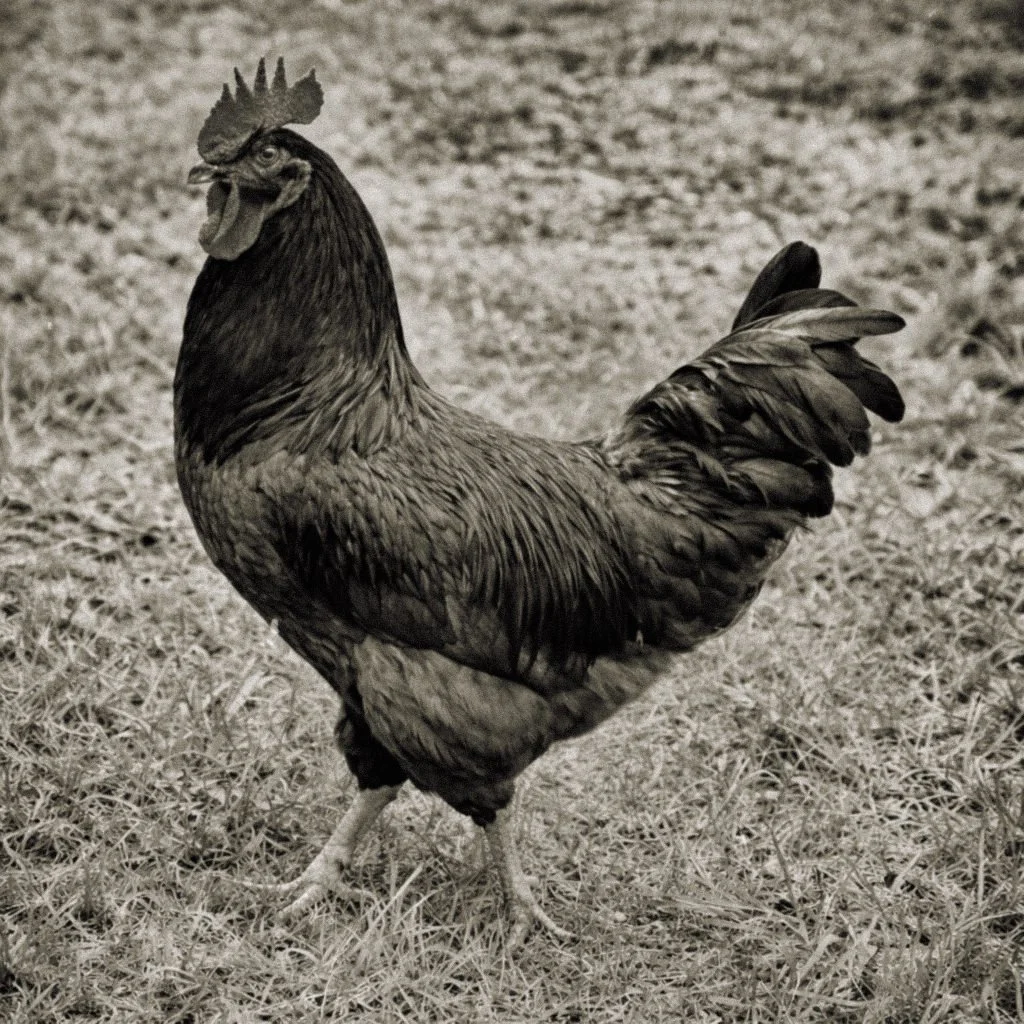
“Big Red”
The first oil was struck in the Pembina Oil Field in June of 1953, but it took a while before the real “boom” broke out. In the flood year of 1954, development was almost in full swing and new, unknown vehicles were everywhere, most of them stuck in the mud in the coulee separating the northwest corner of my grandfather’s quarter-section from the one across the road, owned by my uncle Lloyd and aunt Mary Cooper. It seemed like there was either a Cat or a team of horses on call there all summer long, pulling vehicles up both sides of the steep draw. I think Uncle Lloyd made quite a bit of unexpected cash with his tractor that summer and fall. Our neighbours and friends throughout the district were lending out or renting out every imaginable dwelling from barn lofts and stalls to empty skid-shacks and granaries. The nearby communities of Drayton Valley and Violet Grove were bursting at the seams.
Despite the influx of strange new people and activity with their associated disruption, the semi-annual caravan of indigenous Stoney People with their horses, wagons and multitude of dogs carried on making its regular trek past our little log house in the jack-pines, to and from the higher country in the west and the flatter region near Lake St.Anne. Sometimes there would be as many as 6 to 8 wagons, each with a team of horses and often a few spares. There were usually too many dogs to even consider counting. Although I can’t remember any of them ever stopping, they had a strong effect on me, and I really enjoyed watching them pass by. I always looked forward to their return trip, whether it be in the spring or fall. Altogether, it must have been at least a 2 – 3-day trip, but I don’t remember ever knowing where they camped en route to their destinations. My dad probably knew, but I was too shy to ask. I dreamed about what it would be like to travel with them, and I sometimes wonder if those mystical people and their seemingly carefree connection with the pulses of Mother Nature had played a role in my innate and incessant urge to search the unknown.
Chapter 3
From as early as I can remember, my dad was operating logging camps somewhere in the bush country every winter…
From as early as I can remember, my dad was operating logging camps somewhere in the bush country every winter. Some winters, my mom and I would remain on the farm, tending the livestock and other chores, but, when the operation was of a larger scale or if there was a crunch for time, Mom and I would join the men in the bush, typically occupied with trying to log out and saw into lumber the prescribed quota before break-up in the spring. My mom would take over the cooking responsibilities for the crew and I would be assigned to whatever light chores that could be expected of a youngster.
According to the adults who knew me, I was very slow at learning to speak. Rumour has it that I was well over two years old before I finally uttered my initial ‘’ da-da’’ and ‘’ma-ma’’. However, through an unexpected turn of events one winter, my vocabulary grew considerably. I had no problem in getting to know the men working in the camp – they were a kindly bunch, primarily bachelors who had no kids of their own, along with a mix of married men who probably missed their own children. Nevertheless, throughout the course of the winter, I befriended most of them. I can’t say for certain as to the nature of their motives (although I suspect it was all in the name of fun), but a few of them took it upon themselves to entertain me during lunch breaks or after the day’s work was finished. This often included a chat session somewhere out of sight behind one of the many piles of lumber that continued to grow over the course of the winter. Although my ability to speak improved significantly, the body of the course material was somewhat unorthodox and probably not in line with the educational standards of the day. To their credit, I think they did warn me that some of the language might not be acceptable in the public domain. Unfortunately, I was too young to fully comprehend the meaning of their advice. To me, it was great to finally be learning and pronouncing some new words, regardless of any underlying implications. As it turned out, those first lessons lingered a long time in my memory, causing a certain amount of consternation when I started Grade 1 in Drayton Valley.
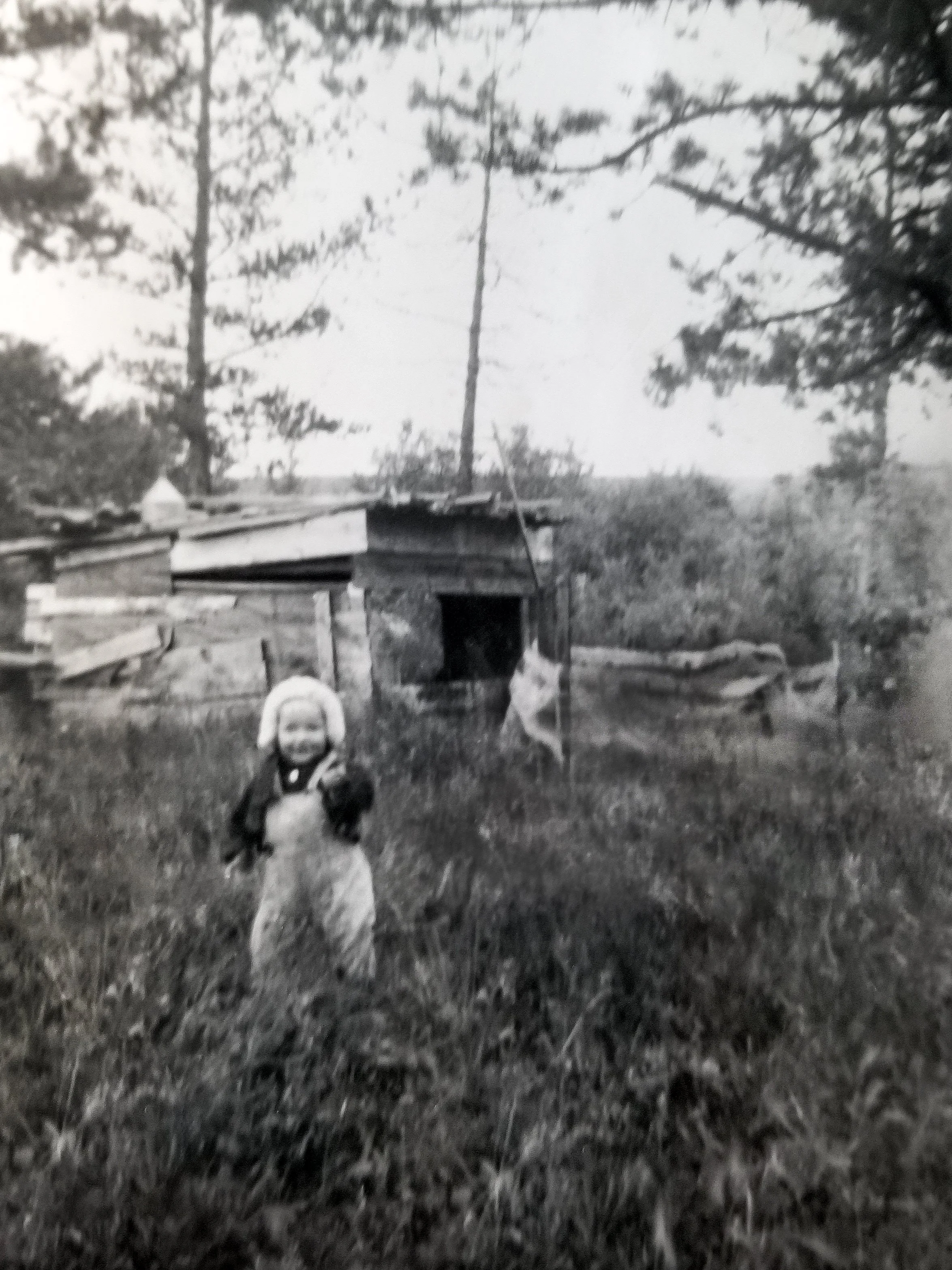
Early Days in the Jack-Pines
The typical routine was that, in the fall, my dad and one or two others would scout out and cruise one or more potential timber berths available for the upcoming winter. Dad would submit a bid to the Department of Forestry and, if accepted, the chosen area would become the location for his logging and sawmill activities through the winter until spring breakup. Most often, the selected berth would be located alongside a river or other watercourse, making roadbuilding and general access a lot easier. As soon as the ice started to set, they could start ‘’freezing in’’ the ice road, starting on foot, progressing to a team and sleigh or light tractor, until the ice was thick enough to carry bigger equipment and, eventually, large loads of lumber. The other advantage of setting up close to a watercourse was the obvious access to water. A hole was usually chopped in a convenient location in the river ice and kept open, from which water would be hauled, often by sleigh or sled, back to the camp cookhouse. Prior to the abandonment of horsepower in the camp, horses would be led to the same water hole two or three times per day, eliminating the need for the hauling of even more water to camp. As I grew older, one of my regular chores would be supplying the camp with water, but in my pre-school years, I was usually a ‘’flunky’’ for my mom, helping with dishwashing, setting the table for meals, supplying wood for the cookstove and other monotonous tasks around the camp kitchen. I learned a few tricks that, in today’s world, are certainly forgotten. One that was particularly useful was for the drying of kitchen cutlery, a seemingly endless endeavour if done in the traditional way. My mom made it easy – upon washing up the dishes after each meal, she simply spilled all the clean forks, knives, and spoons into a clean pillowcase, tied the open end and had me shake the case rigorously until the utensils were dry! In our mundane world, it was a great work-saver!
Everybody in camp worked hard and sometimes the efforts in the kitchen went unnoticed, but it was always a long day for my mother. Partly dependent on the length of the winter days, breakfast was never later than 7:00, so Mom was usually up and about by 5:00, getting prepared for breakfast and for the coffee breaks and meals that followed. As evening approached, it wasn’t uncommon for her to end the day, after finishing up from the supper meal, by helping my dad loading lumber trucks or attending to other undone outdoor chores. I remember many nights falling asleep late to the sound of the sparking slab-fire and the slap, slap, slap of planks hitting the deck of the next load of lumber.
The only chance Mom really had for a breather was in the mid afternoon before the 3:30 coffee break. So, around 2:00, upon cleaning up after the midday meal, she normally took a short nap on the bed in the back room of the cookhouse, during which time I was expected to find my own amusement. Whenever possible, I would don my winter clothes and walk down to the sawmill to watch the action. As I grew older, I eventually tried my hand at lumber-piling and logrolling, but, in the meantime, I usually had to be content with sitting at the small window in the cookhouse waiting for my mother to arise and resume her activities. One afternoon in particular stands out in my memory. My mom was taking her well-earned snooze and I was in my chair near the little window, casually surveying the frosty outside world or the fancy designs that old Jack Frost kept painting on the window panes. It was a cold and dreary day, and it was beginning to snow – one of those days that made one wonder if spring might never come. Staring out the window and sitting so quietly was making me groggy, too, and I was contemplating joining my mother on the bed. Then suddenly, from out of nowhere, a large grey form trotted past the window. I cocked my head aside far enough to see it disappear into the grove of spruce trees at the edge of the clearing. My mom was sleeping soundly, and I did not have the heart to wake her, even though I was bursting with excitement! It seemed like hours before she finally awoke, and, when she did, I couldn’t wait to tell her what I had seen. To my dismay, she said that she didn’t think it could be true. There was no way it could have been a wolf – none of the men had mentioned seeing wolves around this camp. It must have been a shadow, or maybe only a product of my own vivid invention. I knew my dad and the others would believe me, even if my mother didn’t. But, when I informed my dad, I got the same questioning response – he didn’t believe me either! When I brought up the subject at suppertime, a couple of the men thought that it could have been possible, but nobody would openly agree that it might be more than a figment of my imagination. To this day, it puzzles me that something as common as a timber-wolf would be so elusive in the minds of people who had spent most of their lives in the bush! Was it my fault that it had only been me who had seen it? The whole affair seemed bizarre, but there is one thing I know for sure – it was a wolf!
Johnny Jackknife was a popular fellow in the area. He was what everybody in those days called a half-breed, a mixture of Cree and Scottish blood. He was a kind and fun-loving man, slight in stature and quick on his feet. He was well-known as the best step-dancer around. Even at his advancing age, Johnny’s agility was remarkable. He was a conservative drinker, and I can’t remember ever seeing him drunk. He had his wits about him all the time, but whenever anybody pulled out a fiddle or other musical instrument, we knew it would be no time before he would break into one of his favourite steps. He really was a joy to watch, and I never missed a chance to study his movements. There was no shortage of parties in our little log house in the jack-pines, so the opportunities were plentiful. It was just a matter of time before I started trying to copy Johnny’s steps and, before long, he was coaching me and jigging alongside me. It was fun, not particularly difficult, and I loved the attention. Johnny seemed to enjoy my progress and kept egging me on.
My parents and my grandfather were impressed with my newfound talent. My grandpa got a kick out of showing me off in public whenever possible and didn’t miss an opportunity to either clear a space on somebody’s floor or to hoist me up onto a table to do my stuff. I obliged willingly, enjoying the limelight and maybe even more so, the collection of silver that usually accumulated with each performance. Restaurants and other public places were no exception – for my grandpa and me it was a case of “the more, the merrier”! With the advent of improved roads and vehicles, the geographic radius of my performance area grew along with it and I could be found dancing on tables in faraway places such as Entwistle, Seba Beach and Leduc – even as far away as Edmonton and Airdrie!
There were plenty of amateur musicians in the area, so, whenever a party was planned or when one sporadically broke out, there were always a few fiddlers, guitarists, and drummers who drummed on anything from washtubs to pie plates and kitchen cookware, and even the occasional accordionist or other less common instrumentalist. Pianos were expensive and rare, and generally unsuited for the irregularly heated buildings of the day. The few of them that could be found in some of the community halls were so badly out of tune that they were pretty much useless. Bass fiddles were also rare and too bulky to carry around, so the lower end of the musical spectrum was poorly represented. However, on the higher end of the scale, in addition to the fiddles and the occasional banjo, there seemed to be a significant number of mandolin players and there were several neighbours and friends who knew at least a few chords on the instrument.
My dad had an old mandolin that he had taken on trade from Danny McDonald for his Model A Ford a few years prior to my birth. The old car had become embedded in a creek crossing not far from Danny’s place and it wasn’t possible to get it out until the level of the water subsided. So, since Danny wasn’t really playing his mandolin anyway, and since he lived close to where the Model A was jammed, they struck up a deal – Danny took over ownership of the car, for future retrieval, and my dad took the mandolin. The mandolin hung on the wall of our log house and was available to anybody who wanted to play it. Gene Arthur was a relative newcomer to the district and had settled on what came to be known as “Gene Arthur’s Flat”, the flat on the North Saskatchewan River near where the present-day bridge now joins the river’s east and west sides. Gene was a regular attendee at the house parties in the jack-pines, and an enthusiastic mandolin player. He evidently noticed my interest in music and must have concluded that the instrument would be suitable for my small hands. In any event, Gene started to show me a few simple chords, so that I might be able to strum along with the other musicians. The thin strings were sharp on the fingers, and I was barely strong enough to push them down, but, after a few sessions, I was able to play along with some of the tunes. Many of the pieces were in the key of “G”, and that made the task simpler, as the chords in that key were more manageable than some others. It might not have been a great start, but it was more than enough to whet my appetite. It was the humble beginning of an unquenchable desire to make music.
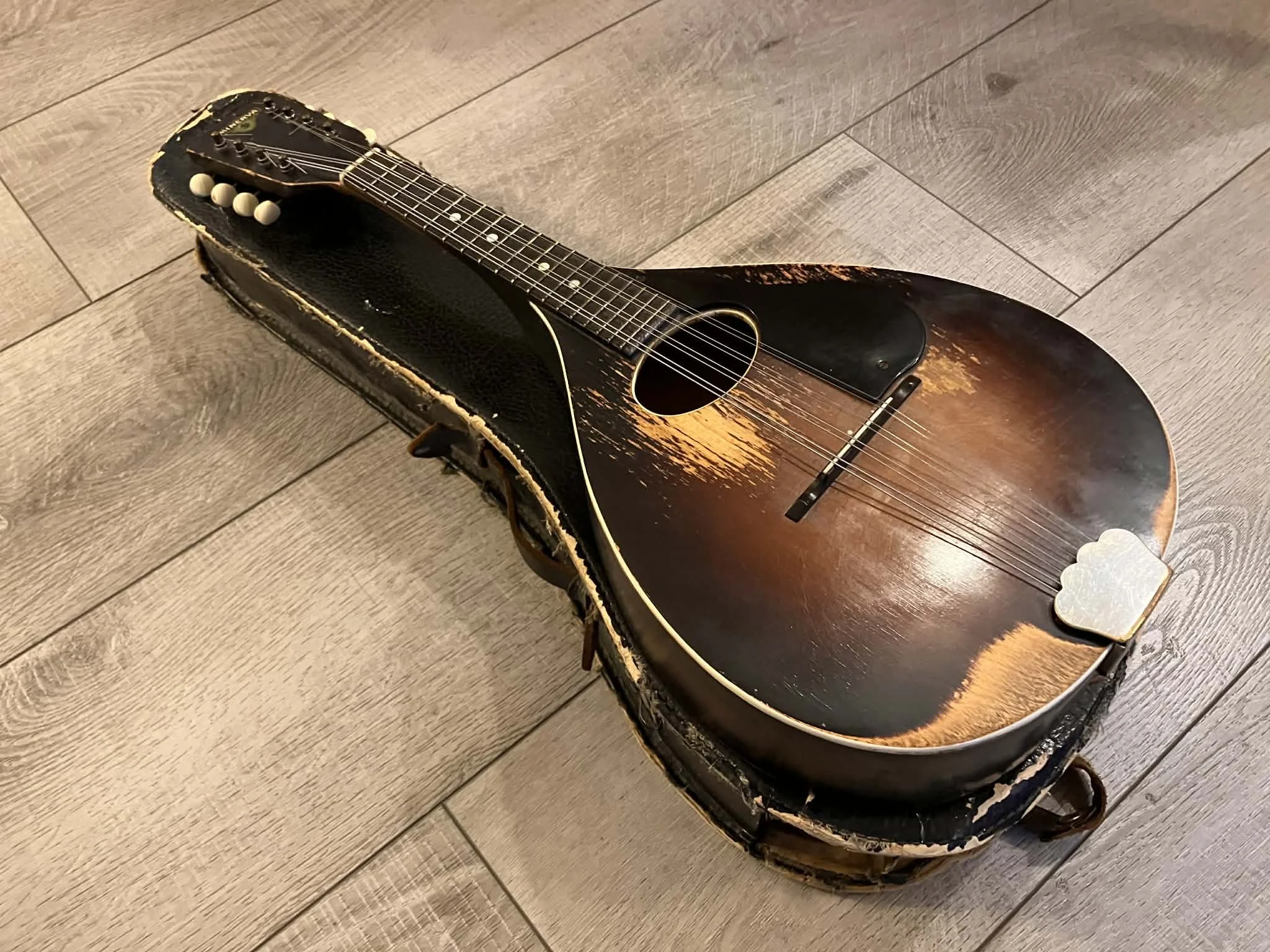
The Old Mandolin
Chapter 4
By 1956, the Pembina oil boom had evolved to an extraordinary level, and, when I started school that September, there were neither classrooms nor teachers to accommodate the enrolment…
By 1956, the Pembina oil boom had evolved to an extraordinary level, and, when I started school that September, there were neither classrooms nor teachers to accommodate the enrolment. Even with the added use of the nearby church parish and whatever other makeshift space that could be put into service, there was simply not enough room for the exploding student population. The problem was temporarily solved by dividing the roster into two separate groups, the members of which attended classes on alternate days of the week. Despite the innovation, class sizes were large and up to three grades were often taught at the same time. Later the same year, elementary students were moved into the first phase of a new, modern building at the opposite end of the school grounds and classes reconvened under less demanding conditions.
I started school in the old Eldorado School building that in 1933 had replaced the original burned-down building from 1915. It was the same classroom where my dad had attended in the 1930s, and his name can still be seen carved in the wall at the school’s present location on the grounds of the Drayton Valley Museum. The first days of school were not easy for me. The surroundings were unfamiliar, and the atmosphere seemed to be uncomfortably rigid. My first teacher was a young lady who lived with her father and his housekeeper just north of our place in the jack-pines and I had known her since I was a toddler. She had always been very nice to me and, only a few days before the start of school, she had picked me up and nurtured me tenderly after a nasty fall on my solar plexus that had knocked the wind out of me. Everybody liked her and she was known to all as Betty, so it was quite a shock to me, when, upon entering the school building, I was sternly directed to refer to her as Miss Whyte. Why would I suddenly be forced to constrain my good relationship with a dear friend by addressing her in such an impersonal way? It made absolutely no sense, and, very often, I slipped back into using the familiar name that I was accustomed to.
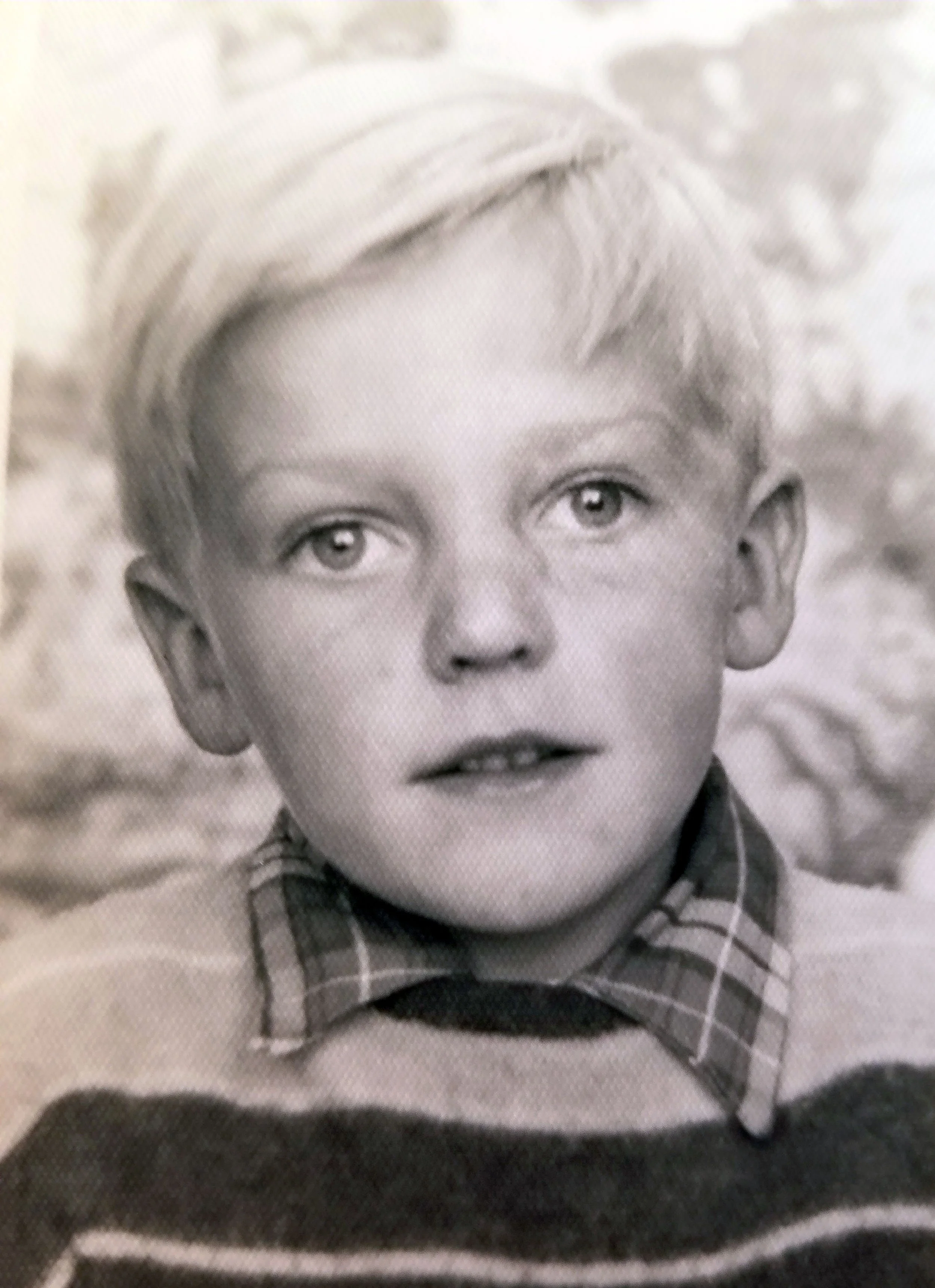
Grade 1
The problem with my teacher’s name was the first of a string of unfortunate complications. Within a few days, I started to get to know some of the other kids and we began to spend more time together. It was unavoidable that our new familiarity would stimulate discussions that concerned our lives outside the classroom. One day, the conversation turned to the upcoming Christmas season and the expected annual visit from Santa Claus. I was a bit surprised that so many people as old as six or seven still believed in that old story and I wasted little time straightening out the facts. My dad had illustrated how difficult it would be for a man of that size to climb down a skinny little chimney, and, if he ever did, how he would be devoured by the flames of the fire below. After all, amid the coldest part of the winter, wouldn’t almost everybody have a fire going? It didn’t strike a pleasant note among the other students and some of them even started to cry. To top it off, not more than a day or two later I felt obliged to share the true facts concerning the origins of newborn babies. That was also poorly received. It was beginning to seem like many of my ideas did not fit in well in academic circles.
Almost everybody we knew was a hunter. It was a simple fact of life – if you wanted to eat, you had to hunt. My father and most of his friends were good hunters and there was never a shortage of meat. In addition, beaver and coyote pelts provided some added income, and even muskrats and squirrels were worth hunting and trapping. As was the case with most young boys, I was eager to join the fold and I pestered my father until he agreed to let me get started. My grandfather had an excellent and compact Remington pump-action .22 calibre rifle with a peep sight that was known for its accuracy and ease of handling. Dad diligently taught me how to handle the gun and lectured me firmly on the dangers of recklessness. I was taught how to take the gun apart and how to clean it, and I was expected to perform that task after every usage, however short the duration. The most important lesson was to never, EVER, point the barrel in the direction of anything I didn’t intend to shoot. As an extra measure of caution, I was only permitted to load one cartridge at a time into the barrel, although the gun had a magazine that would accept a number of them at once. The stock was too long for my short arms, so I learned to shoot with the butt projecting over my left shoulder. As with many other manual endeavours, my left-handedness made the lessons even more complicated. Nevertheless, I shot my first muskrat, right through the eye, while it was swimming in the creek on Brownbill Flats, when I was seven years old. Turning in the cured hide at the Hudson’s Bay, I felt like I had won the lottery!
A year or so later, I was presented with my own Cooey single-shot bolt-action .22 calibre gun with an open sight that had been damaged and repaired. As a result of the work done to the sight, the gun shot consistently high and to the right, but, at the age of eight, I was becoming a seasoned veteran and it didn’t take many practice rounds before I had made the necessary adjustment to my aim. The newer rifle was void of a magazine of any kind, so that the singular option was to load only one cartridge at a time. In addition, the bolt action mechanism was much more quickly and easily removed for cleaning. So, the gun was safer and easier to maintain. My friend, Dale, had a similar gun, but a bit shorter than mine. Although two years my junior, he was a bigger boy than me and could already fit the butt of the stock against his shoulder, while I was still using my ‘stock-over- shoulder’ method. Nevertheless, we were soon allowed to go hunting together. By then, my family had moved from the old Hendricks place to our new home on the farm closer to town where my grandfather had originally homesteaded, so Dale’s family and mine became neighbours. Rabbits were rampant in the area in those years. They were everywhere, eating crops and anything else that might sustain their huge numbers. It was not at all uncommon to awaken to stacks of grain sheaves covered to the point of invisibility by ravenous rabbits. The farmers were irate and open bounty was declared. For young fellows like Dale and me, it was a perfect opportunity to get practised up on our hunting skills. Twenty-two calibre cartridges were sold in boxes of fifty, and we made it our mutual goal to make sure we had a rabbit to show for every cartridge. Sometimes we even hit two rabbits with one shot!
But before long, this kind of hunting proved to be too mundane, and we became bored with the whole idea. Besides, it wasn’t always easy to come up with the money for another box of shells. Maybe we could whittle a couple of longbows from poplar saplings, equipped with a drawstring of binder twine, for hunting rabbits. Arrow-making shouldn’t be a big challenge, since there were always plenty of light, dry spruce trimmings left over from the sawmill or planer. We simply drove a 4’’ nail into the end of a lathe of appropriate length and whittled it to the right thickness, and then sharpened the nail head to an acceptable point. Obviously, it was a shorter-range weapon and less powerful than the .22, but there were usually plenty of rabbits within close proximity. We practised until our shots were at least somewhat accurate, and, after a couple of days, decided that we were ready for our first bow hunt. We were pathetic! Most often, by the time we had strung our crude arrows, the potential game had scuttled away under some nearby bush. Sometimes our makeshift drawstrings succumbed to the pressure of the drawn arrow, and sometimes the poplar bows either lost their resilience and bent backwards or, if a bit too dry, simply snapped in two!
It was beginning to seem like a failed experiment, somewhat of a shock after the huge success we had had with the rifles. Before totally losing heart, I constructed one more improved set of bows and arrows and decided to give the conquest one more try before our planned hunt in a couple of days. I walked into the poplar and willow grove south of the barnyard with my newly constructed gear and took a couple of failed shots that weren’t even close to hitting their marks. But then I spotted another smaller rabbit within close range crouching behind a willow bush. I quietly and carefully nocked an arrow and pulled back on the new piece of twine, aimed a considerable distance above the animal’s body, and let the arrow fly.
Nobody had told me that a rabbit cries like a human baby when it is injured or in distress. With the rifles, Dale and I had never wounded a rabbit – we had either missed entirely or killed the animal outright. Once it was dead, it became a lifeless piece of carrion and of little consequence. My crude arrow point had been adequate to rupture the young rabbit’s stomach wall seriously enough to paralyze it, except for its ability to utter its loud and mournful cry. I was beside myself with remorse, and I impulsively threw down my bow with all its trappings, but the young rabbit’s cries only became louder and more mournful. I wanted to run away, but, as my mind cleared, I knew I couldn’t. I knew I had to put the dying animal out of its misery. I found the broken trunk of a small dry willow tree, freed it from the underbrush, and carried it to within a arm’s reach of the injured rabbit. With a couple or three heavy strikes with the butt end of the trunk, the animal’s life was ended. I laid down the club, left my bow and arrows, and walked slowly away to another secluded area of the woodlot. I would never forget that day nor the sound of the dying rabbit’s cry.
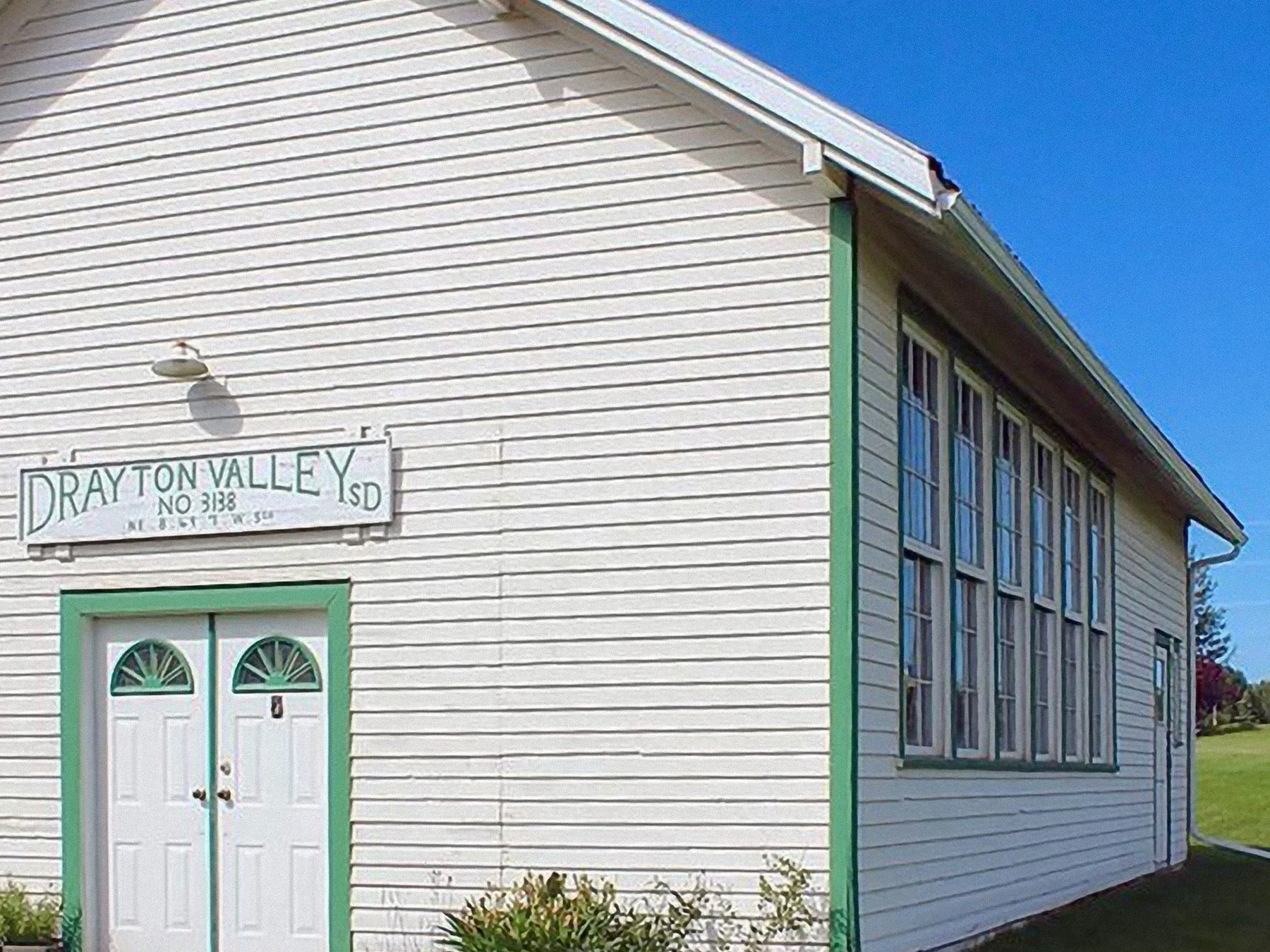
1933 Eldorado School
When I started Grade 2, we were moved from the shiny new elementary school wing and back to more rustic surroundings. The school board had been compelled to acquire several temporary classrooms to try to keep pace with the continued onslaught of new students. In reality, the buildings were nothing more than skid shacks with an entry, a cloakroom and a classroom. There was no running water and a large pot-bellied wood burner near the back of the classroom heated the entire building. Toilet facilities were ‘out back’, except for the occasional frantic run to one of the indoor toilets in the new main building. By comparison, the electric lighting was a definite luxury. My new teacher was a lovely older lady who could undoubtedly be considered ‘old school’ in the purest sense. Even her wardrobe depicted to a tee an era rapidly being replaced by a more modern, fast-paced society. Her dresses reached below mid-calf over her tall frame and were laced or buttoned at the neck and always adorned with various floral patterns and often augmented by a flashy brooch. She wore the old-fashioned dark-brown stockings that had been the go-to style only a few decades earlier, accompanied by the square-cut, heeled black shoes with laces that many of the grandmothers wore on Sundays. I never, ever saw her without her hair done up in a neat bun, usually supported by a couple of large hair clips. To many, she may have seemed boringly out-of-date but, to me, she was one very classy lady. Mrs. Forbes took a liking to me and, before long, she became acquainted with my inherent need for artistic expression. Ever since the early days of ‘’Fun with Dick and Jane’’ in Grade 1, I had thrived on written language and was always eager to try using it in one way or another. About midwinter, I started writing plays, mostly just to satisfy my own curiosity. Mrs. Forbes encouraged me to continue, and I started writing out the various parts on individual slips of paper. One day, somebody suggested that we try to perform one of them in a live setting and I broached the idea to our teacher. She never gave the idea a moment’s hesitation and the following Friday my first play was presented to the class, with each participant reading his or her script from the flimsy strips of paper. The performance was apparently a success and Mrs. Forbes asked if I would be interested in presenting a new play every Friday afternoon. My playwriting career began to blossom.
Unfortunately for Mrs. Forbes, things started getting somewhat out of hand in some of the sequences, possibly a result of the predominantly Western themes. There was a three-quarter length wall separating the classroom from the cloakroom, and some of the cowboys started using their acrobatic skills to scale and straddle the top of wall, firing invisible guns at their assailants down below. Regrettably, I have lost contact with most of my second-grade classmates, so I am not sure how many of them went on to pursue careers as bank robbers or movie stuntmen.
Part of the aftermath from the construction of the new elementary school wing, which was to be the first phase of an entirely new school, were a number of brush piles which hadn’t yet been cleared up, along with a sizeable slough that had been created as a result of the related earthmoving. Although apparently taboo and even dangerous, the brush piles made a great playground for many of us at recess time and during the daily lunch hour. We dug tunnels and made a collection of forts among the piles of dirt and discarded tree trunks. On another dirt-pile devoid of foliage not far from the slough, we played games of ‘’king of the castle,’’ but as the spring thaw approached, the melting snow on the slough presented new challenges. Most of us were familiar with the potential dangers of ‘’rotten’’ spring ice, so we kept our distance, although we had run and played football on the frozen pond all winter long. So, we limited our ball-playing to the area of partly melted snow between the brush piles and the slough.
All went well until, one afternoon recess, somebody with an extra strong throwing arm accidentally pitched a football into the open water near the shore. Not wanting to interrupt our game, especially in the short time we had until the class bell rang, I made a run after the ball, thinking that I might reach it from the water’s edge. However, as I approached it, I realized that the ball was beyond my reach, but only a couple of yards into the water. Earlier in the season, we had learned that the water was quite shallow near the edges, so I opted to take a couple of steps off the shore. The typical footwear for the spring season was high-top rubber boots, and mine were practically brand new and I had not yet folded down the tops as was the common trend. I felt safe in taking the couple of extra steps necessary to reach the ball, although the tops of my boots were within a couple of inches of being totally submersed. I made a hopeful lunge toward the ball, but suddenly lost my footing. The bottoms of my boots slid from under me, and I tumbled headlong into the slough. Before I knew it, my entire body was covered in the ice-cold water! Luckily, the depth of the pond near the shore was barely two feet, so I was able to regain my footing quickly and without difficulty. However, the temperature was barely above freezing, and my clothes were soaked through all their layers, and I knew I had to get out of them fast!
I made a mad dash for my classroom, which was only about 150 yards away. I rushed through the door to find Mrs. Forbes sitting alone at her desk, preparing material for the last couple of lessons of the day, and, no doubt, enjoying a bit of peace and quiet while her students were outside. She recognized my predicament and ushered me immediately into the cloakroom. There she stripped me down to my underwear, wrapped me into her heavy Borg-pile robe (another valued remnant from days gone by) and sat me in a tall chair in front of the pot-bellied heater at the rear of the classroom to thaw out and dry. My teeth had barely stopped chattering by the time the rest of my classmates began to return from the afternoon break. Some who had been nearby and had seen me fall into the slough were not particularly surprised to see me on my perch beside the heater, but a few others could not refrain from pointing and snickering at my unusual attire. The teasing didn’t bother me – I knew how lucky I was to be wrapped in Mrs. Forbes’ warm winter robe, underwear and all!
Chapter 5
By 1956, the Pembina oil boom had evolved to an extraordinary level, and, when I started school that September, there were neither classrooms nor teachers to accommodate the enrolment…
For the third grade, we were, once again, moved into the new building, and my classroom was just down the hallway from the Grade 1 area where I had spent the last part of my first school year. My teacher, Mrs. Mayhew, the wife of a prominent local businessman, and later mayor, of the bustling new oil town, was an up-to-date younger woman with a stricter demeanour than Mrs. Forbes. This younger woman was less artistically inclined and didn’t spend a lot of time catering to miscellaneous theatrical whims, so my blossoming career as a playwright was put on hold. It was a year in which higher level mathematical understanding such as multiplication and division were honed to near perfection, but where above-average English grammar and spelling were also high on the list of expectations. I liked language and was an excellent speller and often won the impromptu spelling bees that Mrs. Mayhew conducted. She was also an avid sports fan and very supportive of all endeavours in that realm, especially in track-meet season. Whether it was the 100-yard dash, the high-jump or broad-jump pits or a ball tournament, she was there to coach, encourage and keep diligent records of the results.
I have always been below average in height among my peers, and, at least during my childhood, I was slight in stature. When class photos were taken, I was usually among those who kneeled in the front row. I guess that might explain why I occasionally got overlooked altogether! At our new place closer to town, the school bus approached every morning from the south, so the drop-off every afternoon was from the north. Since our driveway was east of the highway, that meant having to exit the bus, walk around the front, quickly check for oncoming traffic (even though the bus’s flashing stop lights were activated) and then walk across the highway to the long driveway leading to our house. Such was the standard routine on one particularly warm fall afternoon. The driver turned on the warning signals, stopped, opened the folding door and I exited and started walking around the right-hand front fender to the front of the bus. Here is where the routine was abruptly broken, and, when I was about midway across its width, the bus began moving forward. It would have been impossible for the driver to see a short-legged 8-year-old that close in front of the bus. With both hands I clung to the bumper, desperately trying to figure out what to do. I was sure that, if I let go, I could probably clear the undercarriage of the bus, and, if lucky in my central position, could manage to let the bus pass over me without being run over by its dual wheels. The biggest problem was the potential of being hit by an unseen oncoming vehicle behind the bus. I knew it was only a matter of seconds before I would no longer be able to sustain my grip, so I allowed myself to be pushed toward the left fender. I knew that the only real chance of saving myself was to try to push myself around the driver’s side fender and out of the way of the bus. By now, the driver had picked up speed considerably, and it would be a risky move. With all the strength I could muster (and maybe even a bit more) I gave the left fender a vigorous shove, enough to create some space between my body and the bus. I rolled my body toward the open highway, hitting my shoulder hard against the outside of the fender on the way by. Somehow, I managed to maintain my footing. The bus passed by without making contact again, just in time for an oncoming vehicle coming from behind the bus to swerve and miss me. I ran like a shot across the road and into the driveway, never looking back until I reached the steps of the house.
I will never know what that bus driver was thinking, or why the driver of the oncoming car never tried to contact us. Maybe the adrenaline burst which had freed me from the assault of the bus had propelled me at such a speed in my run home, that he never saw where I had disappeared. In the case of the bus driver, I think his indifference was simply a case of absent-mindedness. A number of students had mentioned that he seemed to be forgetful at times, and he may even have forgotten where he was on his route. When I informed my parents about what had happened, my dad was adamant that he should confront the driver and the school the following day, but I managed to talk him out of it. I didn’t want to cause trouble for the old driver, and I was sure that the situation would be cleared up the following morning. So I was somewhat surprised as I climbed the entry steps, hesitated, and walked slowly past the old fellow the next day. He didn’t utter a word, but simply waited for me to take my seat and drove onward, apparently unaware that anything out of the ordinary had ever happened.
I do not come from a scholastic background. In fact, I don’t recall anybody in my immediate or extended family ever having acquired a high school diploma. My dad, like many of his schoolmates, had left school at the end of Grade 8 since he would have had to leave the community to pursue a higher education. Besides, he was anxious to get to work in one of the many logging camps in the area. My mom came from a poor and rather large family and left home at the age of fourteen and with only a Grade 5 education, to work for a bigger farmer in the district. My grandfather and patriarch of the family never hesitated to share his views on what he called “educated fools”, and how most of them wouldn’t last a day in the bush by themselves. So, I think it was a bit of a shock to all of them as I continued to excel in my schoolwork. It was easy for me; I was like a human sponge, soaking in all the knowledge I encountered and searching for more to learn. I had a good memory and it seemed like I was able to retain what I had learned with little effort. Homework was no issue for me, as I always completed it before the bell rang at the end of the day. Even my tough old grandpa was proud of my scholastic accomplishments.
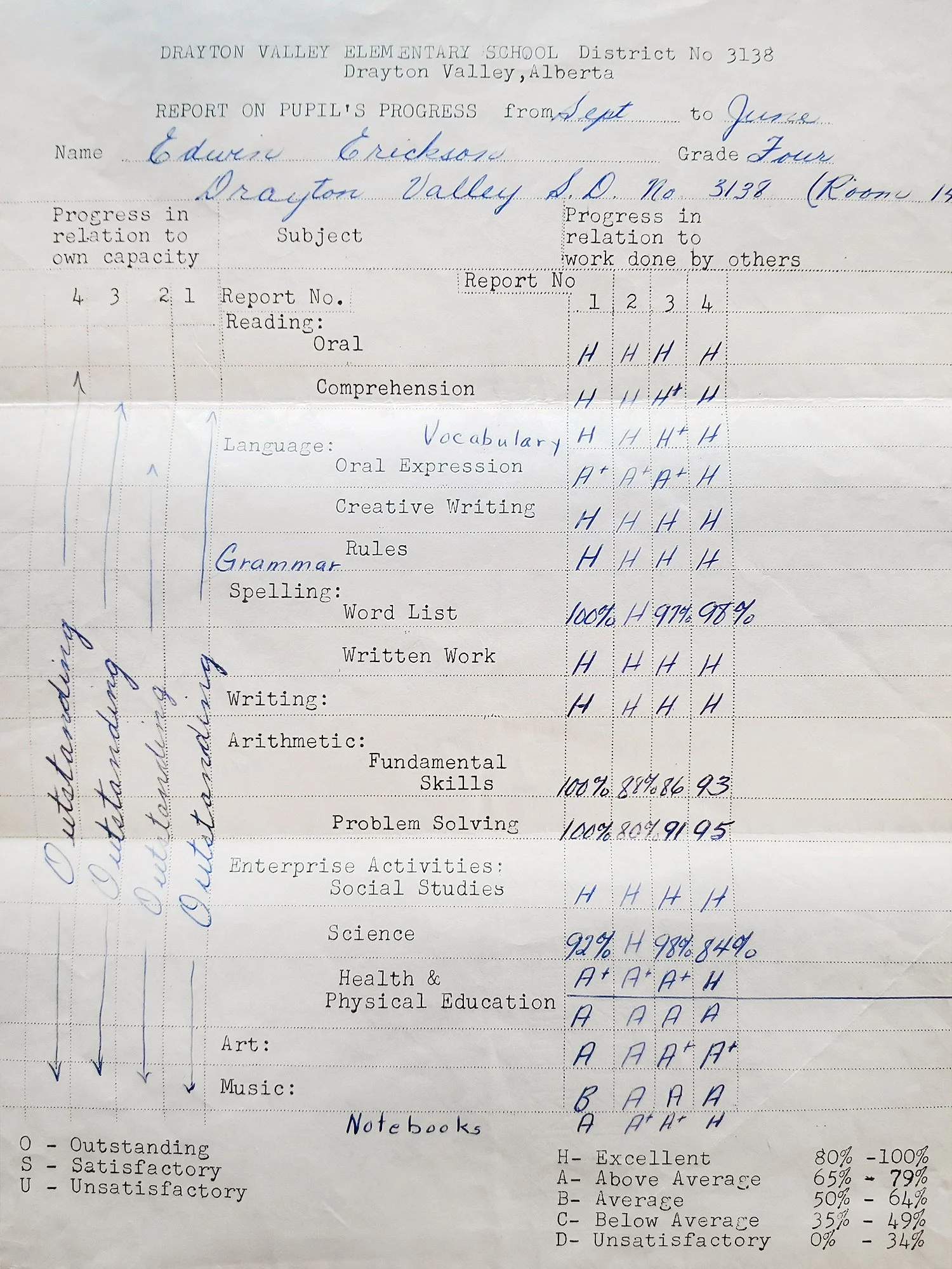
51 Hs
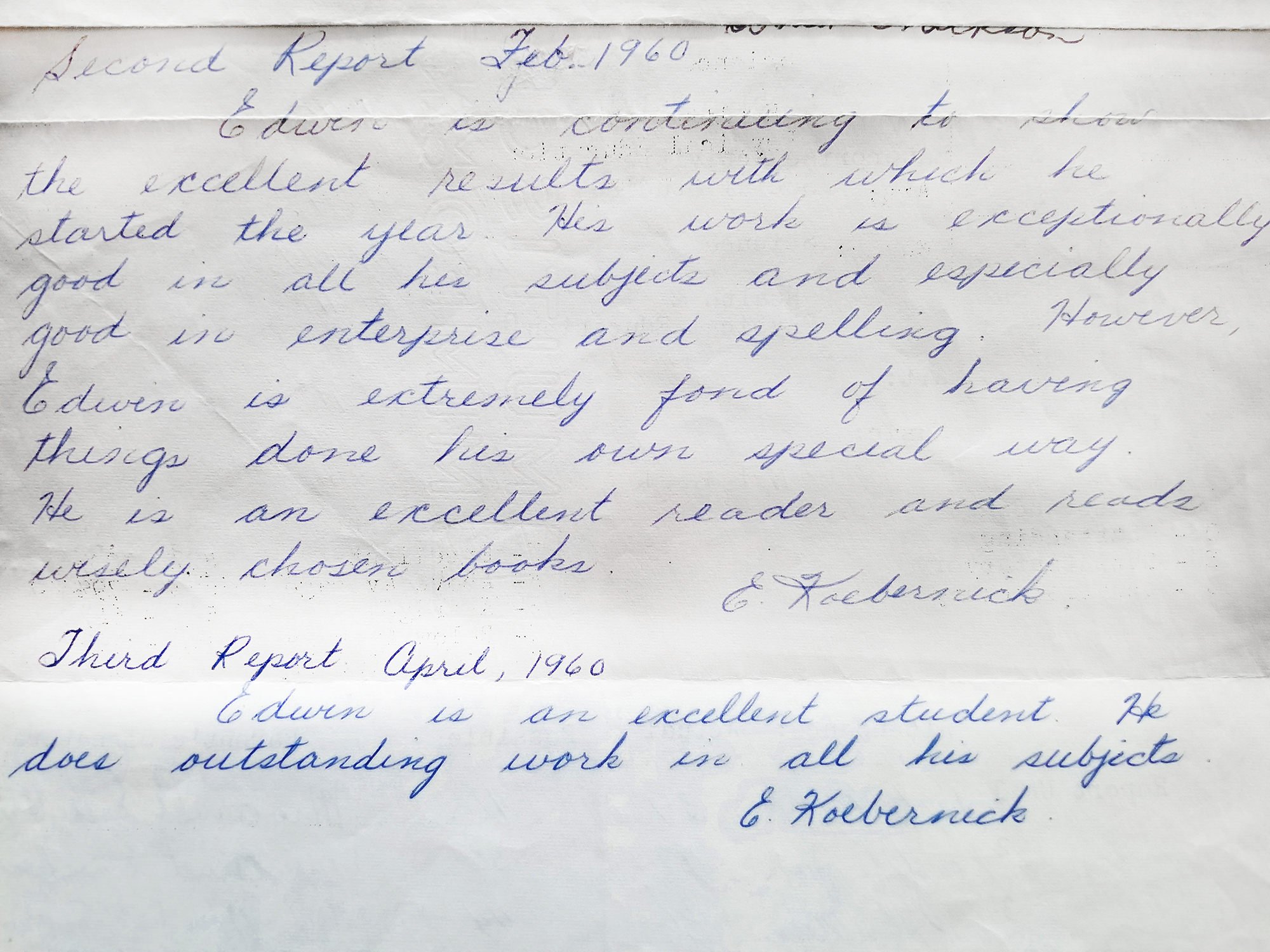
In those days, we were issued four report cards, more or less equally spaced, over the course of the school season. The highest evaluation possible was an H (honour) rating, followed by A, B, C and D ratings. The typical report card provided for these ratings to be attached to each subject in each of the four reporting periods. Grade 4 was undoubtedly the high point of my academic achievement, and at the end of the season I had accumulated a total of fifty-one H ratings throughout the year. The report grid was pretty much inundated by H’s, with only a scattering of A’s and one bashful B peeking precariously through the spaces. I always had a low mark in music – I couldn’t sing three notes in a row, I didn’t care about most of the silly lyrics, and I wasn’t very good at following the teacher/conductor. It seemed to be a waste of time and I preferred to work on my own.
At school, I really liked to talk. Maybe it was because I was often finished with my work ahead of time, or maybe it was just because I loved to entertain and, compared to my existence as an only child at home, the classroom provided a captive audience. As a result, my teachers were usually moving me from place to place in the room to try to alleviate the disruption. Those days, the yardstick was a common weapon for maintaining law and order for many of the teachers. One fateful day, my Grade 4 teacher, Mrs. Koebernick, had had enough of my ongoing antics and came after me with the yardstick. She walked sternly and briskly toward my desk, waving the stick. As she came nearer, I stepped up onto the seat of my desk. I had sharpened the point of my new 2H lead pencil only a few minutes earlier and held it ready along my left side. She came even closer, and I lifted the pencil to the height of my left ear and announced, “Come one step closer and I’m going to let you have it!” She was having nothing to do with my presumably empty threat and continued her approach. I had had plenty of practice hunting muskrats and rabbits and my aim was true. I let the pencil go twirling through the air toward her, finding its mark in the middle of her chest, just above and between her breasts. The sharp lead point was stuck firmly in her flesh, and she ceased her approach. I have often wondered why she didn’t report me to any higher authority, and, even more surprisingly, that we later enjoyed a trusting friendship that survived for many decades.
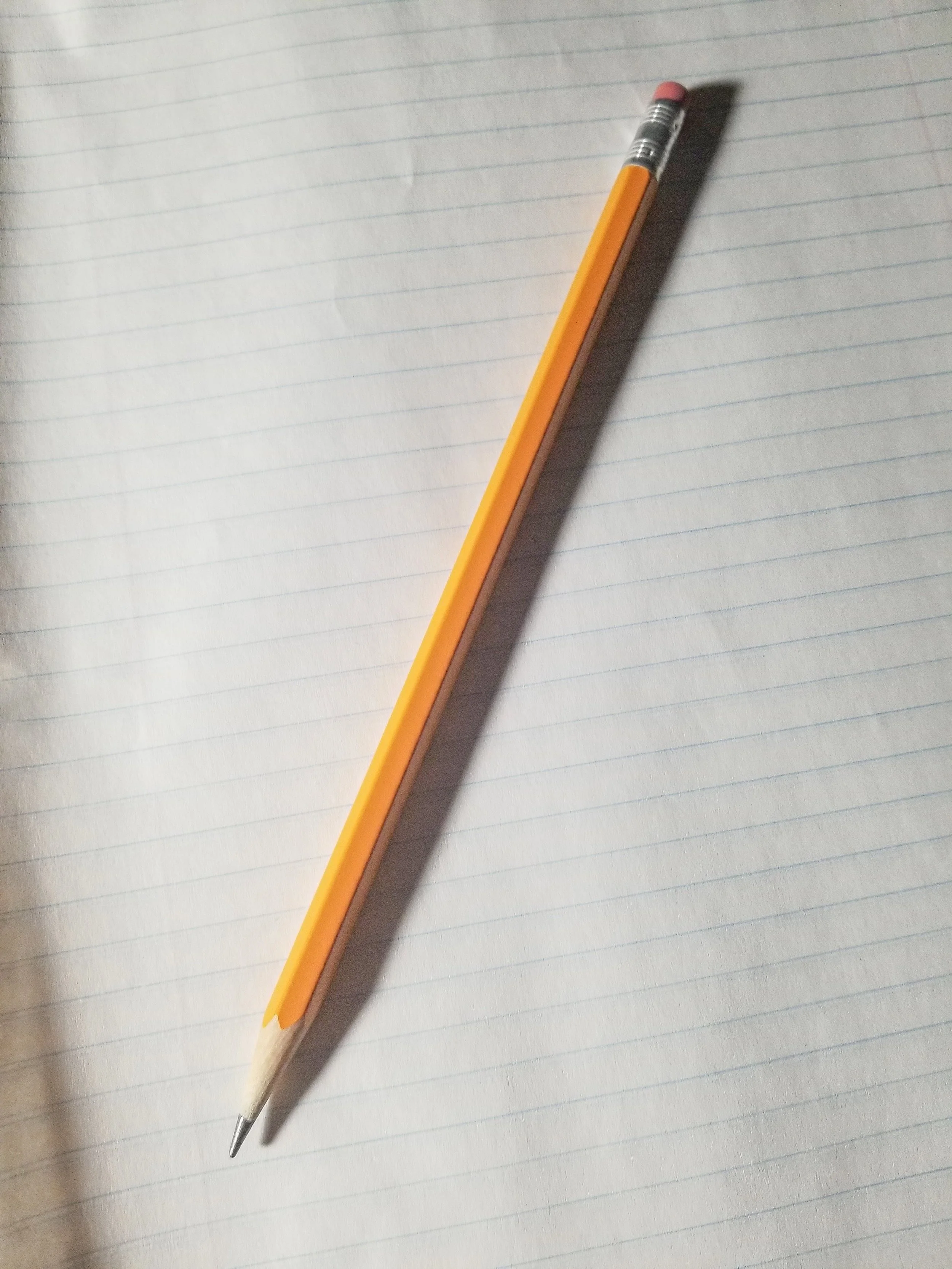
LETHAL WEAPON
Chapter 6
Work on clearing the dam site for the future Brazeau Power Station had been progressing well and my dad was one of six or seven sawmill owners operating in the area…
Work on clearing the dam site for the future Brazeau Power Station had been progressing well and my dad was one of six or seven sawmill owners operating in the area. By the fall of 1960, the pressure was increasing to get the area logged out before the dam was completed and flooding of the area could begin. Bigger timber berths were becoming available, and my dad was offered a choice from several new parcels. All of them were considerably larger than those he had been accustomed to, so, regardless of which one he chose, it would mean enlarging the size of his operation for the upcoming winter. After studying the maps and the synopses for the berths, he chose to investigate one about six miles upstream from the actual dam site that seemed most suitable, and plans were made for a trek into the bush to get a better look at the timber and the terrain. The quality of the timber and the relative ease of logging, combined with a suitable site for a camp were always primary criteria for the final choice.
Cruising the timber would involve driving as close as possible to the site and then walking the final distance to the berth, as well as walking around and through the timber to get a feel for the above-mentioned indicators. My dad would be accompanied on the trek by his two cousins, Vance and Percy, both experienced loggers in their own right, and their input would be valuable in making a decision. I was only ten years old, but adamant to join them, even though my short legs would be a definite drawback. However, the entire walk would likely be about eight miles and, even if they had to carry me on their shoulders part of the time, they conceded to my continuous pleading. We had a small supply of food along, and my dad always carried a knapsack containing the basic necessities such as matches, ammunition for the rifle and some minor first-aid supplies. After eating our lunch in the pickup, we would strike out on foot to our destination. It was a warm fall day, so we didn’t need to carry a lot of extra heavy clothing. Regular autumn clothing, good walking boots and an extra jacket would suffice, along with the token knapsack and its usual contents, two cans of Aylmer beans and a couple of Eat-more chocolate bars for a snack somewhere along the way. Some berries were still in season, and a handful or two now and again would provide some extra nourishment, if desired.
I loved being in the bush and was able to keep pace with the grownups almost all the way, aside from an occasional patch of wet, lower ground that demanded more leg muscle than the average 10-year-old was able to expend. But the patches were not terribly large, and I quickly recovered each time we returned to higher terrain. It was a great day to be on a hike and there were plenty of interesting sights for an inquisitive youngster. The elk were in the midst of rutting season and the calls of the bulls were frequent. At one point, while trekking along the river, we came across a large herd of elk, probably thirty or more. We stopped and watched them cross the river to a steep bank on the other side. It was fascinating to see the athletic, sure-footed animals swim ashore and then immediately scamper up the steep incline. I remember one youngster that was not as lucky as the others, who lost his footing and plunged backward down the embankment. He landed hard on the boulders at the bottom, and we were sure he had broken his back. But, within a few minutes, he was up, shaking himself off, and making a second more successful attempt at the climb, racing through the trees at the top to join the rest of the herd. As the day went by, we were able to watch the herd’s progress along flatter ground on the opposite side of the river. We also managed to catch the occasional glimpse of a timber wolf that followed the herd at a respectable distance, no doubt waiting for a mishap such as the one that we had witnessed earlier at the river crossing.
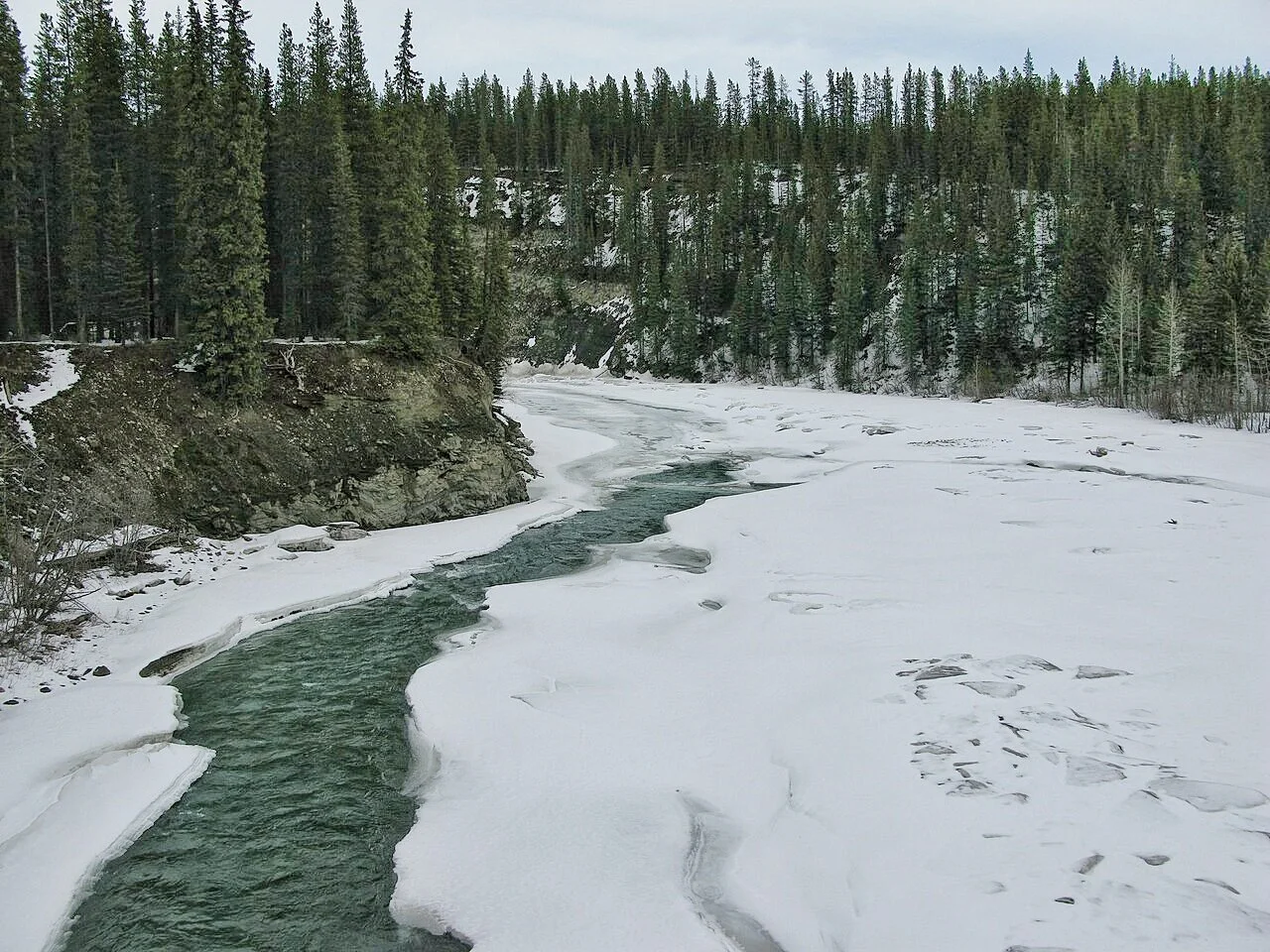
Brazeau River
By late afternoon, the men realized that they had made a mistake. The distances on the map did not coincide with the landscape and the timber was not what was expected for a berth the size of the one in question. After some review of the map, a bit of scouting and discussion, it was discovered that, when we had made a cross-country shortcut, we had ended up too far upstream on the river. The berth we were looking for had to be some distance downstream. My mind started drifting toward the knapsack with the two cans of my favourite beans and the two chocolate bars, but I didn’t dare mention that at this juncture. It was obvious that an important decision was at hand. It seemed ludicrous to have come all this way only to postpone the trip for another day in the near future. The weather was not always this nice in the foothills in the fall, and the next trip might not be so pleasant. It became quite clear – either abort the mission and come back later or prepare to stay the night along the river. The decision was really not that difficult, and it was apparent that there would be enough daylight for us to continue the trek to the timber berth before having to set up camp and consume our meagre supply of food.
As we continued to walk downstream, the men became more certain that their calculations had been correct and that we were, indeed, approaching our original destination. If that was the case, we could camp on the edge of the berth, spend a couple of hours the next morning looking it over, and still be back to the truck reasonably early the next day. An added bonus would be that, as we moved downstream inspecting the timber, we would be walking back toward the truck.
The temperature was beginning to drop, the smell of rain was in the air and, by the time we reached what we thought was the edge of the timber berth, it was starting to sprinkle. There was a nice, gradual slope down to the river, allowing much easier access than many places further upstream. A sizeable fire was lit on the edge of a sandy opening not far from the riverbank. We gathered dry poles and spruce boughs to build a lean-to facing the fire. Then the men gathered some large flat slabs of sandstone from the river and dragged them to our new makeshift camp and dumped them into the fire, where they were allowed to heat while we consumed our evening repast of beans and one of the two chocolate bars. When the stones were sufficiently warmed, they were removed from the fire and placed inside the lean-to and covered with more spruce boughs. Together with the additional heat from the fire itself and the thickly woven spruce boughs above our heads, the bed on the warm stones made for an adequate shelter for the night, despite the stronger drizzle and the typical chilly autumn night.
I don’t remember much more from the earlier part of the evening. It had turned out to be a much longer than expected walk, especially for a 10-year-old, and I must have drowsed off while the men were still discussing the events of the day and the corrections needed for the next morning. For some reason, I awakened sometime in the night. Maybe it was the sound of the rain around our makeshift shelter or the bugling of the elk in the distance, or maybe it was the light from the lingering coals of the fire. In any event, I was obviously the only one awake and I wasn’t particularly comfortable. Not far from the lean-to stood a massive old spruce tree with a trunk that was easily three feet across at the butt end and whose thick, swooping branches reached all the way to the ground. The squirrels had been harvesting its cones for many years and there was a thick layer of them piled around the base of the tree. I arose from my place on the bed of spruce boughs, pulled my jacket tighter around my torso and slipped quietly out from under the shelter. It seemed as though the rain had never developed into more than a heavy drizzle and it was a short and sheltered walk to the grizzled old spruce. As I crouched to find an opening among the heavy branches, I could still see the glowing embers from the campfire. I rustled among the pile of spruce cones and made myself a bed. There was plenty of material to work with and I was easily able to cover most of my body with the insulative material. The massive, thickly grown branches made a continuous circular wall all around me and the forest floor under the branches was completely dry. A lone wolf began to harmonize with his fellow bull elk members of the Brazeau chorus as I leaned my back against the tree trunk and admired my prickly new blanket. Now, with only the companionship of the old spruce, I was the most comfortable I had been all night. In minutes, I was asleep.
It didn’t take long to break camp. It seemed quite strange to start the day without breakfast, but a few drinks of cold, clear Brazeau River water filled up at least part of the void in our stomachs. We would pick a few handfuls of berries as we walked and save the remaining chocolate bar to share later in the morning. The fire had gone out during the night, and, with the warm bed of sandstone and spruce boughs, there had been no need to stoke it up again. So, the fire was safe to abandon, and the lean-to was left intact for any other unsuspecting soul that might happen along, human or otherwise. It was a cool, clear morning and any signs of further rain were not apparent. It was going to be a lovely day, with every indication of being much more fruitful for inspection of the potential timber berth. Almost immediately, we found some axe blazes and markers that indicated that we were, indeed, in the right place. Once we were sure on which corner of the berth we had camped, the remainder was easy. It was simply a matter of walking through the timber in a north-easterly direction until we had seen enough and then continuing onward to the pickup. It went well and my dad was impressed with what he saw. Most of the timber was far enough from the river so as not to be excessively full of sand, which is, of course, very hard on saw blades, and most of the trees were reasonably spaced and without an over-abundance of underbrush, a definite advantage for the fellers and skidders. In addition, except for the river bank itself, the topography was reasonably flat, also a bonus.
As we prepared to leave the berth and start out on the trek back to the truck, we shared the remaining chocolate bar, quite sure that there would be no further complications on the way back. The trek went well until we arrived at a section of muskeg about halfway back to the vehicle. My short legs were beginning to tire, and I was bogging down in the soft footing. Although I really wanted to continue on my own, it was obvious that I wouldn’t make it without an excess of rest stops. Besides, everybody undoubtedly had their sights set on the grub box back in the truck! So, for the remaining couple of miles, I was passed from the shoulders of one to the other. By that time, I was tired enough that even my pride was not too seriously damaged!
Almost immediately upon our return to the farm, a decision was made. My dad was pleased to have found a promising patch of timber on the first attempt, despite the inconvenience of our unexpected overnight stay in the bush. He submitted his bid, and it was accepted. From then on, it was a matter of getting all the necessary equipment and manpower ready to move onto the berth along the Brazeau as soon as the river and the temporary new bush road had frozen enough to handle the traffic. The timber limit was a large one, and there wouldn’t be room for many mistakes before breakup in the spring.
My grade five school year was a short one. It was so short, in fact, that my Grade 5 teacher’s name is the only one of six that I can’t remember. The only somewhat vivid memory I have was preparing the song, “On the Wings of a Dove”, a big hit that year by Ferlin Husky, with two of my female classmates, for the school Christmas concert. As I remember, it was only a marginal success, as my two friends knew virtually nothing about singing harmony while I, on the other hand, was probably the worst singer of the trio. Nevertheless, it filled the time. I tried my best to concentrate on my schoolwork, but it wasn’t easy knowing that I would soon be returning to the timber berth out along the river.
At home, my parents and a number of others were busy preparing for the winter’s activities. By the latter part of December, there was adequate snow cover and the ground had frozen enough to allow my dad and a couple of the men to start preparing a winter road through the timber and “freezing in” the necessary sections of the river. My dad was a skillful cat-skinner, and, in addition, a small Ferguson tractor equipped with half-tracks was used for the first vehicular passes over the ice. Everything seemed to be on schedule for the setup of camp early in the new year, and the first loads of equipment were on the way to the bush by the early days of January.
As usual, camp was set up as close to the river as the forest rangers would allow. Since the entire area was soon to be flooded by the new dam, I think the authorities might have been a bit more lenient than under more normal circumstances. Typically, both sawdust and slab piles had to be a specified distance from watercourses of any kind. The sawmill, cookhouse and a couple of bunkhouses were hauled in by truck, but at least a couple more bunk shacks and a small barn were nailed together with the first green lumber sawed on location, covered with tarpaper and edge boards from the newly sawn logs. Altogether, there would be about twenty men in camp, including mill and bush crews. That number grew somewhat as spring approached and the pressure was on to get the quota filled and everything out of the bush before break-up. Among new members of the crew not part of former years’ activities were my mom’s cousin, Jean, and her husband from the Alberta prairies. Irvin would be driving the arch truck, a new concept for my dad’s operation. It was a three-ton Ford mounted with a skidding arch and used for pulling bigger full-length trees to the mill from longer distances. A couple of smaller Caterpillars were used for shorter skids, and a team of horses was still in use for short skids in difficult locations. Jean would be helping my mom with the cooking and the camp chores and, since she was the academic type, was also the camp bookkeeper and my correspondence school supervisor.
Taking Grade 5 by correspondence turned out to be much easier than anticipated. Once I got the hang of it, I would separate the various subjects and complete large blocks of each one, instead of following the course outline. That way, once I was concentrated on one particular subject area, I would work through several units at once, before moving on to another subject. It was much easier and faster that way, and everything still got sent into the Correspondence School Branch in time, regardless of the order in which they had been completed. I was spending less than half the time that I would have used in a regular school setting, to get more done, and the unit evaluations from the authorities in Edmonton steadily confirmed that the results were above average. The situation couldn’t have been better, as I was left with plenty of time for the pursuit of other more interesting activities around camp. I tried “limbing” fallen trees with an axe for a few days, at the standard rate of seven cents per tree. But try as I did, I was simply not strong enough to make it worthwhile. Many of the trees in the berth were of a significant size, and it took many swings of the axe to dismember the larger limbs near the base of the tree. Around the mill, I was probably most helpful around the lumber piles. Despite my young age and small stature, I was able to neatly pile the 1x4s and other smaller boards.
However, my main job was as the camp “flunky”, helping my mom and Jean with chores around the camp. Peeling potatoes, washing and drying dishes and setting and clearing the long dining table became a regular routine. Among the more demanding tasks was hauling water from the river and supplying firewood to the heaters and stoves in the bunkhouses and the cookhouse. I was also expected to keep the fires going in the bunkhouses during the day when the men were all out working, either at the mill or in the bush. My dad had instructed me to use the petcock valve on the tank of the D2 Cat to drain off enough diesel fuel for lighting the bunkhouse fires when they had gone out. Only enough fuel was needed to ignite the small pieces of kindling; the rest, if loaded properly would continue to burn on its own. Usually, a couple of quarts (a half gallon or so) would suffice for the stoves in all of the bunkhouses.
On one particular day, I hadn’t made my rounds in time, and one of the fires had gone out before I returned. My fuel pail was empty, so I went to refill from the D2, only to find that it had been taken out on a skidding run. However, there were a couple of 45-gallon drums of fuel laying on their sides on some planks not far from the bunkhouse. I rolled one of them slightly sideways to see how much fuel was left in the barrel. It seemed less than half full and was reasonably manageable. If the fuel level was high enough, it would simply be a matter of removing the bung from the barrel, placing my one-gallon container under the opening and rolling the barrel until the necessary amount flowed into the can. My calculation proved to be correct, and I soon had my container half full of fuel, enough to relight a few fires.
I was proud that everything seemed to be going exactly as planned without having to bother asking for help from any of the adults. Unfortunately, there were a couple of lessons that I apparently hadn’t yet learned. Neither my sense of smell nor touch had learned to distinguish between the distinct odour or texture of various fluids, a skill taken pretty much for granted by anybody who works with machinery. The second lesson was really more the matter of a foolish oversight, as opposed to a lesson unlearned. I had eaten many meals beside an open campfire and knew all too well the importance of fully extinguishing the fire and dousing the coals with water before it was abandoned. But the dots did not connect between the campfires and the bunkhouse stove.
I tramped on the foot-lever and opened the stove’s lid, hurling enough fuel onto the remaining coals to facilitate starting a new fire once the wood was added and ignited. Poof! The coals ignited immediately, and the flames blasted through the open lid to my upper torso and face. It was like an explosion – short, but powerful. Luckily, I had dropped the fuel can on the floor right-side-up and on the opposite side of my body away from the fire. Once the initial blast from the fuel had been burned, the fire died to only the smoking charcoal. I ran to the cookhouse and my mom and Jean peeled off my parka, mitts and hat to find that they had protected me well. Although there was some minor burning on my face and ears and significantly more to the front of my hair and eyebrows and eyelashes, all other body parts had escaped a potentially much more serious outcome. Except for some charring, even my clothes were saved. My dad was not at all impressed when he discovered that I had mistakenly poured gasoline instead of diesel fuel onto a bed of coals that also hadn’t been checked for flammability.
My father ran a tight ship in camp. Schedules were closely regulated; starting and quitting times, meal and break times were all strictly adhered to. With spring breakup as a very conclusive deadline, it was completely necessary that the operation stay on track over the course of the winter. Dad treated his men well, but hard work and efficiency were expected. Almost all those who took on work in the lumber camps were acquainted with these basic principles, but occasionally one or two would be sent home with the next lumber truck heading out of the bush. Some would try their luck with one or more of the other camps before leaving the area, but word got around fast, even so far out in the boonies.
Another strictly enforced rule concerned the possession of alcohol in camp. Simply put, it was totally forbidden. Generally, this rule was both understood and accepted by the men. It really wasn’t too difficult to fathom the potential consequences, and all camps in the area adhered to the same principle. However, in most of the half dozen camps in the vicinity, there were always a few men who could not survive for extended lengths of time without a drink. Loggers were a rough and tumble breed and drinking was a staple part of their existence. My dad knew that it was unrealistic to expect these otherwise excellent workers to totally abstain from alcohol over the course of an entire winter, so he planned for a couple of “free weekends” whenever it worked out in the rigid schedule and when the weather and roads cooperated.
Most of the workers either didn’t own a vehicle or had chosen not to bring one over the rough terrain to camp. This made it necessary to arrange transportation to and from camp for those who needed a break. Often it would be as simple as catching a ride with one of the lumber trucks headed for town with a load, or maybe arranging for a lift with one of the married men who had vehicles and were taking advantage of the time off to see their wives and children. Despite potential complications, it usually worked out for those who needed to get out of camp and dispose of some of the winter’s wages.
Getting the stragglers back to camp was often the biggest challenge. It wasn’t uncommon for many of the men to use up all their accumulated earnings before even considering returning to the “dry” camp. My dad knew that the weekend would drag on until money and the resources of friends had run out and they were forced to return to the relative safety of camp. He always had the wherewithal to carefully plan the timing of the break and to organize a backup plan, if necessary, for their extended absence. As an added “bonus”, he was inevitably responsible for gathering up the stragglers who didn’t make it back to camp on their own.
I remember one trip to Edmonton in particular. I had accompanied my dad to find three tardy celebrants who had exceeded the expected return date by a couple of days. My father had a good idea of their potential whereabouts - the trick would be to assemble all of them into one place at the same time. So, we travelled from one downtown dive to another. Dad would go into the pub while I waited in the car, keeping an eye out for clues. A good part of the day went by before we finally managed to round up two of the missing three and, according to them, the remaining man had gone with some friends to the old St. Regis in the midst of the downtown area.
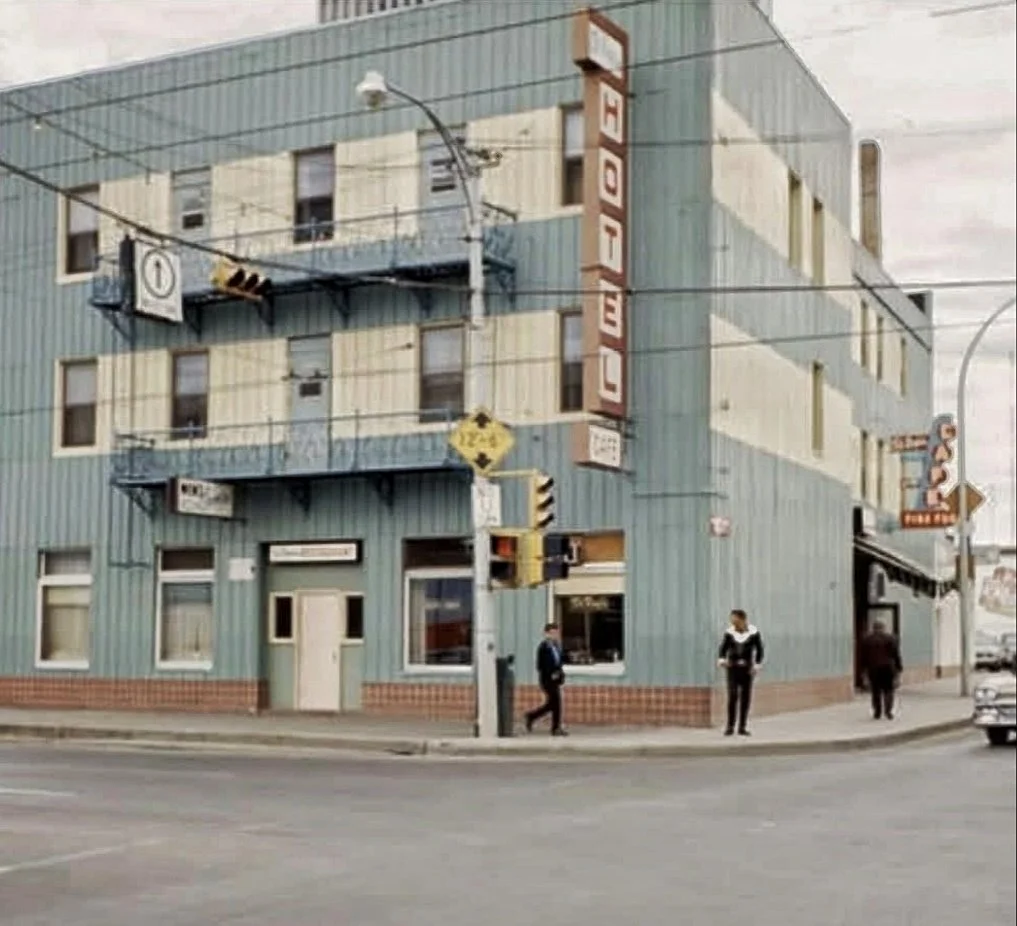
St. Regis Hotel
We parked outside the old hotel and Dad went inside, leaving the fatigued hungover loggers and me to wait in the vehicle. By this time, the two detainees were beginning to dry out and were feeling the pain of the past few days’ escapades. I can’t remember exactly what the delay had been inside the building, but it’s not usually very easy to drag a drinking man away from his last beer. Time lingered on and the two backseat passengers looked as though they might be falling asleep. Then, seemingly out of nowhere, an older man unknown to me approached the car flashing a ten-dollar bill at the men in the back seat. Before I knew what was going on, the two briskly awakened passengers opened the door, jumped out of the vehicle and followed their apparent comrade down the street. It would have been both scary and futile to try to follow. The only hope I had was to pay close attention to where they were headed.
So, when my dad arrived back at the car with what he thought was the last of the stragglers, he was confronted with the new challenge of having to again apprehend the two that he had rounded up not more than an hour earlier! Luckily, I had noticed the two go into another building only a few doors down the street. It was obvious that they had accompanied their newfound pal inside to make appropriate use of the remaining ten dollars. My father wasted no time in taking action, leaving me to babysit the newest arrival while he tromped decisively through the door of the nearby establishment. I could see from his gait that he was becoming a bit more agitated.
Meanwhile in the back seat, my latest assignee was dealing with problems of his own. It wasn’t the first time I’d seen somebody living the trauma of an infliction of the “snakes”, so I had a rough idea of what was happening. Fortunately, the attack had not yet reached the fully convulsive stage, but it was still not a pretty sight. The poor man was in a full-scale verbal battle with himself and his demons. It was as if there were a number of personalities there with him in the back of the car, each struggling to control the conversation. Occasionally, he would thrust himself into a contorted position to better confront his assailants.
Luckily for me, my dad returned in relatively short order with the two other escapees, just as my detainee was in the midst of one of his roughest verbal outbursts, cussing out one or more of his unseen opponents at full volume. When the other two stragglers climbed into the back seat, they unsuspectedly took on the identity of the ghostly participants, at least in the imagination of their afflicted companion. However, even in their hungover state, they were eventually able to calm the man down, at least to the point where he sat reasonably still. The verbal outbursts continued most of the way back to the farm at Drayton Valley but, after a night’s sleep and a decent breakfast, all three were reasonably ready for the trip back to camp where they would spend the remainder of the day resting up before getting back to work the next morning. What a shame that they were starting over with nothing but the clothes on their backs, only to quite possibly play out a similar episode at least once again before spring breakup.
But not everybody in camp was as challenging as these older men, many of whom, a mere twenty-five years earlier, had more than paid their dues to the country and wore the scars to prove it. There was a sizeable group of younger men, both married and single, who worked either in the bush or on the sawmill. One young man from the Carnwood area had pulled a house trailer over the rough road to camp and he and his new wife lived onsite during the course of the winter. Ron worked in the bush as a tree feller and he and his wife, Gloria, spent many of their evenings playing guitar and singing country and western songs in their trailer. Gloria picked up on my interest in music and, before long, she was teaching me some basic chords on the guitar. The timing couldn’t have been better, as I always had some free time when everything was running smoothly in camp and the men were busy either on the mill or in the bush. Gloria and Ron played in a number of different keys, so I began to learn the basic mathematics of musical structure. Very fortunate for me, I was able to add this new knowledge to my very small portfolio of scattered musical notes that was slowly beginning to accumulate.
During the early part of the winter, except for a few everyday glitches, things in camp were progressing more or less as expected. Snowfall was about average, enough to maintain a good ground cover for skidding and moving equipment, but seldom too deep to offer serious challenges, as long as the roads and skid trails were kept open. Most mornings there were a few inches of snow to be shovelled off the sawmill machinery and lumber piles, but the constant movement of manpower and equipment usually packed the snow enough to prevent any serious stoppages. Temperatures were moderate and we were not often shut down due to the cold. The one event that does stand out in my memory is that of a 100-pound propane tank exploding on one particularly cold day. I’m not sure whether it was a faulty valve or if it was the forty below temperature that induced the action, but the almost full tank jumped, hopped and rolled around the cookhouse yard, spewing out propane until it was empty. It reminded me of a two-year-old colt on its first trip to the rodeo!
As the sun started to rise higher in the southern sky and daylight came earlier in the mornings, it was becoming apparent that the size of the bush crew would have to be fortified. There was a lot of timber still to be logged out, and the existing men were simply too few to get the job done in time. Breakup could come quickly and my father wasn’t taking any chances.As usual, he had a backup plan. His cousin’s husband from the Keephills district had a small logging operation in that area and, as it turned out, they had insufficient timber for the season. So, within a few days of my dad’s visit to Keephills, a couple of extra bunkhouses were moved in and a new logging crew installed.
One of the new bunkhouses became the temporary home for a small group of younger men, at least a couple of them only teenagers. Although still considerably older than me, they were the closest I had to a peer group since the beginning of the winter. One in particular was probably about fifteen, and he and I struck up somewhat of a friendship. To pass the time in the evenings, I would sometimes go into their bunkhouse after supper and play cards or simply chat and get acquainted. One evening only a few days after their arrival, the young teenage lad decided it might be fun for the two of us to have a wrestling match. He knew that there was little chance for a ten-year-old against the superior strength of somebody five years older, but he meant no harm and I’m certain that he would never have let the scuffle get out of hand.
My dog, Nipper, was a crossbreed, part German Shepherd and part some other larger breed. He was a young, sturdy dog with powerful legs and torso. He was a good companion and often followed me around the camp as I tended to my various chores. In fact, he was seldom far from my side.
Unknown to any of us, Nipper had chosen to lay down outside while I was visiting with my new friends in the bunkhouse. Upon hearing the sudden commotion inside, he immediately rose to his feet and made one mighty jump at the door of the building, taking it with him as he leaped. Before anyone could react, he had pinned my youthful assailant against the wall. It was all I could do to call him off before he did serious damage to the young man. Fortunately, the only real damage to the youth was to his ego. But that was the end of the wrestling matches, either inside or outside the bunkhouse!
One middle-aged member of the new crew from Keephills apparently fancied himself of management calibre. My dad’s cousin was not able to be in the bush full time as he had other commitments at home on the farm. But my dad and he had a good, solid relationship and well established mutual foundation in the logging business. In addition, cousin Lorne also had a good working rapport with his crew, so everyone had a sound understanding of what was to be done and, more or less, how it was to be carried out. However, the self-proclaimed “manager” had different ideas, and he had a hat, a cigar and a better suit of clothing to show for it. Additionally, it soon became clear that he was neither particularly handy nor capable with the tools of the industry.
So, whenever my dad’s cousin was away, this self-appointed, well-dressed “foreman” felt himself obliged to take over. Occasionally he was actually out in the timber trying to give orders to men who wouldn’t listen, but most often he simply confined himself to the bunkhouse smoking his cigars. Apparently, the bunkhouse had become his makeshift office while the other men were out in the bush working. It wasn’t too long before my dad got wind of his antics and he was warned about keeping his nose out of the management of the operation and to confine his efforts to actually getting some work done. It even got to the point where my dad’s brother, who had temporarily joined us to run a skidding cat, would come into the cookhouse sporting a makeshift fancy hat and a cigar, doing his best imitation of the unbecoming “foreman”. Obviously, this action was carried out behind the back of the “foreman”, and it always got a good laugh!
My dad did not fully appreciate the humour in the situation and, in a few days the “foreman” was an unemployed and unwilling passenger on the next lumber truck heading to town. The “foreman” put up significant resistance, but arguing with my father, especially in those kinds of situations, was like arguing with a brick wall. The “foreman” was gone, never to be seen in camp again.
I had become accustomed to my routine around camp and my chores were beginning to seem more mundane than they had earlier in the winter. I was way ahead on my schoolwork and even the occasional stint of lumber piling or accompanying the horse loggers into the bush was losing its flair. The morning air was void of its crispness, the skidding trails were softening up some afternoons and the smell of spring was in the air. For my father and the crew, the race against spring breakup was imminent, and extra truckloads of lumber were being loaded and dispatched on the frost of the wee hours of the morning. Optimal use of freezing conditions were observed in order to protect the integrity of some parts of the road.
But for me, it was a time of melancholy. I sensed that our time in the bush was slipping away and, with the new intensity in camp, I sometimes felt that I was mostly in the way. I convinced my dad to let me use some of the discarded lumber scraps and a large pail of secondhand nails and went to work building a new doghouse for Nipper. He had been sleeping all winter in a makeshift lean-to attached to the wall of the cookhouse. My timing was far from ideal, but the project kept me occupied when there was nothing more rewarding or interesting to do.
The only tools I had available were a fairly dull handsaw, a claw hammer with a broken claw and part of an old tape measure so, coupled with my limited carpentry skills, progress was slow. Cutting the boards to length was especially cumbersome, partly due to the unsharpened state of the saw blade and partly because of the bigger-than-necessary dimensions of the green lumber. As I rummaged around through the pile of scrap wood, I realized that there seemed to be a relative abundance of material that was either eight feet in length or, with some minimal trimming, could be cut to that length. I also discovered that, if I used some of the longer twelve-foot pieces of two-by-four and two-by-six, I could have a doghouse with an attached deck at the entry without having to do an excessive amount of cutting. So, Nipper’s new home would be 4’x8’ with a solidly attached 4x4 deck, a bit excessive even for a dog of his stature. On the positive side, the framing material was largely rough sawn 2x6’s and 2x4’s and clad with rough one-inch boards, so there was, at least, little risk of the structure blowing away in the wind.
The biggest challenge for me was the roof but, with a few quick tips from my dad and Uncle Stanley, I figured out the necessary angles and how to attach the rafters along the top of the walls. A ten-foot piece of two-by-four would make one set of rafters. Next, I sheeted the roof with more scraps of one-inch lumber and covered it with some leftover rubberoid from one of the bunkhouses built onsite earlier in the winter. The final touch was a flexible two-way door made from a wooden lathe and a discarded piece of canvas. It was a masterpiece! Maybe not exactly a masterpiece in terms of doghouses, but it certainly displayed promise in the realm of exotic granaries or even smaller rail-side grain elevators. But, a masterpiece nonetheless.
Unfortunately, Nipper preferred his old lean-to on the side of the cookhouse and never spent a night in his shiny new abode. A couple of times, I was able to encourage him inside to check the place out but, as soon as I turned around, he would scamper through the canvas door and outside to less restrictive surroundings.
The next couple of weeks went by quickly. Within days, the huge lumber piles were reduced to a fraction of their former magnitude and some of the now empty bunkhouses were loaded onto truck beds, headed back to the farm at Drayton Valley. As the situation escalated, my dad acquired the temporary use of a vacant piece of land along the gravel highway about half way between the camp and the farm near Drayton Valley. Using this as a drop off point would mean having to load and reload everything an extra time, but would help reassure that everything got out of the bush in time. Mother Nature waits on no one, and time was of the essence.
My mother and I stayed until the last day, making sure that all the remaining men were fed, and I continued to look after miscellaneous chores that needed to be taken care of in preparation for the final cleanup. One of the last things to be done was to disassemble and extinguish the slab fire where all the remaining scrap was burned before leaving. I had fallen asleep to the crackling of that fire all winter and it was sad seeing it being flattened and its ashes spread out over the old mill-site.
At last, all the other trucks had left with their loads and my parents and I climbed into the last one, barely in time to make it over the stretch of road on the river before it would no longer carry our weight. We had saved my doghouse for a spot on one of the last loads, but it was simply too big and bulky to fit among all the other more valuable equipment. It had survived the slab fire, but was nevertheless now left to be at the mercy of the natural elements, waiting for the eventual flooding of the area for the new power dam. As we returned to the farm and the days turned into weeks and months, I often remembered my old masterpiece and had visions of it floating about on the future Brazeau Dam, sometimes dangerously approaching the spillway, but never quite being swept over the edge.
Chapter 7
Returning to a regular school classroom had its moments. It was fun to once again be among groups of people my own age but, on the other hand, it was regrettable…
Returning to a regular school classroom had its moments. It was fun to once again be among groups of people my own age but, on the other hand, it was regrettable. I missed the natural, down-to-earth practical wisdom of the loggers and other grownups in camp, but mostly I missed the solitude and independence that I had become accustomed to through my duties and personal activities in the bush. More than ever before, I was beginning to realize that I was not built for a life of conformity. I knew I had to become my own man. I craved opportunities for personal growth which I couldn’t find via the status quo. I hadn’t forgotten my basic guitar lessons back in camp, and I managed to talk my uncle out of an old badly beaten acoustic instrument that he had tried to learn on in his younger days. I was able to fix it up, equip it with new strings and resume practicing the chords I had learned during the winter. I also started tinkering with a small 12-bass piano accordion that my dad and grandpa had found for me in an Edmonton pawn shop a few years earlier.
Academically, the return to school presented little challenge. During the winter months, I had covered the curriculum at will and in my own way, often progressing beyond the prescribed expectations of the subject material. I learned to consume knowledge according to its palatability at any given time. Back in the classroom, I found myself significantly ahead of the class in general and sitting through most of the forty-minute periods was nothing if not boring.
A bigger challenge was to be experienced on the playground. I enjoyed various sports activities, but I had always been small for my age and that was a definite detriment. I wasn’t clumsy or otherwise disadvantaged; I simply lacked the physical proportions necessary to adequately perform many of the expected functions. Although a reasonably fast runner, my legs were only a fraction of the length of many of the boys and, try as I might, I simply got left behind. Invariably, I was among the last ones chosen for the various sports teams, both during the noon hour and within the formal physical education program. But I became accustomed to my disadvantage and did my best to participate whenever it was either necessary or desirable.
However, one spring day proved to be a bit of an exception to the unwritten rule. We were playing our own brand of football, a kind of combination of American football and rugby. There were no explicit rules and the teams were made up of equal numbers from those present and available at any given time. There was an opening kickoff and, from that point, it became somewhat of a free-for-all. However, the ball carrier had to be physically tackled and both passing the ball forward and running the ball into the opponent’s end zone were permitted. After each touchdown, an opening kickoff was again required.
Big Freddie had been held back a couple of grades and was easily a head taller than even the biggest kids, and probably outweighed them by at least twenty percent. He was a fast runner and somewhat reminiscent of a fast rolling steam locomotive as he ran across the field. Simply put, when Freddie had possession of the ball, it was almost certainly a touchdown for his team. No one would dare to tackle him. Unlike me, he was one of the first players selected prior to the start of each game.
But, on this particular day, I saw an unexpected opportunity. I had often thought that there must be a way to stop Freddie on one of his seemingly inevitable runs to the opponent’s end zone. As was often the case, he was passed the ball deep in his own end. Typically, Freddie would then simply run the ball along the field, adding yet another touchdown to his growing arsenal. In usual fashion, potential defenders dropped out of range and, by midfield, he was on his own. Typically, I remained behind the pack, running as fast as I could from the opposite side of the field. But this time I could sense the potential for a unique turn of events. As he roared down the field toward the goal line, I increased my pace to its utmost, until I was running perpendicular to the length of the field and directly toward Freddie. At the last minute, I lowered my head to the height of Freddie’s belly and applied one last spurt of power to my short legs and torso. My aim was perfect and Big Freddie tumbled to the turf, dropping the ball as he fell.
I was exhausted, but Freddie was in worse condition. In my assault, I had inadvertently knocked the wind out of my opponent and he laid helplessly immobile. As the members of the teams stood looking down upon him, he slowly regained consciousness and began to realize where he was. I’m not totally convinced that he knew what had transpired because I’m not sure that he ever saw me coming. Nevertheless, he was not a happy boy as he clambered to his feet. The remainder of the game was somewhat subdued. A lesson was learned that day on the schoolyard, if not for everybody, most certainly for two of us!
My grandpa had been and still was a horseman. It was one more reason for me to admire him and, before he sold his last team, he sometimes let me help him to drive them home and into the barn. My dad, on the other hand, was a machinery man and mentioned on more than one occasion his satisfaction that the horse era was coming to an end. He was a good machine operator and really had nothing against the horses themselves, but looked forward to a career of working with a more modern and efficient medium. It seemed as though horses would have a minimal effect on my future life.
But then, as fate sometimes dictates, a glitch was thrown into the scheme. My friend Dale and his sisters in the Johnson family had acquired a couple of horses and I was welcome to join in the fun of getting to know Buttermilk and Peanuts. Their father was a horseman himself and he had even gone so far as to take some formal courses on training and working with them, a bit unique in a time when many others were following a more industrialized path. I was thrilled to be part of it all and spent many hours on the neighbouring farm, learning some of the basics of horsemanship.
In short order, I was thoroughly hooked. The Johnsons had provided me with the key to a door which my grandpa had already left ajar a few years earlier. I talked about horses daily and urged my father to consider helping me to find one of my own. Despite his innate lack of desire to become reacquainted with the horse realm, he quietly acknowledged my zeal. But he wasn’t prepared to take the easy route - that simply was not his style. He wanted me to fully appreciate the experience and to provide me with a learning experience that would follow me into the future. He and my mother’s brother had some mutual friends who had had some success with capturing wild horses from the foothills. My dad also had an old Willys army jeep that was perfect for off-road travel and, in addition, he had a number of good friends from the Stoney First Nation living at least part time out in the west country. So my dad and uncle Harmon headed out to try their luck at catching one or more “wildies”.
Much to my disappointment, after several days, they were unsuccessful. Apparently, the herds that normally travelled in the area of their search had moved on to greener pastures, and the novice wranglers came home empty handed, without as much as a sight or even a sign of any equine prospects. Through all the exciting talk about wild horses, I had come to really cherish the idea. But now it seemed as though my dream of having a horse at all of my own had vanished into oblivion.
But, true to form, my dad came through with a Plan B and, within a few weeks he had located a wrangler in nearby Rocky Mountain House who was in the business of capturing and selling wild horses. I didn’t really believe my eyes as he drove into the yard with a 5-6 year old bay mare and a 2-year old black filly loaded into a makeshift stock rack on the back of his old pickup and unloaded them into a small cattle pen in the barnyard.
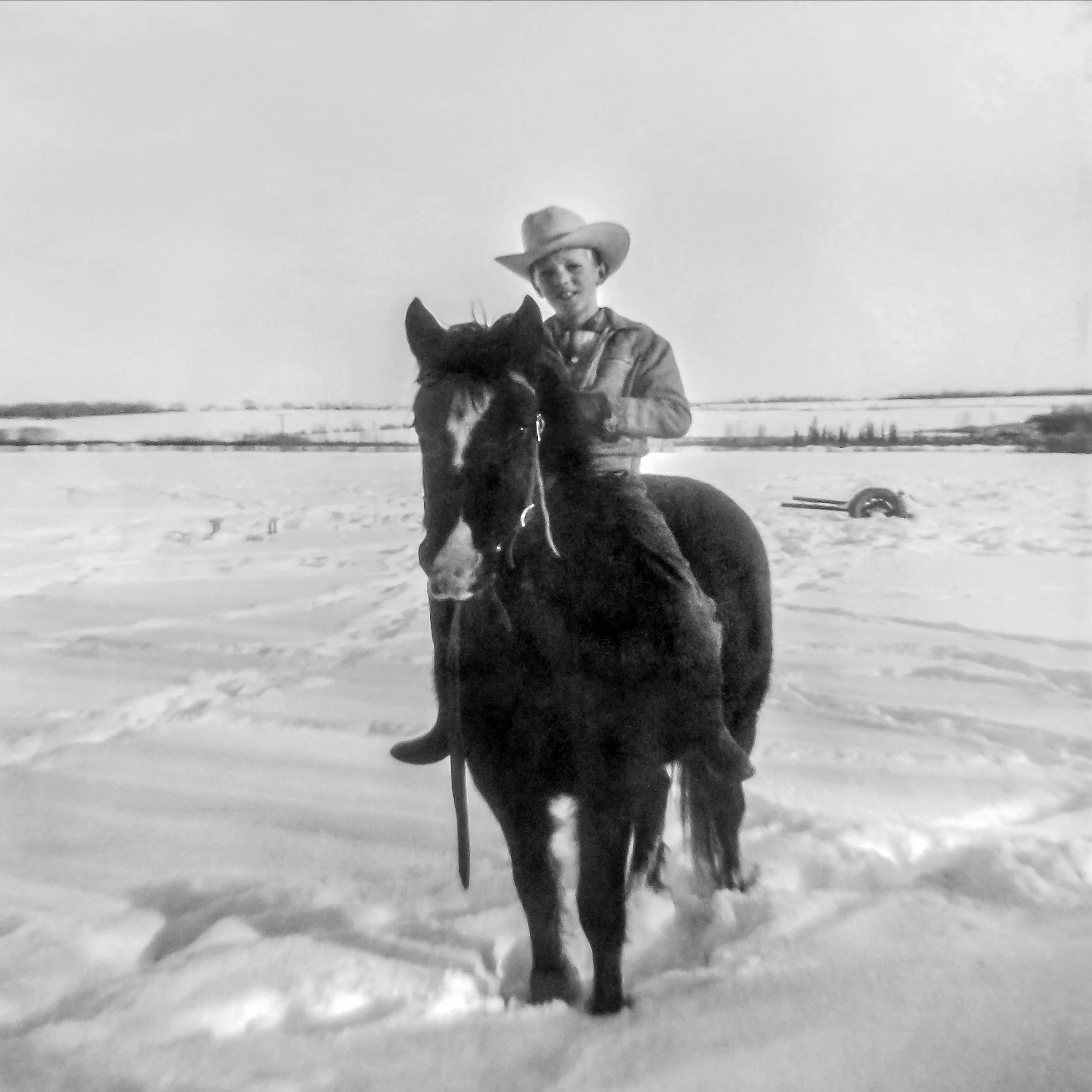
Princess
After a few days experimentation and consultation with a couple of horsemen in the area, it was determined that the bay mare had been mishandled by some unknown rough-handed wrangler and the nerves in her head and neck had been so severely damaged that she did not respond to a halter or rope of any kind. She would pull endlessly with her full strength against the pressure of the gear, without the slightest sign of pain or discomfort. It became apparent that she would never be broken to lead, never mind the prospect of ever riding or driving her. But she was a fine looking horse and a good companion for the younger black filly who was to be my horse.
The little filly was a lot easier to deal with. She had obviously never been either handled or mishandled by humans and had thus never acquired any habits, neither good nor bad. Once the men were able to corner her and get a halter and a lead shank in place, the rest was relatively easy. She was simply tied to a sturdy post and allowed to struggle against her own body weight until she succumbed to powers beyond her control. In a short time, she learned to respect the limits of the rope and to give way upon feeling the pressure. Except for some minor finesses, she was broke to lead. It was great to know that, with careful attention to the use of the lead shank, I was now able to lead my soon-to-be partner pretty much anywhere I wanted to go.
The next step was a bit trickier. Somebody was going to have to climb on her back and try to get her used to a bridle and to the concept of being ridden. I was totally inexperienced and much too small to take on the task and it was important that her first time under saddle was a decisive one. A family friend was quick to step up to the challenge. Roger was in his late twenties, strong, heavy-set and tall. He had been raised on the farm on the Prairies and had been riding horses since childhood. The poor little filly didn’t have a chance. Once on her back, his feet dangled almost to the ground! The little twelve inch saddle that my dad had found for me was altogether too small for Roger, but he really didn’t need it anyway. His weight and strength were more than adequate to control the little horse and, before long, Princess was complying with his tugs to the left and right on the reins. During a second and third session over the next couple of days, he showed me how to cross the reins under her chin so that she could learn to respond to the pressure of neck-reining, the usual method of steering in Western fashion.
After the initial three sessions, Roger had to leave the area and return to the Prairie. Before he drove away, he warned me to be forceful with my little horse, keep the reins tight at all times and, most importantly, not to let her “have her head”. I wasn’t entirely sure what that meant, but I thanked him for his help and advice and told him I would do my best. But I thought to myself as he drove away, that I hoped I wouldn’t have to be as heavy-handed with Princess as he had been. She was going to be my new partner and friend, and I wanted to treat her with kindness. Little did I know then that my empathy might eventually prove to be my downfall. Nevertheless, I was on my own. Roger was gone and I was obviously expected to take up where he had left off.
I was about to embark on one of the biggest challenges I had ever faced, but was totally convinced that I was doing the right thing and that I was about to become a horseman! However, there was one slight glitch in the plan at this point. Due to the absence of suitable tack, Roger had ridden my little horse bareback, without a saddle. This meant, of course, that she had never experienced the tightening of a cinch around her girth nor the presence of stirrups dangling at her sides. Both my dad and I knew I wouldn’t have the strength to tighten the cinch adequately to hold the saddle in place, nor would I have the ability to lift a saddle onto the horse’s back anyway. I really wanted to get started riding and didn’t need any further complications. But we also knew that I did not have the weight, strength or balance to ride bareback, especially at this early stage. So my dad fashioned a simple single girth strap out of a large buckle and a discarded piece of sawmill drive-belt. It wouldn’t be necessary to tighten the strap more than I was capable of, but it would still be stable enough for me to use as a handhold when I was riding, not unlike a bareback bucking rig at a rodeo. The only remaining problem was the one of actually mounting the horse without the use of stirrups, but that was soon rectified through the use of any nearby fence rail, hay bale, 5-gallon bucket or whatever else happened to be handy to stand on. Finally, I was mobile!
Adjusting the homemade cinch turned out to be less of a problem than expected. Princess had learned her lesson well regarding the power of the halter and lead shank. As long as I had her adequately tethered to a post with an attached rail fence, she would stand relatively still while I fussed with attaching the cinch. In addition, the rail fence allowed her only a limited radius of sideways movement. I soon found that, if I slid the end of the cinch over her withers until I could reach under her belly to grasp the loose end, I would cause her the least amount of anxiety. Then it was simply a matter of pulling the end around her belly, being careful not to touch her body as I pulled it toward the buckle on the opposite end. If I was careful enough to thread the loose end through the buckle without alarming her, all that remained was the tightening of the buckle. She was a bit skittish the first couple of times that I tightened the cinch and shifted the buckle to the top of her withers but, after a bit of repetition, she started to become comfortable with the whole affair. Luckily, I had been able to contain my own temptation to jump onto her back the first few times, avoiding any further trauma.
Putting on the bridle and adjusting the bit in her mouth proved to be even more of a challenge. Here again, as was so often the case, my short stature was an impediment. The headstall had to be held up adjacent to the horse’s ears with one hand, while the other hand fitted the bit into the mouth, being careful not to bang the horse’s teeth or otherwise injure her mouth. My parents helped me the first few times, until I was able to perform the procedure myself by climbing up the rails of the fence to the appropriate height so as to attain the position required to get the headstall over her ears and the chinstrap fastened. With a number of practice runs, I felt confident enough with the situation and I was relieved to think that Princess was also adjusting nicely, in spite of my awkwardness.
Now it was time for the ultimate test, actually getting on her back and taking the initial steps toward our forthcoming partnership as horse and rider! There was only one remaining security measure that had to be dealt with before we could be sent off on our own. My parents had decided that it would be best if one of them was to lead my horse while I made the first attempts at riding. I crawled into position from the security of the rail fence, adjusted myself behind my dad’s cinch strap and took the reins in my left hand. I was careful to make sure that the reins were crossed under Princess’s chin, as we would both still be learning the finesse of neck-reining. One or both of my parents would then hold onto the horse while mimicking my commands as closely as possible, so as to reinforce the signals and minimizing the confusion for the horse. It went well and, before long, my parents were able to quietly loosen the grip on the bridle and, without really knowing it, Princess and I were on our own!
At first, I was satisfied to practice my riding skills within the confines of one of the corrals intended for the cattle, and used only during the winter months. It was large enough to offer at least some limited mobility while acting as a security blanket in case of any eventual mishap. This way, I could practice mounting and dismounting, continue working on the neck reining and start getting used to riding at various gaits and speeds with a minimal amount of risk. In the event of falling off and losing grip on the bridle and/or the horse itself, it usually wasn’t too difficult to recapture her and resume where we had left off, especially with the help of a small can of oats which I had learned to keep close at hand for such occasions. Over the months and even the following couple of years, we made a significant dint in the oat bin, and trips to the medicine chest were held to a minimum only because of my characteristic stubbornness!
Spending a winter in the area upstream from the future Brazeau power dam had allowed my Dad and his men to become quite familiar with the area and its resources. Aside from the river itself and the timber remaining after the logging operations, the region possessed an abundance of wildlife, especially elk. The following year, they decided to spend at least part of hunting season trying their luck among the herds in the new area. By now, they had good knowledge of the terrain and access points. New logging trails had been constructed, providing added access to otherwise less accessible parts of the area. New undergrowth had sprouted up on the recently logged berths to provide added nourishment for wildlife. A more promising hunting ground would be hard to come by.
A hunting party was organized to set up camp somewhere close to the previous winter’s logging site. Obviously, this early in the season, access would not be much better than on our initial overnight timber cruising trip the fall before, but the availability of game would likely be equally good along the river between last fall’s parking spot and the site of the winter logging camp. If the hunting party was of significant size, the hunters could break into two camps, allowing for better coverage of the area. The group was made up of my Dad, a couple of his cousins, a few of the men from the previous winter’s logging camp and a couple of old family friends. In a day or two, after they had scouted the area and more or less deciphered the movement of the elk, my grandfather joined the group.
My grandpa was in unusually good shape for a man in his seventies and had spent most of his life in the woods. There was little concern that he might be less capable than the younger men. It was true that he had recently been somewhat troubled by spontaneous momentary blackouts and shortage of breath, but never to the point of serious concern. Doctors were not so readily available in those days and old- time lumberjacks like my grandfather had generally learned to live without them.
As I understand it, my grandfather’s first day in camp was spent hunting in a two-man team, still scouting the various areas and checking out the availability of game. On the second day, he and his partner decided, upon coming across fresh signs of elk, to split up into two different directions. As the sun began to make its way over the horizon, the hunters began to return to camp, but grandpa was not among them. His nephew, who had started out as his partner earlier in the day, had returned, not having seen his uncle, but having heard a couple of rifle shots from the area southwest of where he himself had been hunting. The initial presumption was that the older man had killed an animal and was probably skinning and butchering it before returning to camp. My grandfather was a seasoned hunter and woodsman and the men were familiar with his independent, self-reliant way of doing things.
As evening wore on, the men became more concerned and one of them fired the customary three simultaneous shots in the air as a distress signal, but the expected answering shots did not follow. A bit later, a large bonfire was built, in the event that grandpa might wander to within sight of the camp sometime later in the night. The bright spruce fire would be seen from quite a distance, even in the dark, moonless forest.
However, by daybreak the old patron had still not returned to camp and my dad and the others realized that something out of the ordinary must have taken place. It was decided among the men that the morning would be spent conducting a search and, if that did not produce the desired result, outside help would have to be solicited. Although the nights were getting colder, there had not yet been any significant snowfall, making tracking considerably more difficult.
Upon return to camp in the early afternoon, no sign of grandpa had been seen by any of the searchers and the general consensus was that he must have wandered further to the southwest than was speculated from his rifle shots the day before. It was decided that my dad would make the roughly two and a half hour drive north across the new dam site, to Drayton Valley to gather additional manpower and associated supplies. Meanwhile, the others would continue their search, spreading out more widely from the morning efforts. By now, most of the men were beginning to expect a less than ideal outcome. For the first few hours’ hunt, my grandfather had left his “grub box” in camp and had taken only his small canvas bag with the bare necessities with him on the initial trek. Everyone agreed that this would not be much sustenance for a longer duration.
It was late afternoon before my dad arrived home and broke the news to my mom and me. I simply refused to believe that a man of my grandfather’s calibre could be in danger. He had been through more than his share of difficulty and challenge over the years, and a couple of nights in the bush certainly wasn’t going to bring him down. I argued that he was probably just having trouble preparing his kill or maybe even working on transporting it back to camp.
Meanwhile, my dad had called the RCMP and the Forestry to make them aware of the situation and to ask that they might possibly lend their assistance in the search. The RCMP promised a couple of constables and a tracking dog for the next morning. The Forestry people, who my dad had built a good working relationship with in recent years, thought they might be able to provide a helicopter if necessary.
Early the next morning, my dad set out on his way back to the hunting camp, planning to intercept the remaining men before they began another day of searching. However, as he approached the river crossing at the new dam site, he was met with an unexpected challenge. A watchman had been installed on the crossing, due to a change in construction plans, and had been instructed to turn away anyone attempting to cross. The watchman approached Dad’s pickup and informed him that he was not allowed to cross. My dad attempted to explain the situation to him, but the man was not prepared to make an exception to the orders he had been given. He even stepped in front of the vehicle and gestured to turn the truck around and head back toward the north. My dad was losing his patience, thinking about his father somewhere back in the woods. “You can stand there all you want “, hollered Dad, “but I’m coming through whether you stand there or not.” With that, he engaged the clutch and proceeded at a formidable speed across the dam. The watchman knew that my dad meant business and offered little resistance.
Later that morning, the RCMP constables arrived in camp with a tracking dog. As I remember having been told, other members of our rural community also showed up that day to assist in the search. The word had begun to spread and even the Edmonton Journal had started to cover the story. But, by nightfall, there was still no sign of my grandfather. Apparently there was not enough of a residual scent on any of my grandpa’s belongings to give the dog a baseline from which to pick up a trail, and none of the searchers had found any evidence whatsoever of his whereabouts. The last clue as to his presence in the area had been the rifle shots that the hunters had heard a couple of days earlier. The situation was looking dim, and the general speculation for finding my grandfather alive was tentative at best. However, a sizeable bonfire was once again kindled and kept stoked throughout the night by my dad and the group of men who stayed overnight in camp.
The RCMP had been in radio contact with their Drayton Valley office and with the Forestry to relate the news of the day’s search and to request that a helicopter be dispatched as early as possible the following morning. They had also been in contact with my mom, so that the rest of the family at home would be updated on the status of the situation. She was told to expect an undesirable outcome. But I would not accept the possibility that my grandpa might have perished out in the bush, carrying his rifle, a small hand-axe and a knife, in comparatively mild fall weather. It wasn’t possible for a man of his character and capability. I insisted that he was alive and that he would likely show up on his own accord.
The morning of the fourth day the helicopter arrived and a somewhat reduced ground crew resumed the search. The helicopter made a grid of passes over the area in question, flying as low as possible above the tall timber, some of which still grew tightly despite the logging operations of the past few years. The men in the ground crew tried their best to cover the areas that might not yet have been searched. The RCMP did their part to assist the woodsmen, many of whom had not left camp since the search had begun. Even the tracking dog had been returned, in the event that any new scent might be uncovered.
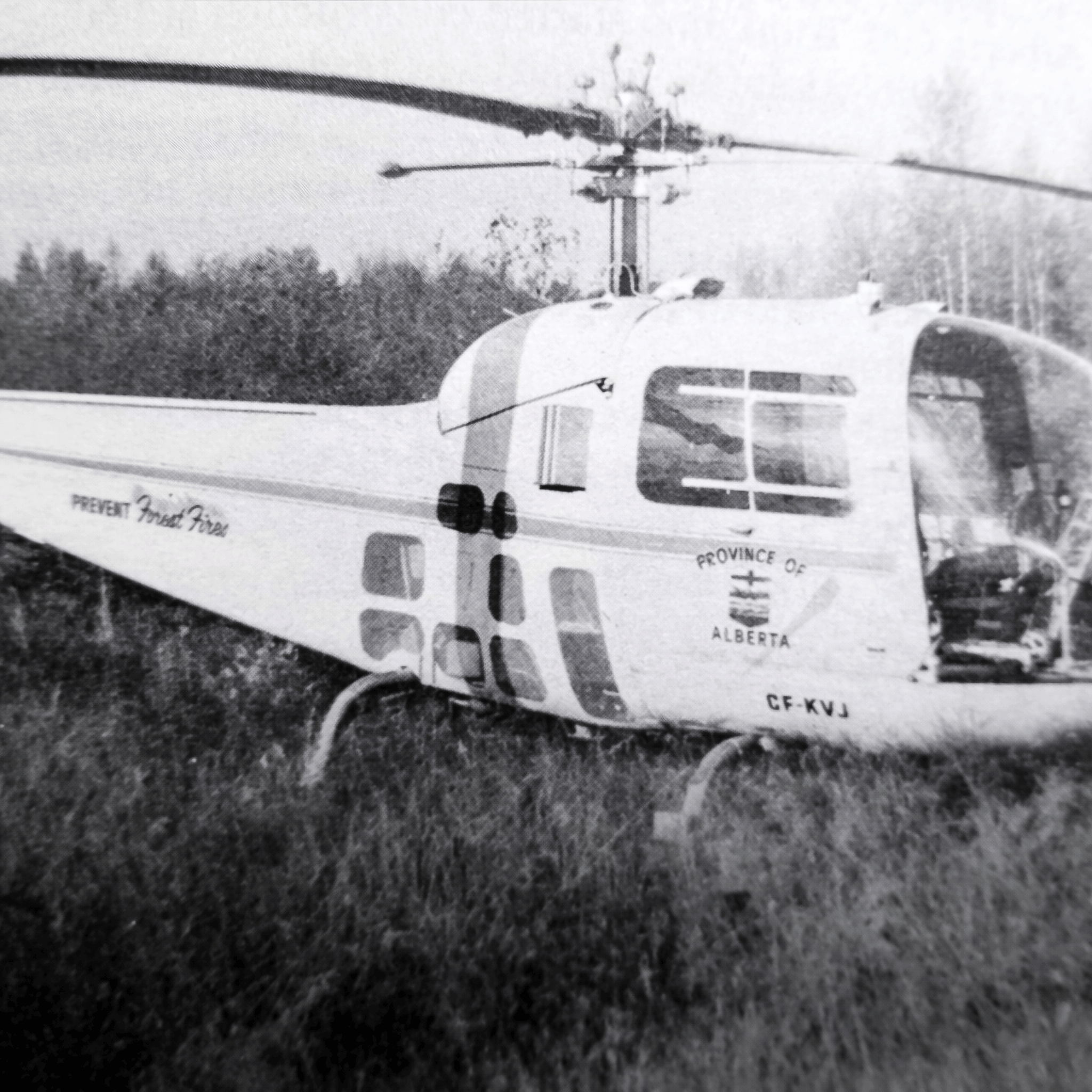
Forestry Helicopter
By late afternoon, many of the men had arrived back in camp, and the helicopter had ceased its surveillance. The pilot had radioed the policemen to inform them that there had been no new leads from overhead. A number of men were sitting around the fire eating some leftover sandwiches, drinking coffee and continuing to speculate on the fate and whereabouts of my grandfather. Beside a tree not far from the fire, my grandpa’s grub box was laying in the moss and out of the way of the heavy foot traffic of the past few days. Someone had left the lid of the wooden box open and its contents were clearly visible to passers by.
Among the staples that invariably made up part of my grandpa’s grub box supplies was a small bottle of whiskey. While sitting among the others, one of the RCMP officers had spotted the box and quietly moved around behind the rest of the group in the waning daylight. As he reached into the box and lifted out the bottle, he heard a rustling in the brush further behind him. Within seconds, a large scruffy looking bearded man appeared out of the woods. “You can put that right back where you found it,” retorted the stranger with the big hat and a big voice laced with a noticeably foreign accent.
It was as if the group of searchers had just seen a ghost as the newcomer walked into the light of the fire, and the inquisitive police officer learned in short order that the strange man who had uttered the words of warning about the whiskey was none other than the owner of the whiskey itself!
I guess nobody, including my grandfather, really knew the details of what transpired during those days in the bush. My grandpa did admit that he had heard a helicopter and a dog barking as he approached the camp. He also thought that he had wounded an elk sometime the first day and had been tracking it. But, between those two points in time, he seemed very vague as to the course of events. My grandfather was a proud man and, even if he did remember more of the details, he wasn’t readily sharing them. My dad was convinced that his father had probably passed out sometime during his search for the elk and may have wandered aimlessly for quite some time before gathering his senses. As far as we could figure out, he had sustained himself from the meagre supplies he had in his little backpack and on whatever plants and over-ripe berries that were available along his path. He had probably made a number of temporary shelters of spruce boughs, moss and grass as he wandered. Although it seems strange that searchers wouldn’t have seen signs of a fire or heard the sound of gunfire, he may have killed some smaller game and roasted it. He always carried a small waterproof container of matches and some snare wire in his backpack. It seems quite possible that he had walked a lot farther than everyone had expected before he regained his wits and sense of direction. He may even have become so disoriented that he found it necessary to walk westward to the river and then follow it downstream.
Nevertheless, he had arrived back in camp unassisted and in unusually good condition. The manhunt was over and, other than for a few remaining hunters, camp was broken and the men dispersed to their homes. My dad loaded his father and his gear into the truck and headed back to Drayton Valley. Although it is unlikely that he ever would admit it, I expect there were a few days and nights of recovery in the comfort of his little cabin on the farm!
Chapter 8
Grade six was an eventful year in many ways. The new, modern school was becoming commonplace and now housed all of the elementary grades from one to six. Within the new hierarchy, those of us who were attending Grade six were the “seniors” in that section of the school. In a way, it almost seemed like we were already in Junior High…
Grade six was an eventful year in many ways. The new, modern school was becoming commonplace and now housed all of the elementary grades from one to six. Within the new hierarchy, those of us who were attending Grade six were the “seniors” in that section of the school. In a way, it almost seemed like we were already in Junior High. The formerly little hamlet of Drayton Valley was growing rapidly into a faster paced town with its accompanying new buildings, modern conveniences and services. In Grade six, we were treated to a film reel at least once per week, and frequently had visits from representatives outside the school, presenting various aspects of life outside our immediate community and further abroad. Current Affairs was a popular subject and our realm of worldly exposure was expanding on a weekly basis.
Halfway into the fall season, our teacher Mrs. Wiuff asked us to write a fictitious essay about something related to recent conditions or events from our Current Affairs studies. The relatively new president of the United States, John F. Kennedy, was a well-known and popular figure throughout the world at the time and most of us had been following his activities south of the border and beyond. I decided to write about him and I let my vivid imagination lead me into a description of the president’s assassination on the lawn of the White House. It was not one of my better pieces but, if I remember correctly, it still earned me an A- grade. The piece also earned a certain amount of interest from some of my fellow students and from Mrs. Wiuff. Although she never questioned me openly about my topic, her body language suggested that the piece had given her an uncomfortable reaction.
Two weeks later, the whole world was thrown into a sudden state of shock when JFK was shot and killed by a random sniper during a presidential motorcade through the streets of Dallas, Texas. Media coverage was inundated by the news and the western world held its breath as the story developed and the search for the president’s assassin became the prime topic for weeks on end.
The following days at school were uncomfortable ones. I’m not sure what my fellow students were actually thinking, but most of them were keeping their distance and giving me some interesting glances. However, as time passed and we learned more about the actual events in Dallas and about the possible identity of the assassin, the focus shifted away from my potential alter ego! Happily, within a couple of weeks, my relationship with my schoolmates was, more or less, restored to normal.
By 1960, the oil industry had taken a firm grip on our little community. Wells were being drilled everywhere and local landowners were signing deals with oil companies leasing 3-acre parcels of their farms, first for drilling and, later on, for oil well sites. Even the meagre $35.00 per well annual rental fee was enough for many of the farmers, and many were able to bargain for somewhat more. In addition, a significantly larger signing bonus was usually offered for the actual drilling and added compensation was paid for roadways and the occasional “battery sites”. The contracts were often negotiated for a 25-year term, an attractive prospect for many. Some men were taking off-farm employment as battery operators, and others went to work on the drilling rigs themselves, eventually changing the culture of the community permanently.
Many residents did not pay much attention to the negative effects of the new developments and , if they did, they chose not to question the source of their newfound prosperity. As more wells were drilled and more services were required, new opportunities arose, creating increasing numbers of jobs and off-farm income. The population of the area continued to rise, offering increased employment in the service sector.
But, a handful of people closer to the land had been noticing the detrimental changes to the land and how the new activity was affecting the resources that many of us had come to rely upon. Even at this point, some people’s water wells were being affected and some of the creeks and other watercourses often hosted an oily film on their surfaces. The little creek that ran past my grandpa’s spring where he got his drinking water was one of them. Poisonous chemicals were sometimes released into waterways and directly onto the land, causing sickness and even death in local livestock. Flare stacks spewing toxic waste had become commonplace. But the oil companies would never admit responsibility for damages and the Social Credit government of the day would not hold them to account. Premier Ernest Manning was not going to let a few thankless farmers come in the way of Alberta’s new fortunes. Besides, it was all in God’s hands, and the premier avidly reinforced that belief on his weekly radio broadcasts.
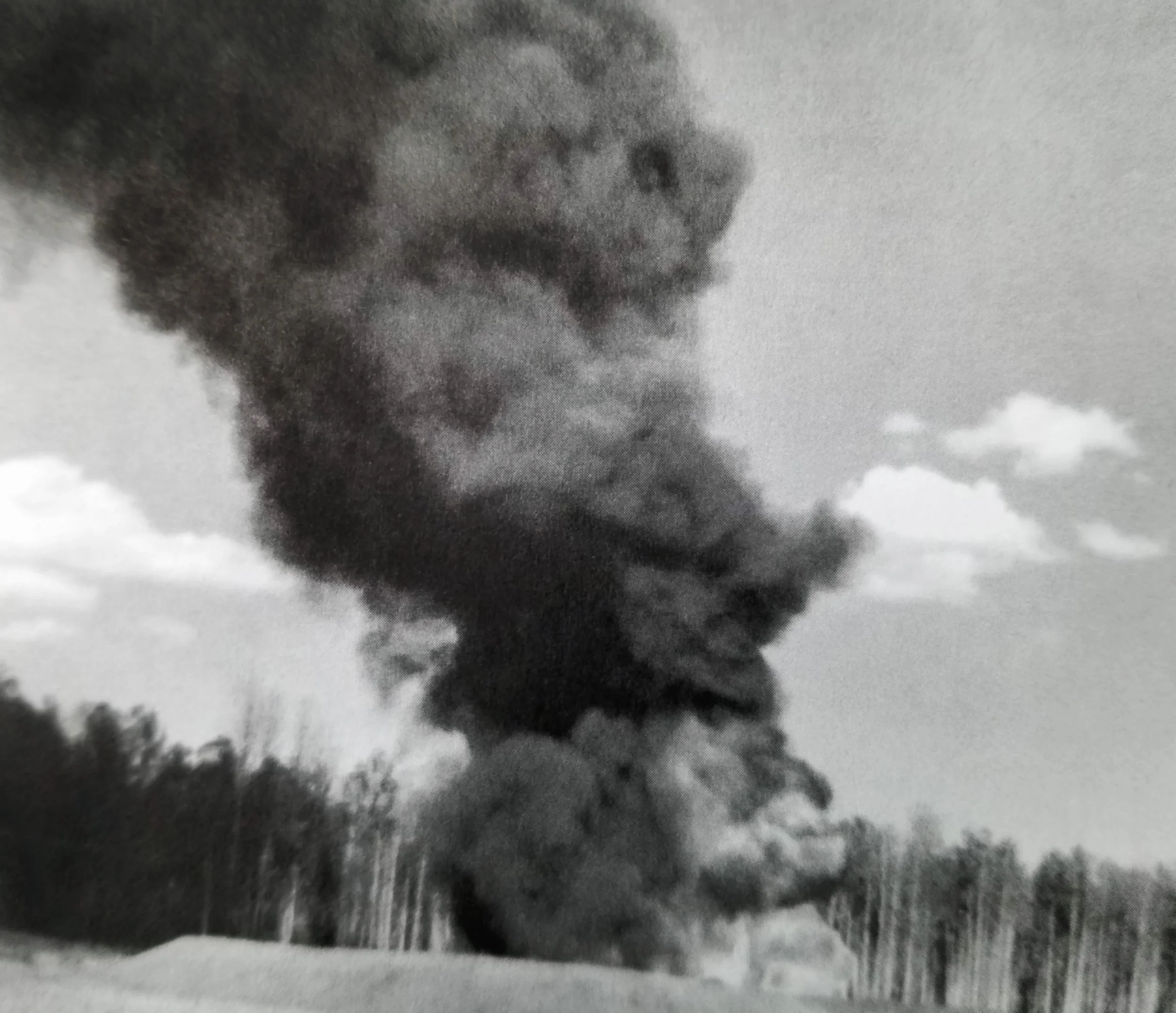
Oilfield Flare Pit
Our little community was changing, trying in its own small way to keep up with the changing larger world. As spring approached, our Grade six class was given a presentation dealing with a new life-saving technique known as “mouth-to-mouth resuscitation.” It was apparently a method that was already saving lives and could be used by anyone who was familiar with the technique. Despite a certain amount of silliness, especially between the girls and the boys, many of us recognized the value of the exercise, at least enough to grasp the general principles of the procedure. Little did I know that the method would soon be put to the test.
Not many weeks later, shortly after my twelfth birthday, my dad, my grandpa and I made one of our infrequent trips to Edmonton. It was a long trip from Drayton Valley to Edmonton in those days and there were typically a number of tasks that had to be accomplished over the course of the day. Almost all of my family’s business was concentrated to the downtown area, so that simplified matters considerably. Once a central parking spot had been decided upon, it was usually just a matter of walking from place to place until all the errands had been done.
It was a cold and windy day, one of those days when Mother Nature still hadn’t decided whether or not she would actually release her grip of winter. In spite of the elements, we simply wrapped ourselves deeper into our clothing, pulled down our hats and still managed to get the lion’s share of our tasks out of the way before lunchtime. There was a favourite restaurant along 101st Street where we often stopped when we were in the area. My grandpa was very fond of pea soup, a dish that he didn’t often make at home and which was apparently a bit of a specialty at this particular restaurant. My dad and I passed on the soup, but we all ate heartily, enjoying the warmth of the indoors and the break from walking. It had been an early start that morning.
Upon returning to the street, we found that the wind had increased in velocity. We buckled our jackets and hats down tighter and prepared to finish off the errands on our list. My grandpa was seldom without his signature wide-brimmed Stetson, which he had been struggling to keep on most of the day. The first wind blast of added intensity nearly caught him off guard, but he pulled the hat tighter onto his long grey hair, grasping at the brim occasionally for additional support.
The next stop was only a few blocks further down the street and we walked quite briskly, hoping for the next opportunity to get out of the wind. However, as we proceeded, my dad and I noticed that grandpa had fallen behind. We looked around to see him apparently still struggling with his hat. He would surely catch up as soon as he got the situation sorted out. But, after another short stretch, we looked around again, and it was obvious that there was something more serious going on. He hadn’t moved from his former position and seemed to be labouring to stand on his feet. Before we could reach him, he had slid down the side of a brick building and onto the pavement. My dad spoke to him, but there was no reply or any indication of response.
“We have to get him inside and out of the wind”, my dad exclaimed. There was an entry to a large bank nearby, so we grasped my grandpa under his arms and dragged him into the entry and then into an alcove opposite the door and away from the main flow of customer traffic. My father checked his father’s pulse a couple of times, but was unable to find a sign of life. By now, my grandpa had turned a strange blue-grey colour and his limbs were completely limp and lifeless.
Suddenly, my memory flashed back to the images of our Grade six class and the instructions on mouth-to-mouth resuscitation and I quickly explained it to my dad. “Should I try it?”, I asked. “Go ahead”, he replied, “We have nothing to lose”. I went immediately to work, trying to remember all the details I learned only a few weeks earlier. Lay the victim flat on his back, tilt the head back and the chin upward to allow for optimal airflow, and blow from mouth to mouth steadily and firmly. Turn the victim on his side occasionally to allow any accumulation of mucus to exit the mouth before it enters the throat. Use your index and middle fingers to assist in the removal, if necessary.
It was all coming back to me clearly and it was only a matter of a few seconds before my dad and I had my grandfather in the desired position for the procedure. I knelt down beside him and pressed my lips against his mouth, remembering to place my lips in such a way as to limit the loss of air as much as possible. Then I began to blow air into his mouth, firmly and steadily and with sufficient pause between breaths as to simulate the natural breathing process and timing my own breathing to match the routine.
I was barely getting into the flow of the procedure when a police officer, apparently on his street beat, held the door open and stuck his head inside inquisitively. “Close the goddam door”, I yelled, thinking only of the accompanying rush of cold air from outside. It seemed as though I had been taken over by some strange persona outside myself and I didn’t care the slightest about what kind of dignitary I was addressing. Meanwhile, a small crowd had begun to gather near the alcove where my grandfather lay, but the consensus must have been that I was the most capable person on the scene and everyone carefully kept their distance.
I continued to administer the routine for what seemed like an eternity, but nothing seemed to be happening. My grandpa’s body remained the same lifeless form it had possessed when we first dragged him inside the bank. It was beginning to look like we would be unsuccessful in bringing him back to life. “What should I do?”, I asked my dad. “Keep on blowing”, he replied, “But blow harder - you have nothing to lose!”.
I resumed my position, using my father’s words as an impetus for renewed vigour. I increased the pressure and the velocity of my blowing and shortened the length of the pause between breaths. My small body was expending as much energy as it was capable of. Then, suddenly a miracle started to take place. My grandpa’s body twitched ever so slightly and I thought I heard a short, muffled groan. That was all the motivation I needed to resume the manoeuvre with renewed strength that I didn’t know I possessed. I was now blowing harder than ever before, but still remembering the necessary pauses between breaths.
His body twitched again and then came the unexpected - pea soup! Pea soup began to come from the depths of his body and rise to his throat, into his mouth and eventually into mine. I spit out the soup and asked my father to help me turn grandpa on his side so I could extract any more of it with my fingers. Then I went back to my work, blowing at least as vigorously as before. Again, more significant amounts of soup came to the surface and, once again, we turned him on his side and I extracted the remainder.
But this time, it seemed as though he was trying to breathe on his own. We pulled him over on his side once again and more of the soup ran from his mouth. He started to take some irregular breaths and the normal colour was returning to his face and neck. With our help, he was able to sit upright on the floor and, a bit later, we were able to move him to a chair that someone had kindly brought from the waiting area.
Meanwhile somebody (maybe even a chastised policeman) had put in an emergency call but, by the time the paramedics arrived, grandpa was already on his feet, although as yet a bit tipsy. While still in a somewhat weakened state, he allowed the medics to take his vital signs and administer a couple of shots of oxygen, something which he would most certainly have ordinarily declined. Before the ambulance crew left the building, he was already chatting and joking with them and others who had remained on the scene.
I’m not sure that my grandfather actually realized what had happened that day and how close he had been to dying. Some of the details probably became known to him after the fact, through ensuing discussions and what was written afterward in the newspapers. For the time being, within a half hour, he seemed to be in his usual vibrant condition and we were able to walk back to the car, where the two of us remained while my dad finished up with a condensed version of our list of activities before heading home. Actually, without really mentioning anything, my grandpa’s only noticeable change in demeanour was that he became increasingly insistent that I was in his presence. Needless to say, that had never been a problem for me, and I spent many enjoyable days with him before he passed away two and a half years later in September of 1964. On several occasions during those years, he brought up the prospect of the two of us travelling together to his Swedish homeland that he had never again seen for almost sixty years. But my parents and I knew that such an experience would be a risky one for a young lad and his ailing grandfather. As much as I would love to have gone, we carefully sidestepped the issue without causing undue disappointment.
A local journalist and the Drayton Valley Lions Club soon caught wind of the story and I appeared in the headlines of a number of area publications for several weeks after the incident. I was also nominated for the “Alberta Junior Citizen of the Year” award, along with a number of other young Albertans. When all was said and done, I lost the citation to a young man a bit older than me, from the southern part of the province, who had saved his younger sister from drowning. For me, it was not really a big loss - I had already been awarded the ultimate prize on a windy afternoon in Edmonton earlier in the year.